
Sonar
CompanyA company discussed on AI Engineer.
5 episodes

In the Land of AI Agents, the Verifiers Are King — Tariq Shaukat, Sonar
Jul 20, 2026 · 18:53
Tariq Shaukat, CEO of Sonar, argues that rigorous verification is the key to unlocking sustained value from AI coding agents, introducing the Agent-Centric Development Cycle (AC/DC) framework: Guide, Verify, Solve. He warns that without it, the initial 3–5x productivity boost from agents dissipates within three months as technical debt—security issues, maintainability issues, and complexity—compounds. Sonar's tests show that multi-layered, zero-trust verification (combining algorithmic and agentic methods) reduces AI-derived production outages by 44% and, in a trial with a large bank, achieved a 92% reduction in issues. Clean codebases, he argues, make agents faster and cheaper, with over 30% fewer tokens consumed when guided by context and constraints. The framework embeds verification into three loops—agentic, CI, and code maintenance—to create a self-reinforcing positive cycle, countering the downward spiral of neglected code quality.

"The engineer of the future is the person who is able to choose what is worth doing." — Addy Osmani
Jul 14, 2026 · 18:26
Addy Osmani argues that the engineer of the future must shift from code production to accountability, judgment, and ownership as AI agents automate more work. He introduces Alpha (the gap between human and model capabilities) and Decay (the clock on that gap), warning that skills like speed and recall erode quickly, while taste—the ability to judge without objective metrics—decays more slowly but still fades. Osmani warns against cognitive debt (losing understanding of your codebase) and cognitive surrender (blindly accepting AI outputs, noting 73% of people felt more sure when AI was wrong). He advocates for an agency ladder where engineers move from flagging problems to discerning which paths deserve ownership, and proposes an operational rule: "explain it or don't ship it." Ultimately, he predicts that lower costs of building will unlock latent demand, moving the bottleneck from "can we build this" to "should this exist" and "can we answer for it."

Can LLMs generate Enterprise Quality Code? — Prasenjit Sarkar, Sonar
May 31, 2026 · 15:12
Prasenjit Sarkar from Sonar evaluates whether LLMs generate enterprise-quality code using SonarQube analysis of 4,444 Java assignments across 53 models. While Gemini 3.1 Pro High achieves 84.17% pass rate, GPT-5.4 Pro High generates 1.2 million lines (high bloat), and Claude Sonnet 4.6 has 300 security issues per million lines. The ACDC framework addresses these gaps: Guide (Sonar Sweep and Context Augmentation), Verify (SonarQube Agentic Analysis in 1–5 seconds pre-commit), and Solve (Remediation Agent that fixes issues and checks regressions before presenting fixes). Sonar's leaderboard at sonar.com/leaderboard provides detailed pass rates, cyclomatic/cognitive complexity, bug density, and security metrics per model.

The State of AI Code Quality: Hype vs Reality — Itamar Friedman, Qodo
Dec 11, 2025 · 21:15
Itamar Friedman, CEO of Qodo, argues that while AI code generation boosts productivity, it has a glass ceiling unless organizations invest in agentic quality workflows and context. Drawing on reports from Qodo, Sonar, and Pharos, he reveals that 60% of developers say a quarter of their code is AI-generated, yet 67% have serious quality concerns, leading to 42% more time fixing bugs and 35% project delays. He notes that AI code review tools double trust and quality gains, and that better context—including standards and best practices—is the top request from developers. Friedman recommends automated quality gateways, intelligent code review, and testing, warning that without dynamic quality processes, the promised 2x productivity remains elusive.
The Benchmarks Game: Why It's Rigged and How You Can (Really) Win - Darius Emrani
Jun 3, 2025 · 11:20
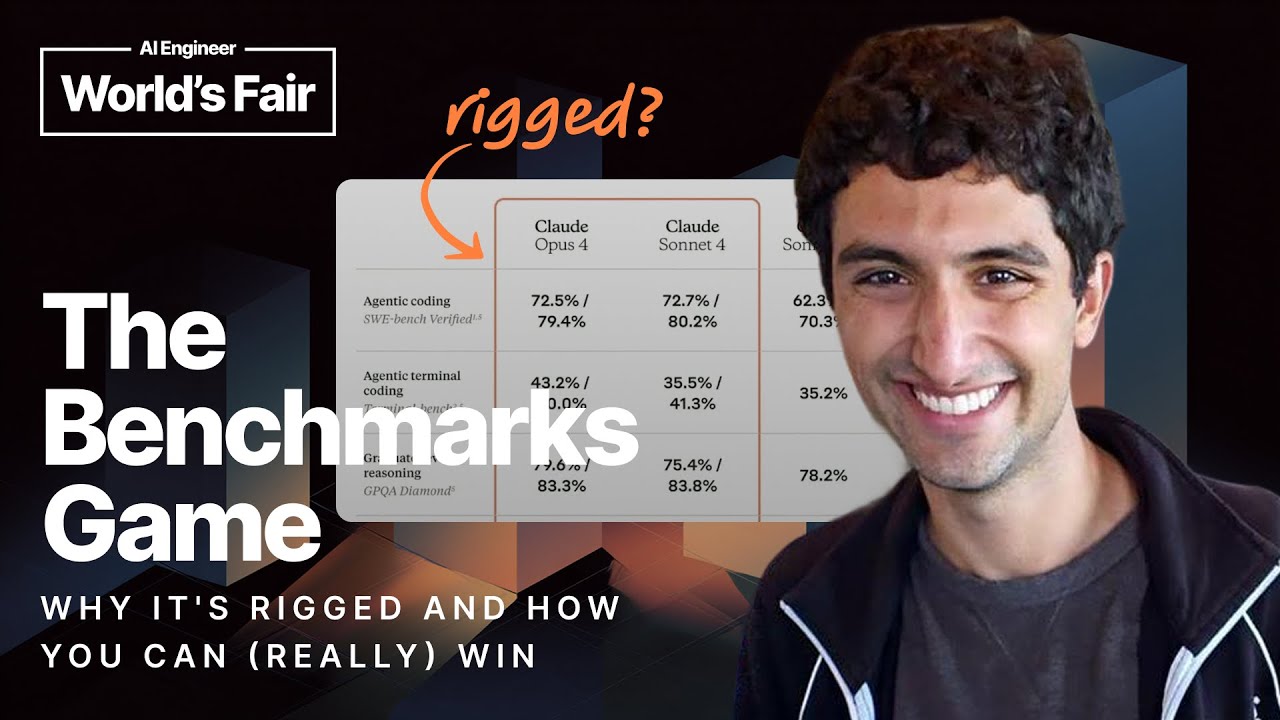
Darius Emrani exposes how AI benchmarks are rigged, showing that xAI cherry-picked Grok-3 comparisons, OpenAI funded FrontierMath for privileged access, and Meta submitted 27 Llama-4 variants to LM Arena optimizing style over substance. Citing Goodhart's Law, he argues that when benchmarks target billions in investment, they cease to measure real capability—Andrej Karpathy admits he doesn't know which metrics to trust. Emrani provides a 5-step framework to build use-case-specific evaluations, emphasizing that 39% of score variance comes from writing style. He advocates for apple-to-apple comparisons, open-source test sets, and style-controlled metrics, concluding that teams should stop chasing leaderboards and instead iterate on real production data to ship reliable AI.
Powered by PodHood