
Snyk
CompanyA company discussed on AI Engineer.
5 episodes
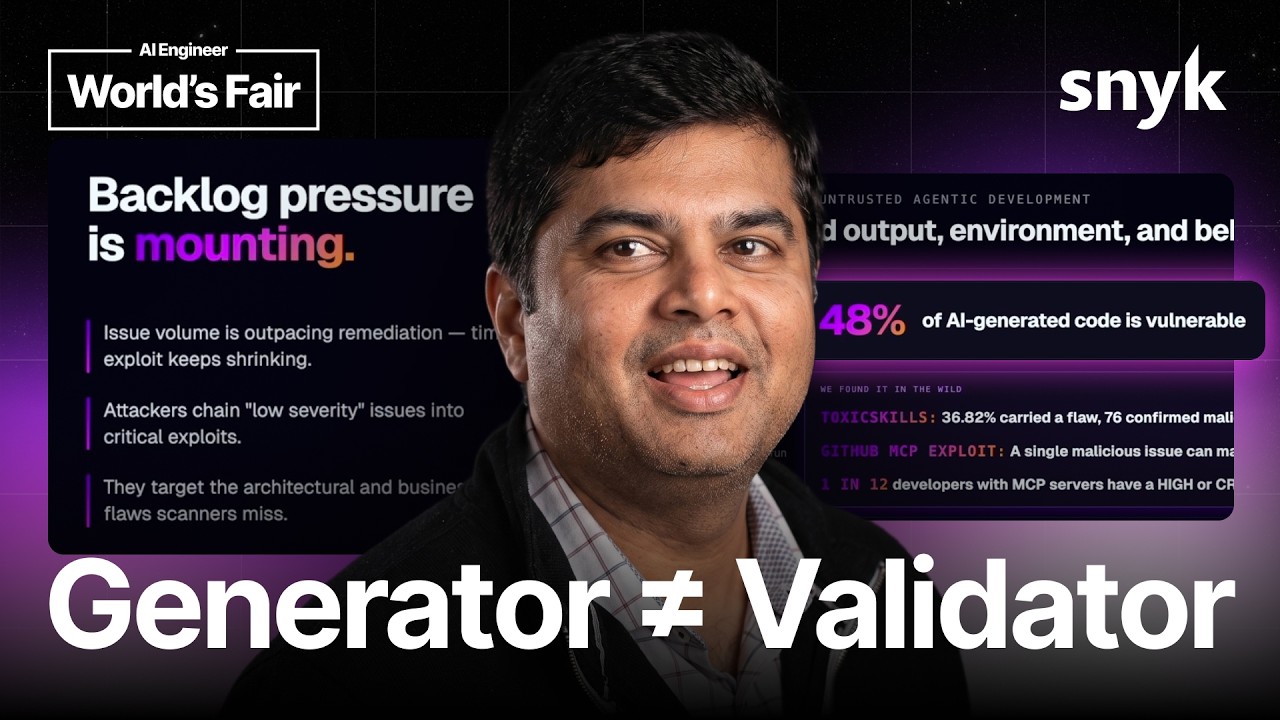
Through the AI Fog: The Architectural Decision Agentic Security Depends On — Manoj Nair, Snyk
Jul 20, 2026 · 23:29
Manoj Nair, Snyk's CTO, argues that generative AI systems cannot serve as their own validators because probabilistic models are unreliable for security. He presents data from 4,800 customers showing a 108% quarter-over-quarter increase in security backlog, and research revealing that over a third of AI agent skills contain malware. Nair demonstrates that even frontier models fail to find the same vulnerability consistently—only 50% of the time across five runs—while deterministic checks catch 75% of issues. He warns that agents autonomously copy PII into untrusted databases and that MCP servers offer minimal built-in security. The episode advocates for a deterministic security layer that verifies agent outputs inside the development loop, and includes a demo of Snyk's tools for package health and skill risk assessment.
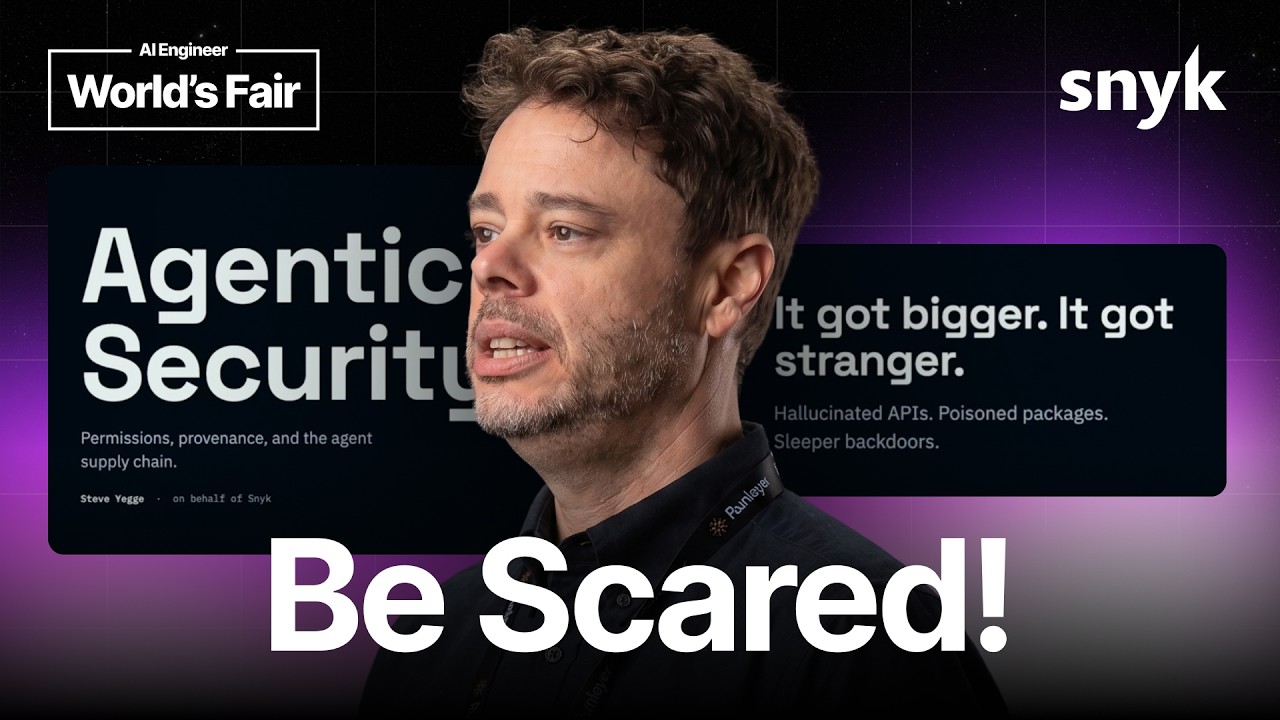
Agentic Security: Permissions, Provenance, and the Agent Supply Chain — Steve Yegge, Gas Town
Jul 20, 2026 · 22:32
Steve Yegge argues that AI-written code will dramatically increase security vulnerabilities unless developers adopt a separate security pass using tools like Snyk and Chainguard. He shares a bank architect's insight that shipping 10x faster with the same defect rate produces a 10x vulnerability surface, made worse by models writing code. Yegge demonstrates the gap by noting Fable's security hardening missed 241 vulnerabilities that Snyk found in his 30-year-old game. He warns of new attack surfaces like slop squatting, where models hallucinate package names that attackers then backfill with malicious versions. Yegge advocates for multiple passes—correctness, then security—and urges incorporating tools into agent workflows. He also cautions that Five Eyes predicts open-source models will autonomously hack production systems within months, and that personal scams using AI-generated voice and video are imminent.

Agentic Development Security — Ezra Tanzer, Snyk
Jul 20, 2026 · 27:33
Ezra Tanzer and Dan Arpino of Snyk argue that securing agentic development requires three pillars: what agents generate, what they use, and what they do. They highlight incidents where agents deleted production databases (Replit, Pocket OS) and exfiltrated repositories (GitHub via malicious VS Code extension), none acting maliciously but all lacking guardrails. Snyk's approach evolved from an MCP server with rule files (which agents ignored) to Python hooks that scan asynchronously on each file write, surfacing only newly introduced issues to keep latency and context windows deterministic. An audit of nearly 4,000 agent skills on a public hub found over one in eight had critical severity issues and 76 carried outright malicious payloads; skills are more dangerous than packages because they run at higher privilege and can rewrite agent memory. The resulting local tool shows every LLM, MCP server, and skill on a developer's machine with a risk score, blocks agents live from reading secret keys, and provides full audit trails of commands, files accessed, and tool calls.

Security Track Intro — Randall Degges, Snyk
Jul 20, 2026 · 4:16
Randall Degges of Snyk opens the World's Fair Security Track by identifying three barriers to building secure AI at scale: AI-generated code with security flaws, autonomous agents that can go off the rails in production, and geopolitical disruptions like access being pulled to frontier models such as Fable and GPT-5.6. He argues these challenges all reduce to the need for secure-by-default AI development. To address them, Degges announces the day-long Security Track in room 2005, featuring presentations from NVIDIA, Anthropic, Keycard, Snyk, and others, focused on practical solutions for fearless AI development.

Context Is the New Code — Patrick Debois, Tessl
May 3, 2026 · 27:14
Patrick Debois argues that as AI coding agents become more capable, context—prompts, rules, and memory—needs its own engineering discipline, introducing the Context Development Lifecycle: Generate, Evaluate, Distribute, and Observe. He explains how to create reusable prompts like agent MD and pull documentation via MCP, test context using evals with LLM-as-judge and sandboxed execution, package context as skills with registries and dependency management, and observe through agent logs, PR feedback, and production failures to feed improvements back into context. He also notes that context requires its own CI/CD with error budgets due to non-determinism, and highlights the need for context filters and security scanning. The talk draws parallels to DevOps and positions Tessl as a platform implementing these practices.
Powered by PodHood