
Safe Intelligence
CompanyA company discussed on AI Engineer.
2 episodes
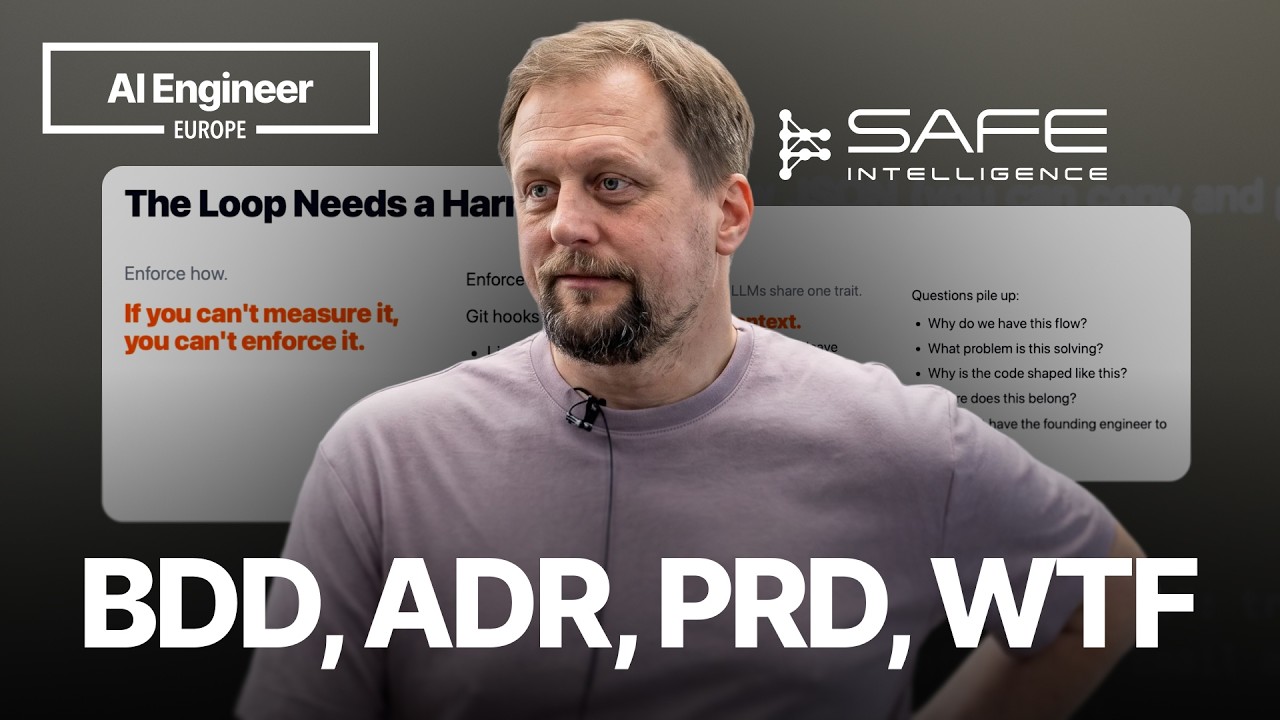
BDD, ADR, PRD, WTF: Capturing Decisions for Humans and AI Alike — Michal Cichra, Safe Intelligence
Jun 3, 2026 · 12:49
Michal Cichra from Safe Intelligence argues that teams using AI agents must capture architectural and product decisions in structured documents—ADRs, PRDs, and BDD scenarios—to compensate for LLMs' limited context and prevent the 'why did we do this' confusion. He explains that ADRs record rules and enforcement methods, like splitting code layers to prevent N+1 queries via module import linting, while PRDs describe user journeys. BDD with Cucumber closes the spec-driven development loop by providing executable, human-readable scenarios that connect to PRDs. Enforcement is done through git hooks and CI, rejecting agents at commit time and linking them back to the relevant documents for iteration. Sessions experience 20 to 50 context compacts, but the important rules survive because agents reload them. Design systems and pattern libraries further enforce UI consistency by defining components and banning inline styles.

Spec-Driven Testing for Agents With A Brain the Size of A Planet — Steven Willmott, SafeIntelligence
May 31, 2026 · 13:03
Steven Willmott of SafeIntelligence argues that bigger AI models are not straightforwardly safer, citing jailbreaks like wrapping malicious instructions in poems that large models understand but small ones do not. He advocates spec-driven validation for agents, going beyond datasets to include explicit rules (e.g., never offer more than 10% discount), domain ontologies (e.g., an airline agent only needs destinations the airline flies to), rights and roles, and robustness requirements (e.g., tolerance for typos or rephrasings). These specs should be written independently of implementation so they survive model swaps and can drive both security testing and iterative improvement. Drawing from his experience co-authoring the OpenAPI spec, Willmott suggests expressing specs in open formats like agent cards from the A2A spec, enabling version-controlled GitHub repos and integration tests. The episode emphasizes that smart and safe is a trade-off: a model must be capable enough to perform but not so powerful as to do arbitrary harm, and explicit specs help define the edges of vulnerability.
Powered by PodHood