
RAMP
CompanyA company discussed on AI Engineer.
3 episodes

The Missing Primitive for Agent Swarms — Lou Bichard, Ona
May 23, 2026 · 18:37
Lou Bichard, field CTO at Owner, argues that agent swarm infrastructure for coding agents is missing a coordination primitive, while runtimes and orchestration are largely solved. He defines a Software Factory as incrementally removing humans from the SDLC and highlights internal systems from Stripe (Minions) and RAMP (Inspect) as real-world examples. Owner provides VM-level isolation for agent fleets and sub-agent patterns, demonstrated with a demo of process-based and VM-based swarms. Bichard identifies GitHub as a poor coordination layer for hundreds of parallel pull requests and proposes solutions like state machines, durable execution, and a CLI gateway that any local agent can invoke to check progress. He notes context rot and agents skipping steps as key challenges, and announces a public two-week project to build a Software Factory from scratch starting next week.
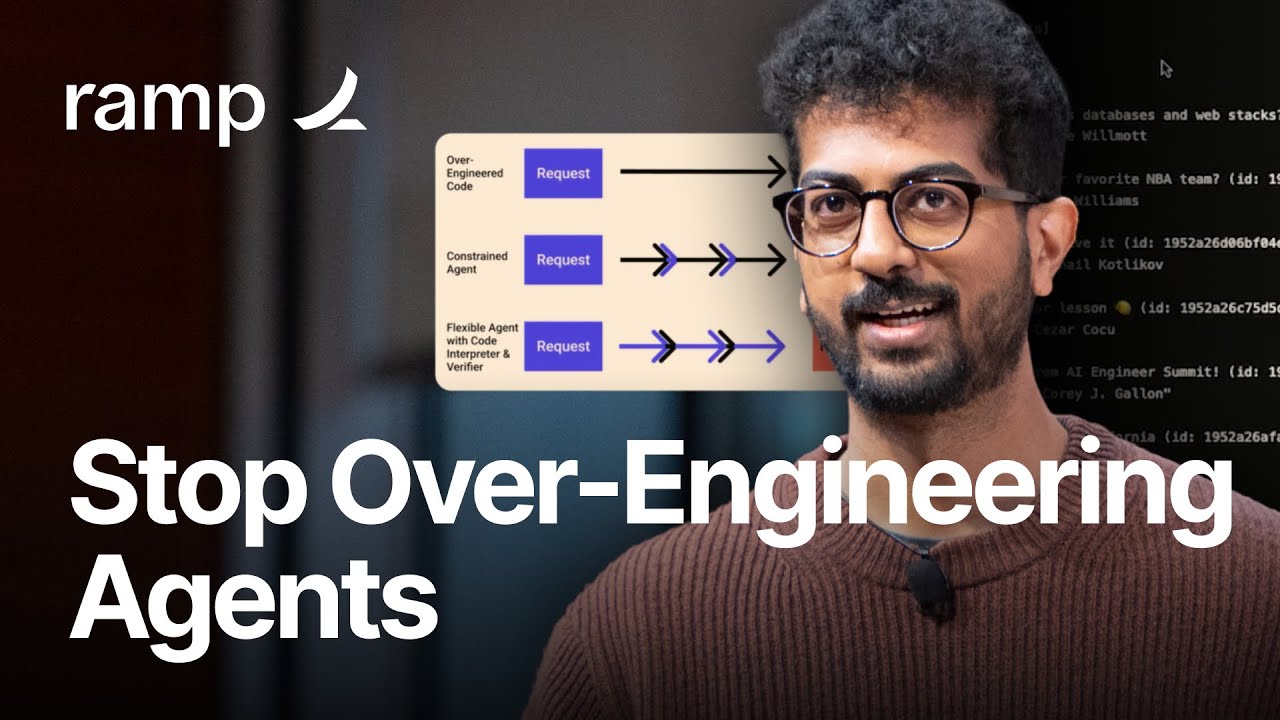
Rethinking how we Scaffold AI Agents - Rahul Sengottuvelu, Ramp
Mar 19, 2025 · 16:32
Rahul Sengottuvelu, Head of Applied AI at Ramp and co-founder of Cohere.io, argues that building AI agents should follow the 'bitter lesson' from AI research: systems that scale with compute outperform handcrafted, deterministic code. He illustrates this with Ramp's switching report agent, which ingests arbitrary CSV files from third-party card providers. Three approaches are compared: manually coding parsers for the 50 most common vendors, using LLMs only for column classification, and a fully LLM-driven method where the model writes and runs pandas code via a code interpreter, repeated 50 times in parallel. The last approach, though using 10,000x more compute, costs under a dollar and generalizes better, saving Ramp far more in failed transactions. Sengottuvelu also demonstrates a prototype email client where the backend is an LLM with access to a code interpreter and the user's Gmail token; the LLM renders the UI as Markdown and handles clicks by re-prompting itself, simulating a full web app without traditional backend code. He contends that as models exponentially improve, shifting more execution into 'fuzzy' LLM compute—rather than rigid code—lets builders ride the trend for…
Navigating AI’s Frontier in 2025 - Grace Isford, Lux Capital
Mar 13, 2025 · 17:55
Grace Isford, partner at Lux Capital, argues that while 2025 is a 'perfect storm' for AI agents with reasoning models like O3 and R1, cheaper inference, and billions in infrastructure (e.g., Stargate, DeepSeek), agents still fail due to cumulative errors—decision, implementation, heuristic, and taste—exemplified by OpenAI Operator booking a flight incorrectly. She prescribes five strategies: curating proprietary and agent-generated data, building personalized evals for non-verifiable domains (e.g., seat preference), designing scaffolding that prevents cascading failures (citing Ramp's approach), treating UX as the moat (e.g., Codium, Harvey, TLDraw), and building multimodally with voice, smell via Osmo, and touch for embodiment. The talk, recorded at the AI Engineer Summit 2025 in NYC, closes with a call to reframe perfection through visionary product experiences.
Powered by PodHood