
Notion
CompanyA company discussed on AI Engineer.
11 episodes
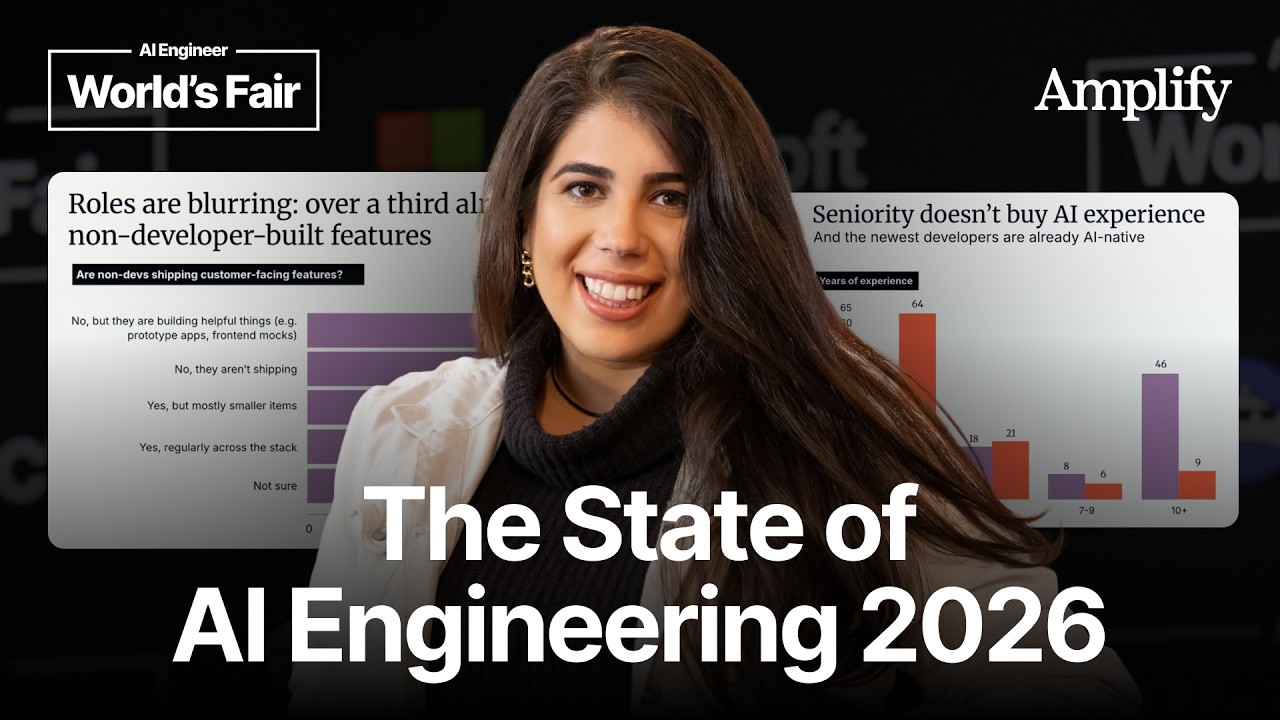
2026 State of AI Engineering — Barr Yaron, Amplify Partners
Jul 21, 2026 · 19:47
In the 2026 State of AI Engineering survey presented by Amplify Partners' Barr Yaron, 1,048 AI engineers reveal that cost is now a first-class engineering constraint—40% say it regularly shapes how ambitiously they use AI. Agents have exploded: 95% of teams now use agents, and 89% of those agents have write access, tripling from last year. Image generation adoption doubled to 36%, while audio shows the strongest intent-to-adopt at 56%. Open-weight models augment rather than replace closed models—45% use open-weight, but over 90% of them also use closed models. Evals remain the top infrastructure challenge, and inference is the most bought layer, while prompt management (61% built in-house) stays close to product logic. Teams report 97% net positive impact, but 59% fear long-term liabilities from AI code, and over a third say non-developers now ship features.
You Didn't Ship a Bug. You Just Wrote It for a Human. - Ravi Madabhushi, Scalekit
Jul 19, 2026 · 12:50
Ravi Madabhushi, co-founder of Scalekit, explains why infrastructure built for humans breaks when AI agents act 60 times faster than users, citing a production database spike caused by a 'last seen' timestamp updating every tool call. He argues that OAuth scopes, designed for deterministic human-written programs, cannot constrain non-deterministic agents, which need attribute-level, time-bound, and principle-scoped permissions. Madabhushi warns that 60% of LLM errors stem from rate limits designed for humans, not agents, and advocates for just-in-time authorization and absolute visibility into every agent action—who took it, on behalf of whom, and when authorized. He concludes that without deterministic guardrails, teams are merely 'praying' agents won't delete production data.

Understanding is the new bottleneck — Geoffrey Litt, Notion
Jul 10, 2026 · 19:33
Geoffrey Litt from Notion argues that understanding code written by AI agents is crucial for creative participation, not just correctness checking. He presents three techniques: explanations via his 'explain diff' skill, which generates HTML or Notion documents with background, intuition, interactive figures, and literate code diffs, capped by a five-question quiz to ensure understanding before sharing code; micro-worlds, like a step-by-step debugger for a Prolog interpreter or a 'video game' that walks through migrating a website; and shared spaces in Notion where humans and agents can collaborate in multiplayer chat threads and comment on documents. Litt emphasizes that agents can build ephemeral UIs and simulations to help humans understand better, leveraging education principles to stay deeply in the loop.

Benchmarking semantic code retrieval on Claude Code — Kuba Rogut, Turbopuffer
Jun 3, 2026 · 16:08
Kuba Rogut from Turbopuffer benchmarks semantic code retrieval on Claude Code, finding that raw Claude Code wastes one in every three file reads (65% precision), windowed grep drops that to one in five, and adding semantic search cuts it to one in eight (87% precision). Semantic search wins on behavior-adjacent tasks where files share no keywords; grep wins on import tracing. Cursor's production numbers show a 24% relative improvement in answer accuracy from semantic retrieval plus a 2.6% increase in code retention in large codebases. Rogut explains Cursor's model knows when and why to call semantic search, while Claude Code treats it as just another tool, limiting gains.

Don't Build Agents, Build Skills Instead – Barry Zhang & Mahesh Murag, Anthropic
Dec 8, 2025 · 16:22
Barry Zhang and Mahesh Murag of Anthropic argue that instead of building domain-specific agents, developers should build reusable Skills—organized folders of files that package procedural knowledge for agents. They explain that skills are progressively disclosed to protect the context window, use scripts as self-documenting tools, and have already grown to thousands in five weeks, including foundational, partner, and enterprise skills. Skills complement MCP servers by providing expertise while MCP handles connectivity. The future includes treating skills like software with testing and versioning, and enabling agents to create their own skills for continuous learning, ultimately creating a collective knowledge base that makes agents more capable and reliable.

Survive the AI Knife Fight: Building Products That Win — Brian Balfour, Reforge
Jul 14, 2025 · 14:10
Brian Balfour, CEO of Reforge, argues that winning in today's AI knife-fight requires answering 'What do I build and why will it win?' by focusing on proprietary data, unique functionality, and unmet customer needs rather than building custom AI. He illustrates with Granola, which entered a crowded AI note-taker market by understanding users wanted help taking better notes, not full automation, and assembled off-the-shelf AI (DeepGram, Anthropic, OpenAI) with unique data (user notes plus transcription) and functionality (Mac app, calendar integration) to create a competitive edge. Balfour warns competitive advantages now last only 2-3 weeks, so teams must sequence smaller moats continuously, each buying time to execute faster. The talk emphasizes treating AI as Lego blocks—assembling pre-trained models, data, and product superpowers into a system that spins a data flywheel.

Evals 101 — Doug Guthrie, Braintrust
Jun 27, 2025 · 48:31
Braintrust solutions engineer Doug Guthrie presents the full AI evaluation lifecycle, covering offline and online strategies for building robust AI products. He explains that evals require three ingredients—tasks (prompts or agentic workflows), datasets (real-world examples), and scores (LLM-as-a-judge or code-based)—and demonstrates how to run them in Braintrust's playground and via SDK. The talk emphasizes creating a feedback loop: production logs feed into datasets, enabling human review and user feedback to iteratively improve offline evals. Guthrie showcases a changelog app, the new AI-driven "loop" feature for prompt optimization, and answers audience questions on A/B testing models, handling multiple human scorers, pre-launch validation, and exporting data for custom dashboards.
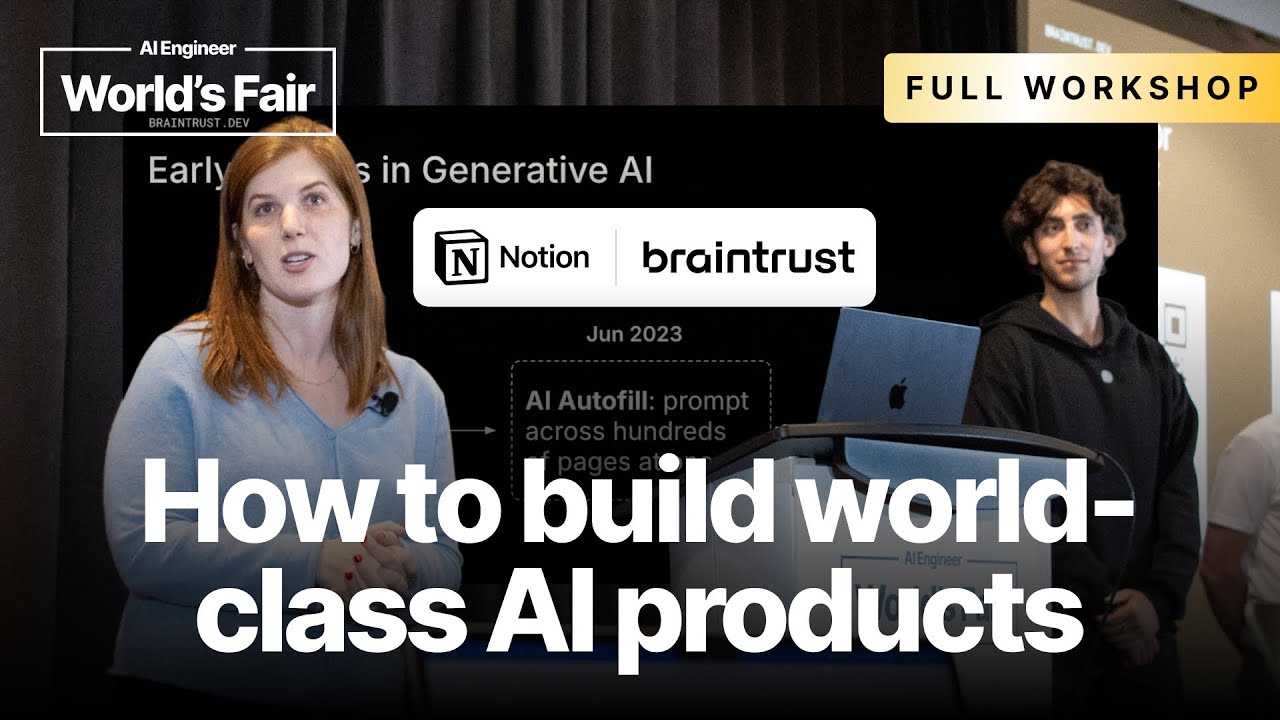
How to build world-class AI products — Sarah Sachs (AI lead @ Notion) & Carlos Esteban (Braintrust)
Jun 27, 2025 · 1:43:46
Sarah Sachs (AI lead at Notion) and Carlos Esteban (Braintrust) explain that building great AI products requires 10% prompting and 90% evals and observability, with Notion AI using Braintrust to iterate on prompts and models. Sachs details their cycle: curate small datasets, tie them to scoring functions (LLM-as-a-judge with per-sample prompts and heuristic checks), run evals before shipping, and use production logs to catch regressions. She notes Notion AI supports 100M+ users, switches models in under a day, and 60% of enterprise users are non-English—requiring multilingual eval rigor. Carlos and Doug then walk through Braintrust's framework: tasks (prompts, tools, agents), datasets, and scores (0-1). They demonstrate offline evals via playground and SDK, online scoring in production, user feedback capture, human review setup, and remote evals to bridge complex code with the playground. The workshop covers moving from pre-prod evals to production monitoring, closing the feedback loop by adding underperforming spans to datasets.
Real ROI: Lessons from Enterprises that have already succeeded with LLMs at Scale: Raza Habib
Dec 31, 2024 · 20:01
Raza Habib, CEO of Humanloop, shares lessons from enterprises like Duolingo, Filevine, and Ironclad that have achieved real ROI with LLMs at scale. He argues that success hinges on centering domain experts (e.g., Duolingo's linguists do all prompt engineering), needing less ML expertise than expected, and breaking down evaluation into small, testable components rather than chasing a single metric. Habib emphasizes collecting end-user feedback (acceptance rates, edits, thumbs up/down) and building tooling for logging, regression testing, and team collaboration. Filevine doubled revenue by launching six LLM-powered products; Ironclad's open-source Rivet logging tool enabled agents to auto-negotiate 50% of contracts. The talk covers how to optimize the four-component chain (base model, prompt, data selection, function calling) and why simpler systems will win as models improve.
How Zapier Builds AI Products and Features with the Help of Braintrust: Ankur Goyal & Olmo Maldonado
Nov 7, 2024 · 14:59
In this talk, Olmo Maldonado (Senior AI Engineer at Zapier) and Ankur Goyal (CEO of Braintrust) explain how Zapier uses Braintrust's evaluation and observability platform to build and improve AI features like AI Zap Builder and Copilot. They moved from 7 manual unit tests to over 800 automated evals, improving accuracy by nearly 300%. Braintrust's tracing capabilities let them dissect Copilot's multi-tool agent performance, leading them to adopt GPT-4 Turbo for the message router despite latency trade-offs. When switching to GPT-4.0 caused a regression below 80% scores, they diagnosed the issue via evals—GPT-4.0 was ignoring system prompts—and fixed it by relaxing prompt engineering and adjusting tool choices, recovering accuracy and cutting response time from 14 to 3 seconds. The episode details how eval-driven development and observability enable rapid iteration and reliable AI products at scale.

The Hidden Life of Embeddings: Linus Lee
Nov 7, 2023 · 18:15
Linus Lee, a Research Engineer at Notion, presents a tour of embedding visualization and manipulation at the AI Engineer Summit 2023. He demonstrates an encoder-decoder model fine-tuned from T5 that can reconstruct text from embeddings, allowing direct manipulation of features like length and sentiment by moving in latent space. Lee shows that mixing embeddings by splicing dimensions from two texts produces a semantic blend, and a linear adapter can decode text from OpenAI's text-embedding-ada-002 embedding space. Using CLIP, he interpolates between photographic and cartoon images and performs vector arithmetic to modify facial expressions. Lee releases these custom text embedding models on Hugging Face, enabling others to explore and interact with latent spaces. He argues that making model internals visible and manipulable fosters deeper understanding and more humane interfaces to generative AI.
Powered by PodHood