
Netflix
CompanyA company discussed on AI Engineer.
7 episodes
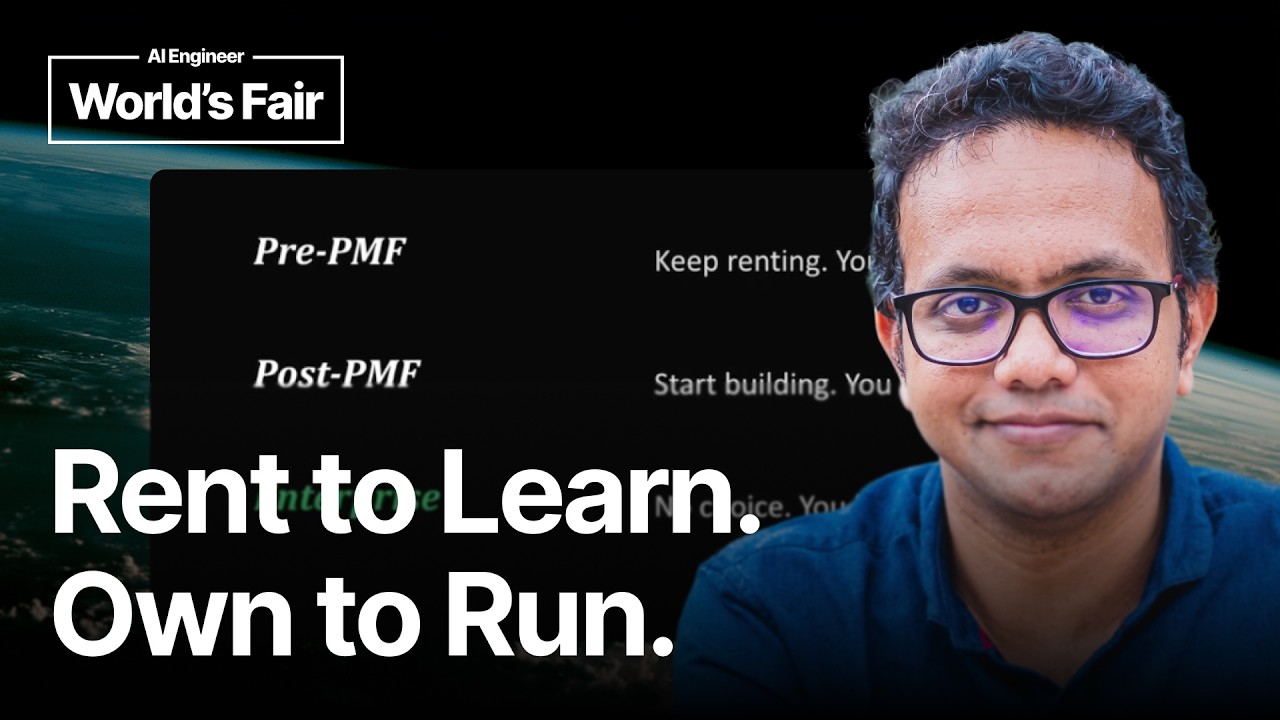
Stop Renting Your Cognitive Infrastructure - Thiyagarajan Maruthavanan, Kalmantic Labs
Jul 18, 2026 · 7:52
Thiyagarajan Maruthavanan of Kalmantic Labs argues that AI teams should stop renting inference from providers like Anthropic and build their own infrastructure, coining "rent to learn, own to earn." He recounts his app UltraSuno costing hundreds of thousands of dollars in inference, a stolen key hitting $10,000, and moving to his own DGX Sparks hardware. Three enterprises—a fund, hospital, and tax practice—each hit walls with renting: control, audit redlining, and reproducibility. He open-sourced JustTokenMax (benchmarked better than Netflix's Headroom) and wrote the book "Peak Inference" on building your own inference infra. He notes the market's conflicting pitches (Jensen's token factory, Nadella's unmetered, NeoClouds' endpoints) but concludes owning is essential post-PMF.

Beyond Components: Designing Generative UI for MCP Apps — Ruben Casas, Postman
Jun 3, 2026 · 16:58
Ruben Casas from Postman argues that AI models can now write better frontend code than he can—his prompt to rewrite his blog produced a search box with blur animation and accessibility out of the box—yet most agent UIs still invoke static prebuilt components. He presents three levels of UI generation: static components (AG UI, Goose) passing props to predefined React elements; declarative UI where the model generates JSON or YAML for a rendering engine (e.g., Vercel's JSON Render), which he deems the current ideal balance; and fully generative UI where the model writes HTML, CSS, and JavaScript on demand, as in his weather agent that does so in one tool call. The key obstacle is trust, necessitating sandboxing, and MCP apps with their double iframe default are the best delivery mechanism. He likens today to early TV—radio shows with cameras—and predicts the future lies beyond components in collaborative human-agent interfaces on shared canvases, as seen with the Skeletro MCP app.

The Infinite Software Crisis – Jake Nations, Netflix
Dec 20, 2025 · 18:57
Jake Nations, engineering lead at Netflix, argues that AI-generated code accelerates the software crisis by conflating easy with simple—producing tangled, incomprehensible systems. He traces the crisis from 1968 to today's infinite code generation, citing Fred Brooks' 'No Silver Bullet' and Rich Hickey's definition of simple as 'one fold, no entanglement.' Nations presents a three-phase methodology—research (compressing 5 million tokens of code into a 2,000-word spec), planning (paint-by-numbers implementation steps), and implementation (using a manual migration seed)—to maintain human understanding. He warns that without this approach, engineers lose the ability to recognize dangerous complexity, and challenges listeners: will we still understand our own systems when AI writes most of the code?

ComfyUI Full Workshop — first workshop from ComfyAnonymous himself!
Jul 19, 2025 · 51:25
ComfyAnonymous and Yedrick Kosinski present ComfyUI, an open-source node-based canvas for generative AI that has become the top 150 most popular GitHub repos with 78,000 stars and 3 to 4 million active users. Started as a personal project in January 2023, it now supports image, video, audio, 3D, and text models, with 22,000 custom nodes from 3,000 developers. A key feature is embedding full workflows into generated files for easy sharing. The team discusses its story, including ComfyAnonymous's time at Stability AI and founding ComfyOrg, and addresses questions on CFG, VAEs, LoRAs, control nets, API nodes for remote generation, and future plans for cloud inference and improved onboarding.

Netflix's Big Bet: One model to rule recommendations: Yesu Feng, Netflix
Jul 16, 2025 · 22:28
Netflix staff research scientist Yesu Feng explains the company's bet on a single transformer-based foundation model for all recommendation use cases, replacing dozens of specialized models. He validates that scaling laws apply to recommendation systems, with the model growing from a few million profiles to 1 billion parameters, and that multi-token prediction (inspired by DeepSeek) notably improves metrics by forcing less myopic learning. The foundation model is consumed via three patterns: as a subgraph in downstream models, through precomputed embeddings (both member and content), and via fine-tuning or distillation. Feng reports that over the past 1.5 years, the model has been integrated into many applications, with A/B test wings showing high leverage and infrastructure consolidation. Future directions include universal representation for heterogeneous content types, generative retrieval for collection recommendation, and prompt tuning for faster adaptation.

Recsys Keynote: Improving Recommendation Systems & Search in the Age of LLMs - Eugene Yan, Amazon
Jul 16, 2025 · 20:54
Eugene Yan's keynote presents three innovations for recommendation systems: Semantic IDs, LLM-augmented data, and unified models. Kuaishou’s trainable multimodal Semantic IDs increased cold-start coverage by 3.6% and velocity by 3.5% by clustering content embeddings. Indeed used GPT-4 fine-tuning and distillation to filter bad job recommendations, reducing bad recs by 20% while boosting application rate 4% and cutting unsubscribes 5%. Spotify’s LLM-generated exploratory search queries drove a 9% increase in exploratory queries for new categories like podcasts. Netflix’s Unicorn unified ranker matched or exceeded specialized models across search and recommendations, while Etsy’s unified embeddings with a quality vector achieved a 2.6% sitewide conversion lift and 5% more search purchases.

Hiring & Building an AI Engineering Team: Dr. Bryan Bischof
Dec 31, 2024 · 29:07
Dr. Bryan Bischof, Head of AI at Hex, argues that building an AI engineering team requires hiring based on product stage—starting with full-stack engineers and data profiles, then adding designers and later MLEs—while avoiding the 'mythical man month' trap in early AI products. He advocates for data intuition over LeetCode in interviews, using a take-home data exercise to assess candidates' ability to extract meaning from data and give feedback. Key attributes he looks for are curiosity, urgency, and product-mindedness, noting that enthusiasm alone is insufficient. Bischof also recommends working directly with domain experts to model AI behavior and suggests a centralized AI platform team to support multiple product teams, rather than having each team build AI infrastructure independently.
Powered by PodHood