
Minimax
CompanyA company discussed on AI Engineer.
3 episodes

State of the Claw — Peter Steinberger
Apr 17, 2026 · 44:12
Peter Steinberger, creator of OpenClaw, presents a five-month update on the world's fastest-growing open-source project. He details the project's staggering growth—30,000 commits, nearly 2,000 contributors—and the immense security burden: 1,142 advisories (16.6 per day) with 99 critical, often AI-generated slop that demands human vetting. Steinberger refutes media fearmongering, citing how researchers ignore security docs to fabricate scary scenarios. He clarifies OpenAI did not buy OpenClaw; he joined the company while establishing the OpenClaw Foundation to remain vendor-neutral. He emphasizes the importance of local models for data sovereignty and describes his coding workflow of running 5-6 agent sessions simultaneously, iterating on taste and personality. Future visions include ubiquitous agents, 'Dreaming' for memory reconciliation, and modular plugins. For engineers, he champions taste, system design, and learning to say no.
Let LLMs Wander: Engineering RL Environments — Stefano Fiorucci
Apr 8, 2026 · 40:35
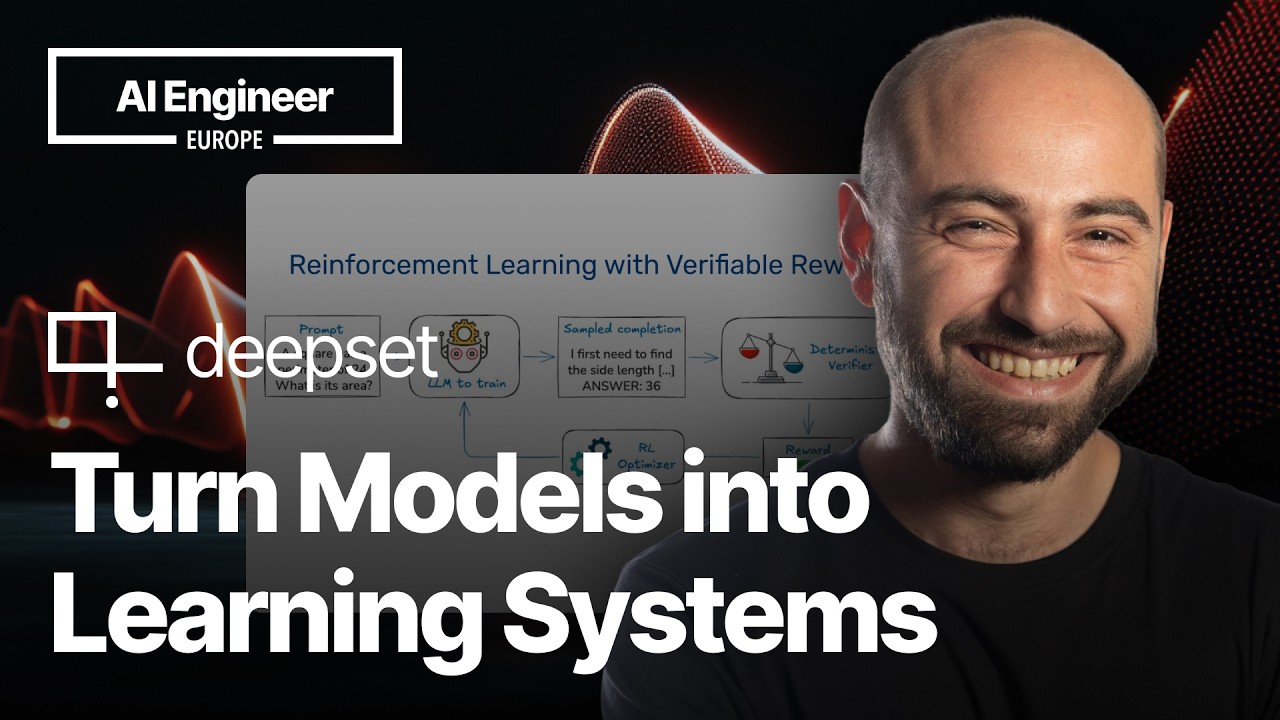
Stefano Fiorucci demonstrates how to build Reinforcement Learning environments for language models using the open-source Verifiers library, arguing that training small models with verifiable rewards can surpass large closed models on specific tasks. He maps classic RL concepts to LLMs, introduces Verifiers components for single-turn, multi-turn, and tool environments, and then walks through an experiment where he takes LiquidAI's LLM 2 — a small open model — and transforms it into a tic-tac-toe master via supervised fine-tuning and GRPO-based reinforcement learning. After training, the model dominates random opponents and draws 85% of games against optimal ones, eventually outperforming GPT-5 Mini against identical optimal opponents. Fiorucci shares practical lessons: large batch sizes (≥256) ensure stable training, hidden biases in opponent algorithms can skew results, and starting from a base model (not a reasoning model) avoids truncated thinking traces. He concludes that if you can define a clear reward signal, you can build an environment and train a small specialized model to beat a large closed model at a fraction of the cost.
Minimax M2: Building the #1 Open Model – Olive Song, MiniMax
Dec 13, 2025 · 13:41
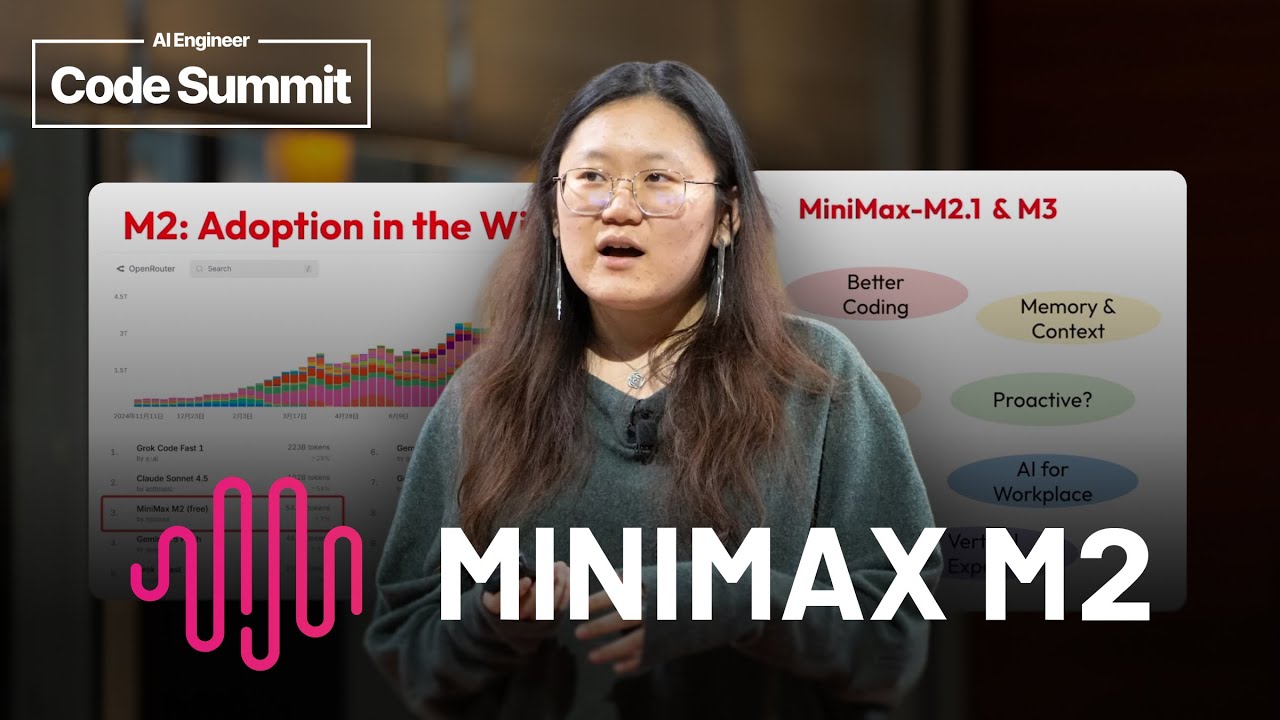
Olive Song, Senior Researcher at MiniMax, presents the Minimax M2, an open-weight model with 10 billion active parameters that achieves top rankings in intelligence and agentic benchmarks while being cost-efficient for real-world coding tasks. The model's success is attributed to four key characteristics: scaled environments and expert developer feedback for code experience, interleaved thinking with reinforcement learning for long-horizon tasks, perturbation pipelines for robust generalization across agent scaffolds, and small size enabling multi-agent scalability. Song details how these features allow M2 to handle noisy, dynamic environments, perform multi-tool workflows autonomously, and adapt to various scaffolds and prompts. The talk also previews future developments like M2.1 and M3, with plans to integrate audio and video generation capabilities.
Powered by PodHood