
METR
CompanyA company discussed on AI Engineer.
5 episodes

In the Land of AI Agents, the Verifiers Are King — Tariq Shaukat, Sonar
Jul 20, 2026 · 18:53
Tariq Shaukat, CEO of Sonar, argues that rigorous verification is the key to unlocking sustained value from AI coding agents, introducing the Agent-Centric Development Cycle (AC/DC) framework: Guide, Verify, Solve. He warns that without it, the initial 3–5x productivity boost from agents dissipates within three months as technical debt—security issues, maintainability issues, and complexity—compounds. Sonar's tests show that multi-layered, zero-trust verification (combining algorithmic and agentic methods) reduces AI-derived production outages by 44% and, in a trial with a large bank, achieved a 92% reduction in issues. Clean codebases, he argues, make agents faster and cheaper, with over 30% fewer tokens consumed when guided by context and constraints. The framework embeds verification into three loops—agentic, CI, and code maintenance—to create a self-reinforcing positive cycle, countering the downward spiral of neglected code quality.
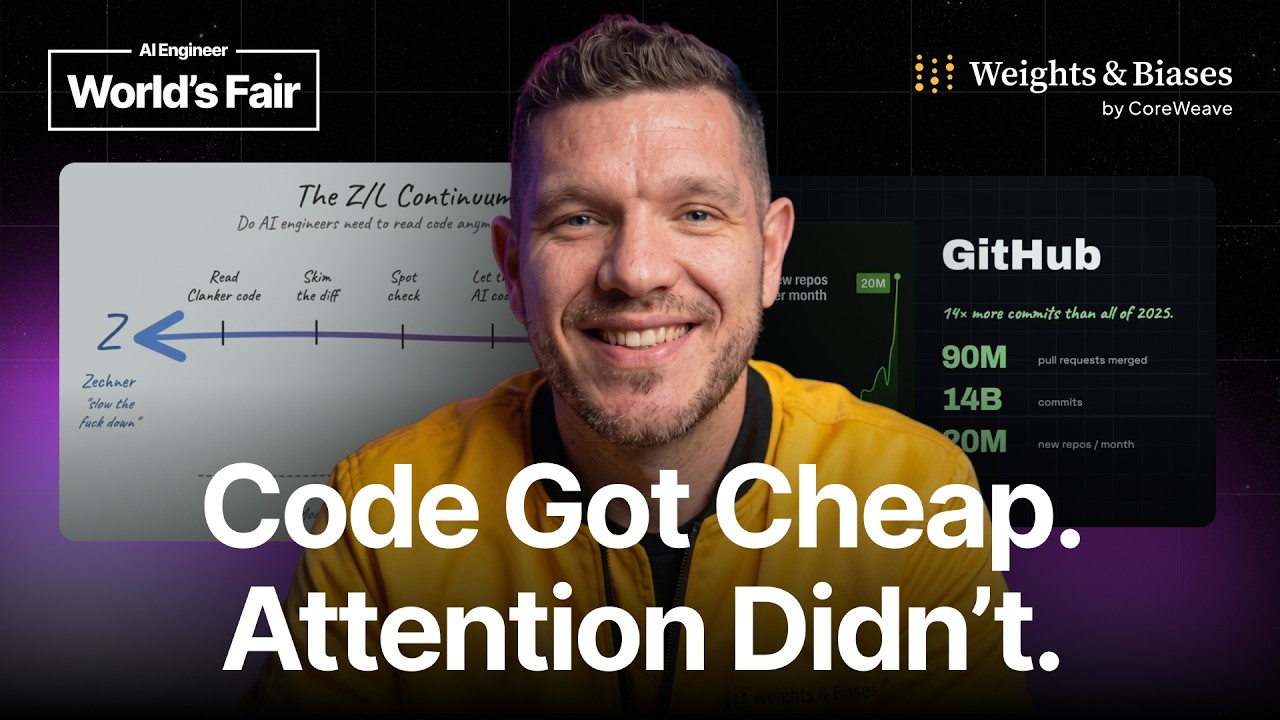
Should AI Engineers Still Read Code in 2026? The Z/L Continuum — Alex Volkov, ThursdAI
Jul 10, 2026 · 21:35
Alex Volkov examines the debate sparked by Ryan Lopopolo's claim that 'code is free' and Mario Zechner's counter that engineers must 'read every fucking line' of critical code, arguing that the Z/L Continuum is about task-level proof rather than personality. Citing a Ferrous AI survey showing an 861% increase in code deletion per PR and a 242% rise in incidents, he notes Anthropic's recursive self-improvement essay admitting human code review is a new bottleneck. Volkov's routing table prescribes reading every line for authentication, money movement, and irreversible data, while letting agents handle less critical changes. He also introduces loops—cron-like agent systems that self-verify—as the next frontier, quoting Adi Osmani that automated loops don't remove judgment. Volkov concludes that capability drift moves where proof belongs, but every system still requires human judgment.

How METR measures Long Tasks and Experienced Open Source Dev Productivity - Joel Becker, METR
Jan 19, 2026 · 1:15:52
Joel Becker of METR argues that AI benchmark scores are soaring while real-world developer productivity barely budges, reconciling this gap by presenting METR's time horizon measurements and a 16-developer RCT showing no significant speedup from AI on mature open-source projects. He cites reliability issues, task distribution mismatches, and the J-curve effect from Meta's developer data, noting that experienced users still fail to accelerate. The episode explores why AI struggles with messy enterprise data (e.g., LinkedIn's 5,000 'impressions' tables), the failure of computer-use agents in 'Agent Village,' and the possibility that hardware constraints may slow progress. Becker also previews new metrics like 'watched versus unwatched' time horizons and future studies on greenfield coding and data science.

Why Agent Hype can fall short of reality – Joel Becker, METR
Dec 24, 2025 · 21:22
Joel Becker, a researcher at METR, examines why AI models that ace benchmarks like SWE-bench fail to boost real-world developer productivity. METR's time horizon measurements show AI capabilities doubling every 6-7 months, with Claude 3.7 Sonnet achieving a 50% success rate on tasks taking humans 4 minutes. Yet a randomized controlled trial of 16 experienced developers on large open-source projects found they were 19% slower when using AI tools like Cursor Pro, contradicting expert predictions of 40% time savings. Becker attributes the gap to high context requirements, low AI reliability, and task complexity—developers spent significant time verifying and correcting AI outputs. The episode warns that benchmark-style evidence, which uses low-context human baselines, overstates AI readiness for messy, interdependent real-world tasks.
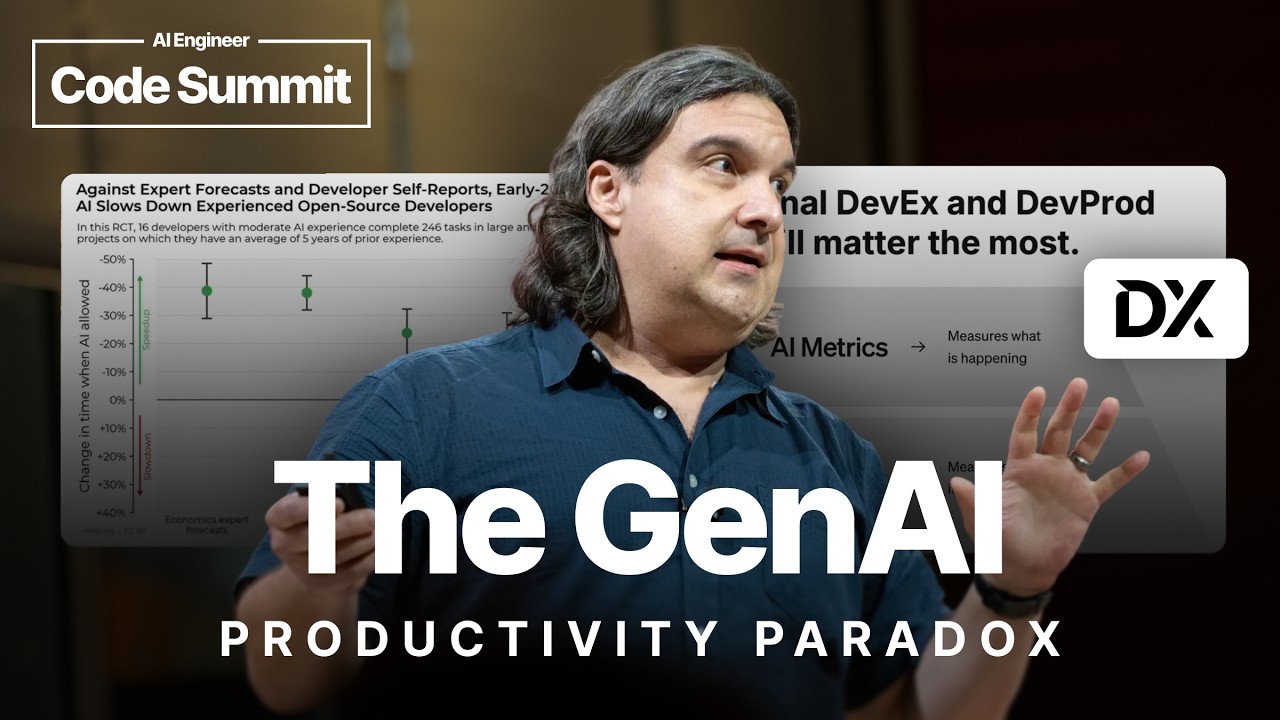
Leadership in AI Assisted Engineering – Justin Reock, DX (acq. Atlassian)
Dec 19, 2025 · 18:11
Justin Reock, Deputy CTO at DX (acquired by Atlassian), argues that AI's impact on engineering productivity varies wildly and that leaders must move beyond top-down mandates to focus on psychological safety, measurement of actual outcomes, and targeted integration across the SDLC. He presents data showing a 2.6% average increase in change confidence but extreme variability across companies, with some seeing 20% drops. Emphasizes that writing code is rarely the bottleneck; instead, leaders should identify and fix bottlenecks like context switching, citing Morgan Stanley's DevGenAI saving 300,000 hours annually by converting legacy code specs and Zapier reducing engineer onboarding to two weeks via AI agents. Introduces DX's AI Measurement Framework covering utilization, impact, and cost, and stresses trust-building through system prompt feedback loops and temperature settings. The episode delivers actionable guidance on measuring AI's true impact and enabling engineers through education, time to learn, and creative unblocking of usage.
Powered by PodHood