
Meta
CompanyA company discussed on AI Engineer.
41 episodes

The Desktop Frontier — Ahmad Osman, Osmantic
Jul 21, 2026 · 18:02
Ahmad Osman, founder of Osmantic, argues that within roughly 18 months (by late 2027) a single RTX 5090 will run intelligence equivalent to GLM 5.2, driven by the Densing Law of increasing impact per parameter. He shows this trend through concrete examples: a 27B-parameter Qwen 3.5 now beats the 405B LLaMA 3, and the same eight RTX 3090s that once struggled with LLaMA 2 can now run 15 parallel Qwen 3.5 agents. Osman presents the Densing Law—every 3.5 months, 50% fewer parameters achieve the same capability—as a systematic pattern, not coincidence. He advocates for sovereign AI: owning your own hardware (like a DGX Station or RTX 5090) gives you control, avoids cloud limitations, and sees hardware appreciate in utility as models become more efficient. He asks why fund cloud data centers when local hardware can run frontier intelligence and grow more valuable over time.

Voice Agents That Handle Interrupts - Chintan Agrawal and Daniel Wirjo, AWS
Jul 20, 2026 · 32:57
AWS Solutions Architects Chintan Agrawal and Daniel Wirjo argue that the hardest problem in production voice agents is audio engineering—not AI—specifically turn-taking, the decision of when an agent should stop speaking or start responding. They present three levels of turn detection: Level 1 uses Silero VAD with a silence timeout (e.g., 300ms default), Level 2 delegates to STT providers like Cartesia or Deepgram for built-in endpointing (p50 ~250-300ms), and Level 3 combines Silero VAD with SmartTurn, an open-source 8MB model achieving 58.9% recall and 68.4% precision while falling back to VAD on low confidence. They show how interruption handling (barge-in) flushes TTS/LLM in ~15ms and distinguish real interruptions from backchannel acknowledgments. Latency budgets are tight: 40ms mic encoding, 52ms network/jitter, 300ms STT+endpointing, 500-650ms LLM time-to-first-byte (dominant bottleneck), and 120-190ms TTS playback, totaling 800-1300ms in standard cloud setups. Co-locating models in one GPU cluster can achieve ~500ms voice-to-voice. For LLMs, Nemotron 3 Ultra and GPT-4.1 achieve ~530ms p50 but GPT-4.1 spikes to 1.7s p95, and multi-turn drift (>15 turns) can break prompt…
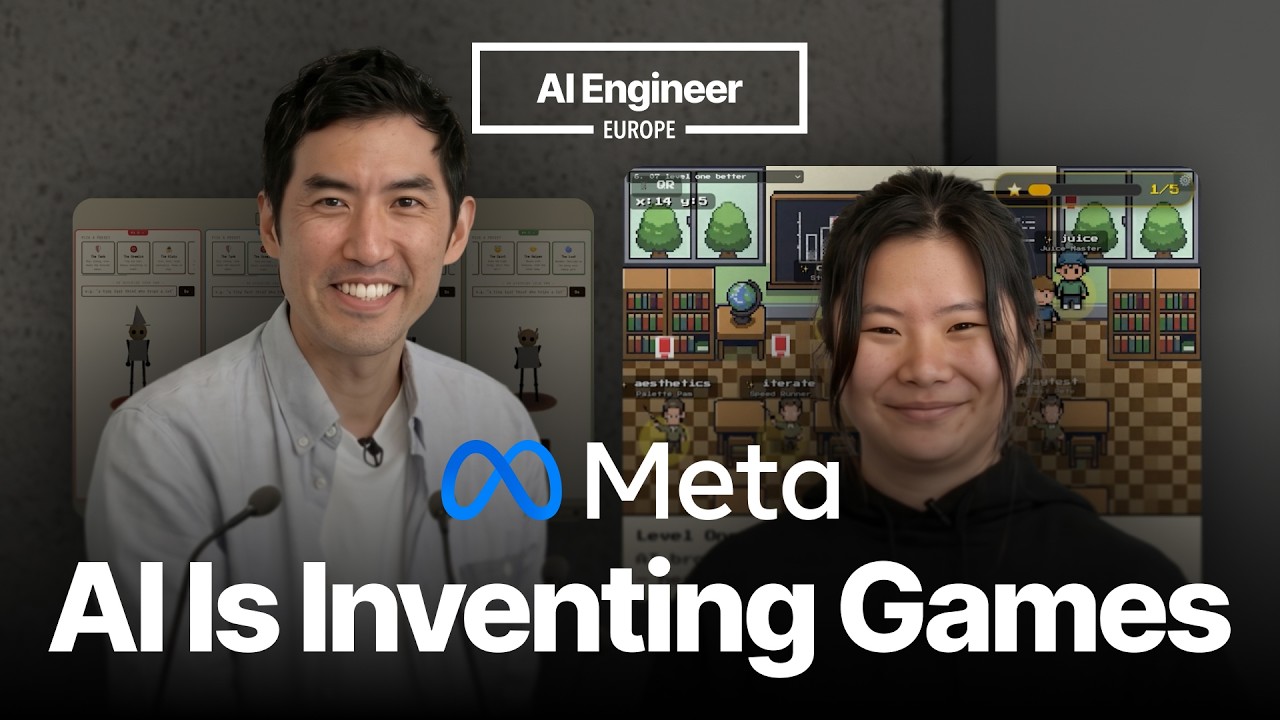
Think You Can Build a Game with AI? Think Again! - Danielle An & David Hoe, Meta
Jul 8, 2026 · 18:00
Meta engineers Danielle An and David Hoe share insights from leading AI-driven game creation at Meta, arguing that while anyone can now prompt a basic game with AI, truly standout games require aesthetic cohesion, playtesting, and runtime LLMs that make NPCs dynamic and unscripted. They demonstrate how anchoring an LLM on a single image (like a QR code) can unify art style and gameplay, and show a multiplayer game where LLM-driven NPCs compete with unique personalities. The key shift is from linear, costly game development to parallel, rapid iteration cycles enabled by AI tools. They also highlight challenges: managing indeterminism across the entire stack (from user prompts to platform ranking), debugging agentic systems, and ensuring content safety with runtime generation. The takeaway: whether you're a beginner, intermediate, or advanced creator, the AI gaming frontier is at day zero, with open problems in token economics and scalable safety.

Deterministic Infra for Non-Deterministic AI Agents - Nishant Gupta, Meta Superintelligence Labs
Jun 29, 2026 · 7:14
Nishant Gupta, a Software Engineering Tech Lead at Meta Superintelligence Labs, argues that AI agents must be treated as distributed systems and that infrastructure, not prompts or models, will determine competitive advantage. He highlights the 'great mismatch' between deterministic cloud infrastructure and probabilistic, stateful, long-running agents, which leads to failures like recursive reasoning loops and retry amplification. Gupta advocates for a control plane that separates model proposals from production execution via policy engines and execution gateways, and emphasizes layered safety, multi-dimensional observability, and controlled recovery patterns adapted from distributed systems. He notes that memory consistency is a critical challenge, and that human oversight should remain as exception handling rather than being eliminated. The episode concludes that the future of AI will be won by better systems, not better prompts or models.

Production Evals For Agentic AI Systems - Nishant Gupta, Meta Superintelligence Labs
Jun 25, 2026 · 8:12
Nishant Gupta, a Software Engineering Tech Lead at Meta Superintelligence Labs, argues that evaluating agentic AI systems requires a shift from offline benchmarks to production infrastructure. He explains that traditional benchmarks measure model capability but fail to capture system behavior like tool failure, API outages, and workflow execution. Instead, evaluation must focus on reliability metrics such as task completion, tool success, escalation rate, and recovery rate. Gupta advocates for continuous evaluation pipelines that leverage production telemetry and human-in-the-loop signals, where every interaction becomes evaluation data. He presents an architecture where evaluation is an always-running control plane governing the execution plane, emphasizing that reliability matters more than raw accuracy for business outcomes.

Evals Are Broken, Use Them Anyway — Ara Khan, Cline
Jun 6, 2026 · 19:04
Ara Khan from Cline argues that evals are broken—people either treat benchmark numbers as gospel or dismiss them for vibes—but that the truth lies in between, and they should still be used. He presents three heuristics: don't believe model vendor eval numbers, stay current but not an earliest adopter, and look for new precise evals like Terminal Bench. Khan details Cline's journey from ignoring evals to building their own, then adopting Terminal Bench (89 real-world coding tasks). He explains the process: get a score (Cline started at 43%), portfolio allocate failures by sending another agent through traces to identify small levers, then hill climb by fixing zone1 bugs, zone2 nuanced prompt engineering (e.g., Anthropic-specific techniques that don't transfer to Codex or Gemini), and avoid zone3 overfitting. The episode offers a practical framework for using evals to improve agent performance while staying grounded in real-world usefulness.

Training an LLM from Scratch, Locally — Angelos Perivolaropoulos, ElevenLabs
May 4, 2026 · 1:21:26
Angelos Perivolaropoulos from ElevenLabs walks through building a small GPT-2-like LLM from scratch on a local machine, demonstrating that the core techniques used by major labs are accessible in a few hundred lines of PyTorch code. The workshop uses character-level tokenization (65 tokens) on a Shakespeare dataset to enable fast training with limited compute. The model architecture includes multi-head self-attention, MLP layers, residual connections, and layer normalization, totaling 10 million parameters across six transformer blocks with a 256-token context window. The training loop employs next-token prediction with a warm-up cosine decay learning rate schedule and validation loss to detect overfitting. Inference uses temperature sampling (default 0.7) and top-k sampling to improve creativity. Perivolaropoulos explains that audio and multimodal models share the same transformer foundation but differ in tokenization (e.g., mel-spectrograms for audio) and use specialized losses like L2 or KL divergence, while reasoning models result from post-training base models with high-quality chain-of-thought data.
How AI is changing Software Engineering: A Conversation with Gergely Orosz, @pragmaticengineer
Apr 21, 2026 · 26:42
Gergely Orosz explains how AI is reshaping software engineering, from token maxing at Meta, Microsoft, and Salesforce—where engineers use AI tools to inflate token counts out of fear of layoffs and performance reviews—to the broader shift in the engineer's role toward orchestrating agents rather than managing people. He notes that big tech companies like Uber, Airbnb, and Shopify are building custom internal AI infra (MCP gateways, coding agents) to stay ahead, even tolerating high churn for a six-month competitive edge. Shopify secured GitHub Copilot a year early by offering feedback from 3,000 engineers. Gergely also shares how The Pragmatic Engineer hit product-market fit: 100 paid subscribers before publishing, reaching 1,000 in six weeks, and becoming the #1 paid tech newsletter by focusing on two deep-dive articles per week for two years.

How METR measures Long Tasks and Experienced Open Source Dev Productivity - Joel Becker, METR
Jan 19, 2026 · 1:15:52
Joel Becker of METR argues that AI benchmark scores are soaring while real-world developer productivity barely budges, reconciling this gap by presenting METR's time horizon measurements and a 16-developer RCT showing no significant speedup from AI on mature open-source projects. He cites reliability issues, task distribution mismatches, and the J-curve effect from Meta's developer data, noting that experienced users still fail to accelerate. The episode explores why AI struggles with messy enterprise data (e.g., LinkedIn's 5,000 'impressions' tables), the failure of computer-use agents in 'Agent Village,' and the possibility that hardware constraints may slow progress. Becker also previews new metrics like 'watched versus unwatched' time horizons and future studies on greenfield coding and data science.

Jack Morris: Stuffing Context is not Memory, Updating Weights is
Dec 29, 2025 · 1:02:44
Jack Morris argues that large language models fail at niche, long-tail knowledge tasks, such as optimizing AMD GPU kernels or answering private company queries, because they rely on context windows and RAG, which suffer from quadratic self-attention costs and context rot. He advocates for a third paradigm—training knowledge directly into model weights—using synthetic data generation (e.g., synthetic continued pretraining from Stanford) to expand small datasets and parameter-efficient methods like LoRA or memory layers to avoid catastrophic forgetting. Morris demonstrates that full fine-tuning on a 3M 10-K report causes the model to only regurgitate exact sentences, whereas generating diverse synthetic question-answer pairs enables better generalization. He notes that RL-based fine-tuning (e.g., GRPO) can achieve improvements with as few as 14 parameters, while memory layers offer the best trade-off between learning and forgetting. The episode also explores temporal information handling, federated learning resurgence, and the practical decision boundary between RAG and weight-based injection based on data freshness and volume.

Vibes won't cut it — Chris Kelly, Augment Code
Aug 3, 2025 · 15:34
Chris Kelly of Augment Code argues that vibe coding—letting AI write code without review—fails for production systems, where every line of code carries maintenance burden and decisions about architecture, packages, and trade-offs. He contends that code generation is not the job; software engineering is changing code safely, requiring context that LLMs lack despite their human-like output. Claims that generating 30% of code against millions of existing lines leaves little wiggle room, and that complex systems have emergent failures that pattern matching can't fix. He advises documented standards, reproducible environments, easy testing, clear boundaries, and defined tasks—tools every engineer needs. Cites Jeff Atwood: 'The best code is no code at all.' Notes professional engineers are slowest to adopt AI, and suggests code review is the most important skill for an AI-assisted future.
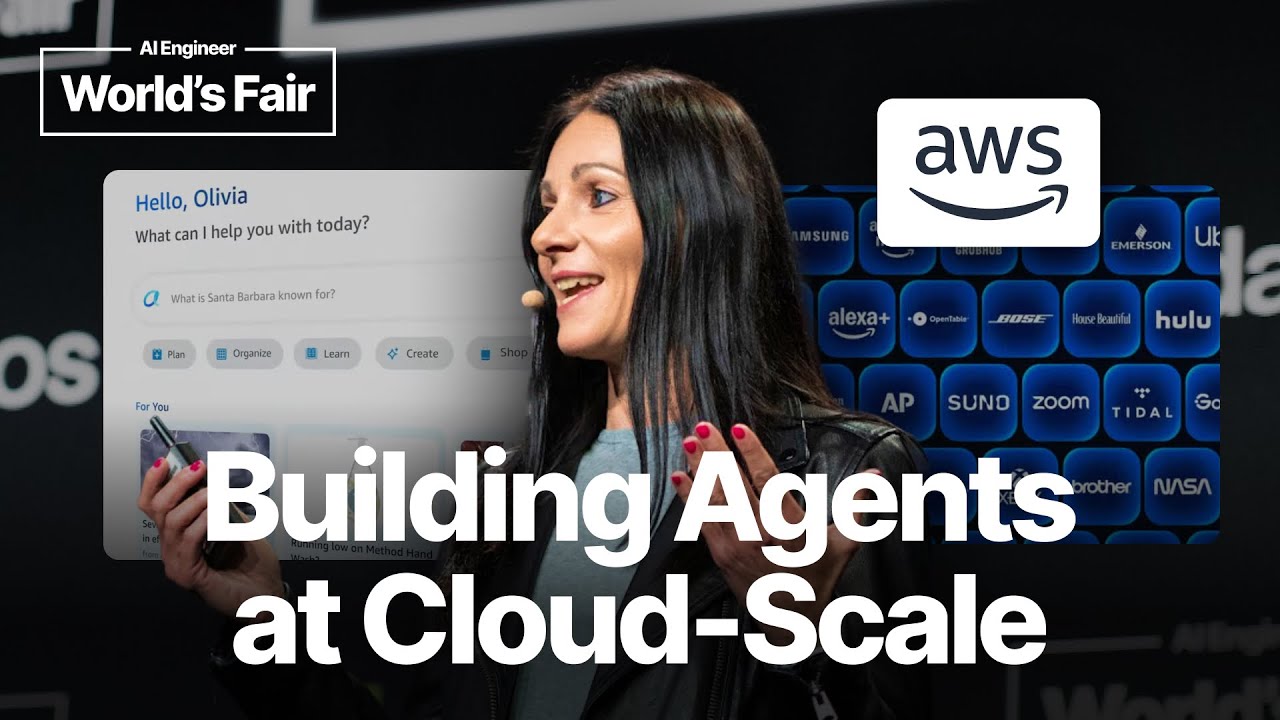
Building Agents at Cloud Scale — Antje Barth, AWS
Aug 2, 2025 · 19:00
AWS Principal Developer Advocate Antje Barth demonstrates how to build and scale AI agents using cloud-native patterns, arguing that specialized agents will reinvent customer experiences. She showcases Alexa Plus, which orchestrates hundreds of expert systems across 600M+ devices and tens of thousands of services, and the Amazon Q Developer CLI agent, shipped in just three weeks. Barth introduces Strands Agents, an open-source Python SDK for building production-ready agents that supports multiple model providers (Claude, Llama, OpenAI) and over 20 prebuilt tools including memory, RAG, and multi-agent workflows. She demonstrates integrating MCP servers via Lambda with DynamoDB for session storage, and previews upcoming A2A protocol support and a future of personal agents connecting to agent stores.

The Unofficial Guide to Apple’s Private Cloud Compute - Jmo, CONFSEC
Jul 30, 2025 · 20:36
Jonathan Mortensen explains Apple's Private Cloud Compute (PCC), a paradigm shift in confidential computing that delivers cryptographically provable privacy for AI inference on remote servers. He details Apple's five requirements—stateless computation, enforceable guarantees, non-targetability, no privileged runtime access, and verifiable transparency—and six technical components, including oblivious HTTP, blind signatures, secure enclave, remote attestation, transparency logs, and secure boot. The talk highlights how remote attestation allows an iPhone to verify server software and tie encryption to that verified state, while the transparency log enables public auditing of all deployed binaries. Mortensen notes trade-offs: complete trust in Apple's supply chain, higher latency and compute costs, and no support for custom models or third-party developers. He points to alternative tools like TPMs, SigStore, and confidential VMs for non-Apple environments, and concludes that Apple's approach is being adopted by Azure AI and Meta.

Latent Space Paper Club: AIEWF Special Edition (Test of Time, DeepSeek R1/V3) — VIbhu Sapra
Jul 25, 2025 · 53:54
VIbhu Sapra presents DeepSeek's latest models and announces a new curriculum-based Test of Time Paper Club. DeepSeek's May 28th R1 update doubles reasoning tokens (12k→25k) and matches O3/Gemini 2.5 Pro, improving AIME 2024 from 70% to 87.5%. A new distillation of R1 traces into Qwen 3 8b achieves performance on par with Qwen's 235b thinking model, proving reasoning models distill efficiently. The Test of Time Paper Club will cover 50–100 foundational papers over six months in San Francisco and remote, targeting core AI engineering topics from attention and scaling laws to inference techniques. Sapra emphasizes that pure RL (GRPO) on verifiable math and code unlocks emergent reflection and aha moments, shifting scaling from pre-training compute to inference-time reasoning.

Does AI Actually Boost Developer Productivity? (100k Devs Study) - Yegor Denisov-Blanch, Stanford
Jul 23, 2025 · 18:12
Yegor Denisov-Blanch from Stanford presents findings from a study of nearly 100,000 developers across 600+ companies, showing AI boosts developer productivity by an average of 15-20%, but the effect varies widely. The study measures functionality delivered, not commits, and reveals that AI introduces significant rework—bug fixes from AI-generated code. Productivity gains depend on task complexity, codebase maturity (Greenfield vs. Brownfield), language popularity, and codebase size: low-complexity Greenfield tasks see 30-40% gains, while high-complexity Brownfield tasks see only 0-10%. AI can even decrease productivity for low-popularity languages like COBOL or Haskell, and context window limitations reduce performance on larger codebases. The study provides data-driven guidance for when AI helps or hinders, with a matrix showing 20% gains for low-complexity common languages and minimal gains for complex niche ones.

How to Hire AI Engineers when EVERYONE is cheating with AI — Beth Glenfield, DevDay
Jul 22, 2025 · 6:45
Beth Glenfield, from DevDay, argues that AI has broken technical hiring because candidates cheat with AI tools, making LeetCode puzzles obsolete, and small companies are crushed in the talent war with big tech. She cites the AI cheating service CLUI, which raised $5.3M and is heading toward $1M ARR, and notes 93% LeetCode wizard success rates for Google/Meta interviews, with 1 in 3 interviews now using AI assistants. Instead of puzzles, she proposes real-world workplace simulations where candidates collaborate with AI agents (perfectionist, pragmatist, etc.) to measure skills like handling ambiguity, mentoring, and business judgment. She highlights that big tech can brute-force hiring (100 candidates for 5 hires), but startups cannot afford bad hires costing $20k-$60k. Referencing Mark Zuckerberg's prediction that AI will handle mid-level engineering and Marc Benioff's announcement that Salesforce won't hire software engineers due to a 30% productivity boost from AI, Glenfield argues engineering jobs now require creativity, collaboration, and working with AI rather than being replaced by it.

[Full Workshop] Reinforcement Learning, Kernels, Reasoning, Quantization & Agents — Daniel Han
Jul 19, 2025 · 2:42:28
Daniel Han of Unsloth presents a technical workshop covering reinforcement learning (RL), kernels, reasoning, quantization, and agents, arguing that RL with verifiable rewards (RLVR) is the key to unlocking LLM capabilities beyond supervised fine-tuning. He explains why open-source models plateaued after September 2024 until DeepSeek-R1 showed that RL can elicit reasoning, and breaks down PPO, GRPO, and the REINFORCE algorithm, emphasizing that GRPO removes the value model for efficiency. Han details how reward functions—not algorithms—are the hardest part, with examples like distance-based scoring for math. He demonstrates a free Colab notebook training a base model to reason, and shows that dynamic quantization can shrink models like DeepSeek-R1 from 730 GB to 140 GB with only ~1% accuracy loss, arguing that GPUs may stop getting faster after FP4 precision.

2025 in LLMs so far, illustrated by Pelicans on Bicycles — Simon Willison
Jul 9, 2025 · 18:30
Simon Willison reviews the past six months of LLM releases — including AWS Nova, Llama 3.3 70B, DeepSeek R1, Mistral Small 3, Claude 3.7 Sonnet, GPT 4.5, Gemini 2.5 Pro, GPT-4o, Llama 4, GPT 4.1, O3/O4 Mini, and Claude 4 — using his 'pelican on bicycle' SVG benchmark to argue that local models have become good enough to run GPT-4 class models on a laptop and that combining tools with reasoning is the most powerful technique in AI engineering, while noting risks like prompt injection and the 'lethal trifecta'. He tracks 30 significant model releases, highlighting that Mistral Small 3 (24B) matches Llama 3 70B's performance, which itself matched the 405B model, enabling local inference. DeepSeek's R1 caused a $500B+ Nvidia stock drop on January 27. GPT 4.1 Nano is the cheapest model yet at a fraction of a cent per pelican. He also examines bugs: ChatGPT's sycophantic 'shit-on-a-stick' incident and Claude 4's tendency to snitch to authorities when given ethical instructions and email tools. Willison concludes that while the pace is accelerating, control over context and security remain critical.

Trends Across the AI Frontier — George Cameron, ArtificialAnalysis.ai
Jul 8, 2025 · 17:52
George Cameron of Artificial Analysis presents multiple frontiers—reasoning, open-weights, cost, speed—across the AI stack, arguing that trade-offs between intelligence, latency, and expense are critical for building applications. Reasoning models like O4 mini high use an order of magnitude more output tokens (72M vs GPT-4.1's 7M) and take over 40 seconds per response versus 4.7 seconds, impacting agentic workflows where 30 sequential calls multiply latency. The open-weights gap has nearly closed, with China-based labs like DeepSeek R1 and Alibaba's Qwen 3 leading. O3 cost roughly $2,000 to run the intelligence index, while GPT-4.1 nano is over 500 times cheaper. Output speeds have jumped from GPT-4's 40 tokens/s in 2023 to over 1,000 on a B200 accelerator. Despite efficiency gains, demand for compute will keep rising due to larger models, reasoning’s extra tokens, and multi-step agents.
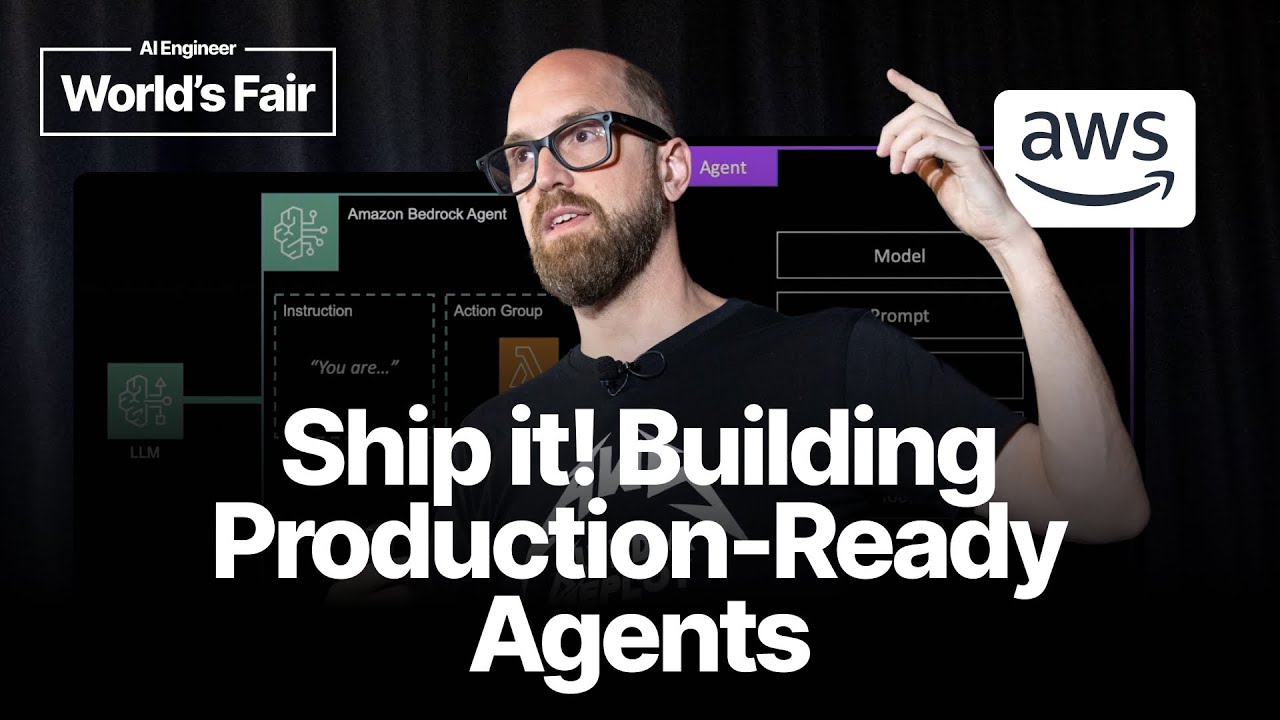
Ship it! Building Production Ready Agents — Mike Chambers, AWS
Jun 27, 2025 · 19:37
Mike Chambers, a developer advocate at AWS, demonstrates how to take a simple local agent—built with a Llama 3.1 8B model and a dice-rolling tool—and ship it to production at cloud scale using Amazon Bedrock Agents. He breaks down the essential components of an agent: model, prompt, loop, history, and tools. Then he live-deploys the agent with Bedrock Agents, configuring instructions and an action group wired to an AWS Lambda function that handles the dice roll. The fully managed service automates scaling, infrastructure, and the agentic loop. Chambers also highlights free courses on DeepLearning.AI and invites attendees to discuss MCP servers and the new open-source SDK for model-first agents.
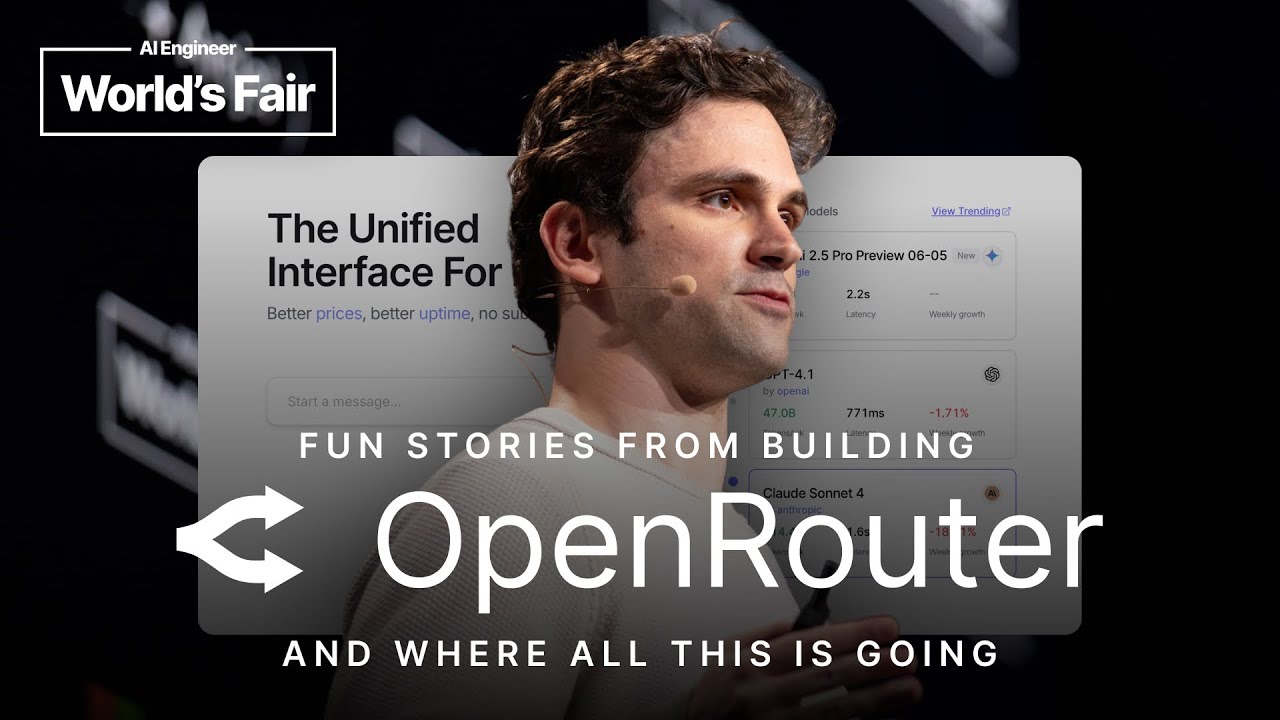
Fun stories from building OpenRouter and where all this is going - Alex Atallah, OpenRouter
Jun 25, 2025 · 18:47
Alex Atallah, founder of OpenRouter, tells the story of how he launched the LLM aggregator in early 2023 after observing the open-source race sparked by Meta's Llama 1 and Stanford's Alpaca distillation under $600. He argues the inference market is not winner-take-all, citing OpenRouter's data showing Google Gemini growing from 2-3% to 34-35% of tokens over 12 months. The platform evolved from a simple model collection into a marketplace with over 400 models and 60 providers, solving architecture challenges like 30-millisecond latency, cancelable streams, and a middleware plugin system for web search and PDF parsing. Atallah explains that OpenRouter grew 10-100% month-over-month for two years, and he predicts future additions like transfusion models that generate images and more powerful geographic routing for enterprise optimization.
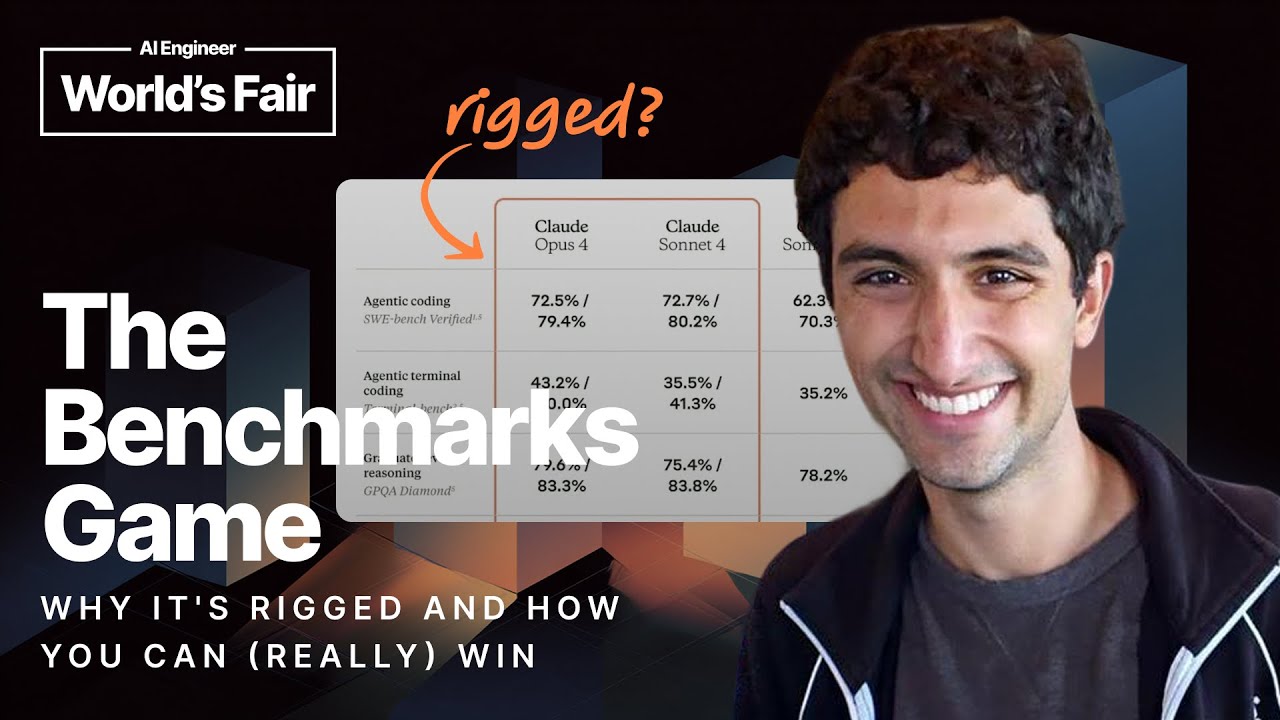
The Benchmarks Game: Why It's Rigged and How You Can (Really) Win - Darius Emrani
Jun 3, 2025 · 11:20
Darius Emrani exposes how AI benchmarks are rigged, showing that xAI cherry-picked Grok-3 comparisons, OpenAI funded FrontierMath for privileged access, and Meta submitted 27 Llama-4 variants to LM Arena optimizing style over substance. Citing Goodhart's Law, he argues that when benchmarks target billions in investment, they cease to measure real capability—Andrej Karpathy admits he doesn't know which metrics to trust. Emrani provides a 5-step framework to build use-case-specific evaluations, emphasizing that 39% of score variance comes from writing style. He advocates for apple-to-apple comparisons, open-source test sets, and style-controlled metrics, concluding that teams should stop chasing leaderboards and instead iterate on real production data to ship reliable AI.

Function Calling is All You Need — Full Workshop, with Ilan Bigio of OpenAI
Apr 23, 2025 · 1:42:54
Ilan Bigio from OpenAI argues function calling is the essential primitive for building AI agents, demonstrating how to implement memory, delegation, asynchronous task execution, and even self-modifying tools—all using the same loop. Starting from a basic weather tool, he builds an agent that stores user facts in a JSON file, delegates complex requests to o1, runs multiple weather lookups in parallel with asyncio, and creates a Bootstrap agent that writes its own Python functions on the fly. He also shares practical tips from his work on Swarm and the Real-Time API, including a stay-silent function to prevent premature responses and the ability to read scripts with XML tags. The workshop emphasizes that sophisticated agent behaviors emerge from simple function calling patterns without needing heavy frameworks.

The Devops Engineer Who Never Sleeps — Diamond Bishop, Datadog
Apr 22, 2025 · 16:18
Diamond Bishop, Director of AI Engineering at Datadog, explains how his team builds AI agents—the On-Call Engineer and Software Engineer—that automate DevOps tasks like incident investigation, remediation, and postmortem writing. He details how the On-Call Engineer wakes up for alerts, reads runbooks, queries logs and metrics, and suggests fixes to let human engineers sleep. The Software Engineer proactively fixes errors by generating code diffs and pull requests. Bishop shares four key lessons: scope tasks and evaluate rigorously, assemble teams of optimistic generalists and UX experts, adapt UX for human-agent collaboration, and treat observability as critical for debugging multi-step agent workflows. He predicts that within five years, AI agents will surpass humans as primary users of SaaS platforms like Datadog, urging builders to design for agent consumers.

Insights on Building AI Teams — Heath Black, SignalFire
Apr 15, 2025 · 20:30
Heath Black, Managing Director of Product at SignalFire, uses Beacon platform data to guide AI team building, arguing that credentialism is declining—only 7% of AI engineers had PhDs in 2023 versus 16% in 2015—and that work experience now outweighs education. He shows AI talent concentrates in San Francisco (35% of AI engineers), Seattle (22%), and New York (10%), and that tracking retention rates (e.g., Anthropic at 66% four-year retention vs. Perplexity at 43%) helps time outreach. Black advises hiring based on a candidate's body of work, removing academic requirements from postings, and understanding generational job-hopping (27% of Gen Z left jobs in 2023). He warns against relying solely on salary and equity, as AI engineers command 5% salary and 10–20% equity premiums, and recommends narratives centered on mission, speed, and collaborative teams. The talk emphasizes using data to filter, locate, time, and close hires effectively.

Personal, Local, Private AI Agents: Soumith Chintala
Apr 6, 2025 · 20:32
Soumith Chintala, co-founder of PyTorch, argues that personal AI agents should run locally and privately to maintain trust and control over intimate data. He warns that cloud-based agents, lacking complete context (like access to all messaging or financial accounts), become unreliable and potentially dangerous—catastrophic actions like buying a Tesla instead of Tide Pods are possible. Key technical challenges include slow local inference, immature open-source computer-use models, and poor catastrophic action classification. He is bullish on open models surpassing closed ones through coordinated improvement, citing Linux, Llama, and DeepSeek. Chintala also plugs open reasoning data from gr.ink and PyTorch’s work on enabling local agents, urging AI engineers to tackle these gaps.

How We Build Effective Agents: Barry Zhang, Anthropic
Apr 4, 2025 · 15:09
Barry Zhang of Anthropic's Applied AI team argues that effective agents require simplicity, not complexity, and should be built only for tasks with high value and ambiguous problem spaces. He offers a checklist: ensure task complexity is high, value justifies token cost, critical capabilities are de-risked, and errors are easily discovered (e.g., coding with unit tests). Agents are just models using tools in a loop — environment, tools, and system prompt — and he advises iterating on these three components before optimizing. To improve agents, developers should think like them by narrowing their perspective to the agent's 10-20k token context window and even asking Claude to critique its own tools and trajectories. Zhang forecasts three open challenges: making agents budget-aware by enforcing time/token/money limits, enabling self-evolving tools via meta-tools, and building asynchronous multi-agent communication beyond synchronous turns.
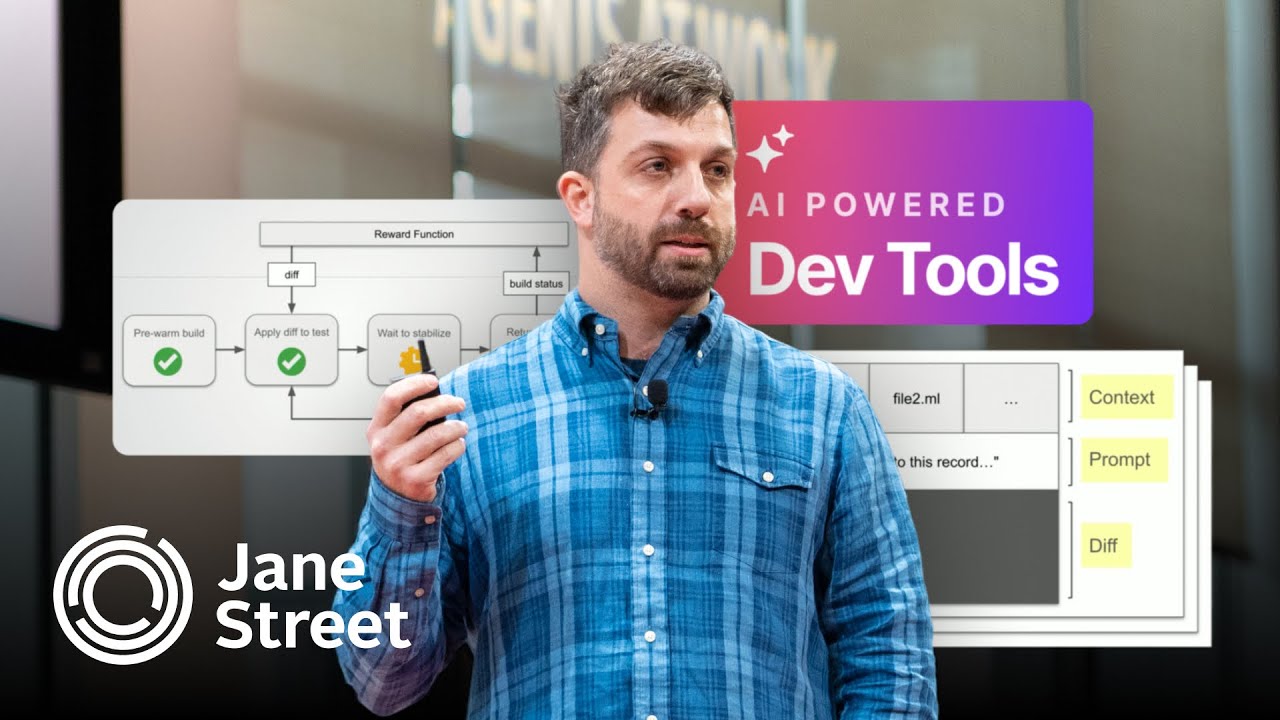
AI Engineering at Jane Street - John Crepezzi
Mar 28, 2025 · 16:57
John Crepezzi, an engineer on Jane Street's AI Assistants team, explains how they built custom LLM-powered coding assistants for OCaml, a functional language with scarce public training data. To overcome off-the-shelf tool limitations, they trained models on data from workspace snapshots — automated captures of developer workstations every 20 seconds, tracking build status changes from red to green. They used a Code Evaluation Service (CES) for reinforcement learning and evaluation, pre-warming builds to quickly test if model-generated diffs compile and pass tests. Their sidecar architecture, AID, serves thin editor integrations for Emacs (used by 67% of the firm), VS Code, and Neovim, allowing easy model swapping and A/B testing (e.g., sending 50% of users to different models). The talk details the end-to-end process: data collection from features, commits, and snapshots; training with supervised data and RL; and building pluggable infrastructure for domain-specific tools.

Customized, production ready inference with open source models: Dmytro (Dima) Dzhulgakov
Feb 16, 2025 · 18:55
Dmytro (Dima) Dzhulgakov, co-founder and CTO of Fireworks AI, argues that open source models are the future for production Gen AI applications, and Fireworks provides a platform to make them customized and production-ready. He explains that while proprietary models like GPT-4 are powerful, they are too large, expensive, and slow for many use cases, whereas open models like Llama or Gemma can be fine-tuned for specific domains to achieve better quality at up to 10x speed and lower cost. The main challenges of using open models—complex setup, performance tuning, and production scaling—are addressed by Fireworks' custom serving stack, which achieves the fastest long-prompt inference and serves SDXL fastest among providers, handling over 150 billion tokens per day. The platform supports fine-tuning and serving thousands of LoRA adapters on the same GPU with serverless pay-per-token pricing. Dzhulgakov also highlights the emerging architecture of compound AI systems, where function calling—exemplified by the open-source Fire Function model—connects LLMs to external tools and knowledge sources, enabling agentic applications like stock querying and chart generation. The episode…

LLM Quality Optimization Bootcamp: Thierry Moreau and Pedro Torruella
Feb 8, 2025 · 53:05
Thierry Moreau of OctoAI demonstrates how to fine-tune Llama 3 8B on a PII redaction task using OpenPipe and OctoAI, achieving 47% better accuracy and a 200x cost reduction (from $30 to $0.15 per million tokens) compared to GPT-4 Turbo. He explains that fine-tuning should follow prompt engineering and RAG, and works best for specialized tasks like function calling. The talk walks through building a fine-tuning dataset from the PI Masking 200k dataset, using OpenPipe to train a LoRA for $40, deploying it on OctoAI, and evaluating it to show the fine-tuned model scores 0.97 accuracy versus GPT-4’s 0.68. Moreau emphasizes that this continuous deployment cycle requires monitoring data drift and retraining, but tools like OpenPipe and OctoAI make it accessible even for teams without deep ML expertise.

Building security around ML: Dr. Andrew Davis
Feb 8, 2025 · 25:01
Dr. Andrew Davis, Chief Data Scientist at HiddenLayer, argues that machine learning models remain highly vulnerable to adversarial attacks despite a decade of research, and defenses must be layered with observability, logging, and skeptical data handling. He details how ImageNet's URL-based distribution enables data poisoning via expired domains, and how model theft can replicate a LLaMA 7B model's performance for just $600 in OpenAI queries. Adversarial examples still evade robust defenses, with best-case robustness only 50-60% against advanced attacks, and multimodal LLMs amplify the threat as pixel-level modifications are far harder to detect than text prompt injections. Spotlighting — encoding data in base64 to prevent instruction-following — is a promising prompt injection defense, but attackers can craft readable base64 strings to bypass it. The ML supply chain on Hugging Face is fraught with risk: models can execute arbitrary code via Lambda layers or TensorFlow functions, so verifying provenance, scanning for malware, and sandboxing are critical. Finally, software vulnerabilities in tools like Ollama (with recent RCE CVEs) demand the same patching discipline as traditional…

[Full Workshop] Llama 3 at 1,000 tok/s on the SambaNova AI Platform
Feb 7, 2025 · 1:00:58
Michelle Matern and Petro Milan of SambaNova present their full-stack AI platform, built on the SN40L RDU chip with a three-tiered memory architecture capable of storing up to 5 trillion parameters. They demonstrate Samba1 Composition of Experts (CoE), a trillion-parameter model combining 92 expert models behind a single endpoint, and show Llama-3-8B achieving 1,000 tokens per second with a time-to-first-token of 0.09 seconds and total inference time of 0.65 seconds—far exceeding GPU-based providers. The workshop includes a hands-on basic inference call using LangChain and SambaStudio API, and a RAG-based Q&A system for enterprise search that integrates Unstructured for document loading, E5-large-v2 embeddings, ChromaDB vector store, and the high-speed Llama-3 endpoint. Attendees learn to configure prompts with special Llama-3 tags, set chunk size and overlap, and optionally run embeddings on SambaNova's RDU hardware for faster processing.

Which Jobs Can Be Replaced Today: Fryderyk Wiatrowski and Peter Albert
Feb 6, 2025 · 19:59
Fryderyk Wiatrowski and Peter Albert, co-founders of Zeta Labs, argue that autonomous browser agents will first replace reactive jobs—like customer support and scheduling—by automating low-leverage tasks while preserving human focus on high-leverage activities. They propose a trigger-pool system where agents react to emails, Slack, or events, requiring only approval for actions. Peter details building reliable agents: start with prompting optimized for model distribution, then add cognitive architectures (e.g., planning, scratchpads) to split tasks, and finally fine-tune with synthetic data or reinforcement learning. He advises minimizing noise in prompts, preferring text-based reasoning over images, and using language model judges to filter training data. The founders see continuous model improvement enabling agents to handle increasingly complex, proactive roles, moving toward full job replacement.

Best Practices for Evaluating Large Language Model Applications with llmeval: Niklas Nielsen
Feb 5, 2025 · 9:33
Niklas Nielsen, CTO and co-founder of Log10, introduces llmeval, a command-line tool that enables teams to ship reliable LLM applications by evaluating and testing prompts and configurations. The tool initializes with four lines of code, uses Meta's Hydra for configurable test structures, and runs multiple samples (default 5) per test to assess stability. Nielsen demonstrates prompt engineering for a math problem, showing how stripping spaces or adding instructions like 'only return the answer' affects strict pass/fail results across Claude, GPT-4, and GPT-3.5. Advanced use cases include testing tools for Python code generation and model-based evaluation, where a larger model grades outputs on criteria like mermaid diagram quality. He notes pitfalls: models favor their own output and struggle with point scores. Log10 addresses this by bridging model-based and human feedback—collecting prior human ratings to train an 'auto-John' that pre-fills reviews for new completions.
Making Open Models 10x faster and better for Modern Application Innovation: Dmytro (Dima) Dzhulgakov
Oct 9, 2024 · 18:55
Dmytro Dzhulgakov, CTO of Fireworks AI, argues that open-source models are the future for GenAI applications because they offer lower latency, lower cost, and domain adaptability compared to proprietary models. He explains that open models can be up to 10x faster for narrow domains and cut costs significantly, using examples like fine-tuned Llama 3 for function calling. Fireworks addresses the challenges of setup, optimization, and production readiness with a custom serving stack that delivers the fastest inference for long prompts and image generation (e.g., SDXL). He highlights FireFunction V2, an open-source model for function calling that combines chat and tool use, and notes that Fireworks serves over 150 billion tokens per day for companies like Quora and Cursor. The talk emphasizes that platforms like Fireworks enable developers to start with serverless inference, fine-tune models, and scale to enterprise-grade deployment with dedicated hardware.

Everything you need to know about Fine-tuning and Merging LLMs: Maxime Labonne
Sep 25, 2024 · 17:52
Maxime Labonne from Liquid AI explains the LLM training lifecycle—pre-training, supervised fine-tuning (SFT), and preference alignment—and when to use fine-tuning over prompt engineering. He details SFT dataset creation (accuracy, diversity, complexity) and techniques like full fine-tuning, LoRA, and QLoRA, with key hyperparameters. The core of the talk is model merging: combining weights of fine-tuned models without GPU, using methods like SLERP (spherical linear interpolation for two models), TIES (pruning redundant parameters to merge many models), pass-through (concatenating layers, e.g., Meta LLaMA 3 120B Instruct by repeating layers gives strong creative writing), and Franken-MoE (extracting FFN layers from domain-specific models with a router). Labonne demonstrates these with his NeuralBeagle and Beyonder models, noting merged models dominate the OpenLLM leaderboard and that TIES merging often outperforms more experimental Mixture of Experts approaches.

Judging LLMs: Alex Volkov
Sep 9, 2024 · 18:39
Alex Volkov, as an LLM judge from 2034, humorously judges AI engineers on their development practices, emphasizing the importance of tracing, iterative prompt engineering, and robust evaluation pipelines. He finds Daniel guilty of deploying without logging, Sasha guilty of premature fine-tuning without prompt iteration, and Morgan guilty of ignoring AI news—commuted to attending ThursdAI. Francisco’s overreliance on programmatic evals leads to a legal loss, while Maxime is 'awesome' for using Weights & Biases Weave. Alex concludes with a primer on evaluation methods: programmatic, human-in-the-loop, and LLM-as-judge, stressing the need to validate validators and create custom criteria. He promotes Weave for tracing and evals, and ThursdAI for staying updated.

From Software Developer to AI Engineer: Antje Barth
Jul 24, 2024 · 19:48
Antje Barth, a Principal Developer Advocate for generative AI at AWS, outlines five practical steps from software developer to AI engineer: understanding foundation models, getting hands-on with AI developer tools like Amazon Q Developer, prototyping with models via Amazon Bedrock, integrating agents, and staying up to date with community events. She demonstrates Amazon Q Developer's ability to generate, explain, and transform code, reducing unvaluable tasks from 70% to focus on creative work. Barth introduces Amazon Bedrock's unified Converse API for standardized model invocation across providers like Anthropic's Claude 3.5 Sonnet, and shows how agents can be built to control a Minecraft bot through reasoning and tool use. The episode concludes with the announcement of the AI Engineering Hub at the AWS loft in San Francisco for community workshops and events.
How to Become an AI Engineer from a Fullstack Background - Reid Mayo
Feb 2, 2024 · 10:19
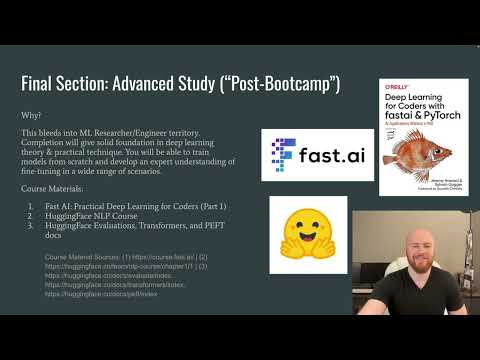
Reid Mayo presents a step-by-step syllabus to transition from fullstack engineer to AI engineer, covering generative AI foundations, prompt engineering, LangChain, fine-tuning, and cost-effective open-source model deployment. The syllabus starts with Cohere's LLM overview, then dives into prompt engineering via Elvis Seravia's guide and Learn Prompting org docs. It emphasizes LangChain as the glue layer for modular AI systems, with tutorials from Mayo Ocean. Evals are treated as software tests using OpenAI's cookbook. Fine-tuning is taught via OpenAI's cookbook and then open-source LLaMA 2, with a specific case study showing a $19 fine-tuned LLaMA 2 matching OpenAI's $24,000 model on a target task. The boot camp ends with advanced deep learning courses from FastAI and Hugging Face for further mastery.

[Workshop] AI Engineering 201: Inference
Nov 7, 2023 · 1:43:16
Charles Frye, instructor of the Full Stack LLM Bootcamp, leads a workshop on AI engineering inference, focusing on the build-versus-buy decision between proprietary and open models. He argues that proprietary models like OpenAI's GPT-4 and Anthropic's Claude are currently more capable but expensive, while open models like LLaMA 2 are less capable but offer hackability, though they may catch up if capabilities requirements saturate. Frye covers inference on end-user devices, noting that running models locally avoids network latency but faces tight memory and power constraints—e.g., a 7B parameter model requires 14 GB, too large for phone RAM. He explains inference-as-a-service (e.g., OpenAI, Replicate) versus self-serving on cloud GPUs or serverless platforms like Modal, highlighting that memory bandwidth is the bottleneck: GPUs have 1.5 TB/s memory bandwidth vs 312 TFLOPS compute, so batching is crucial for throughput. Frye also discusses inference arithmetic, custom silicon like TPUs which offer ~30% better efficiency but not drastic gains, and containerization challenges for GPU workloads.

Building AI For All: Amjad Masad & Michele Catasta
Oct 23, 2023 · 25:13
Amjad Masad and Michele Catasta announce Replit's AI for all, giving free AI-powered coding to millions of users. They detail the training of Replit Code v1.5, a 3.3B parameter model trained on 1 trillion tokens of code, which outperforms StarCoder 3B and approaches Code LLaMA 7B in Human Eval despite being half the size. The model is optimized for low-latency inference, generating over 200 tokens per second per GPU. Catasta explains the data pipeline using permissively licensed code from The Stack and Replit public repos, with five epochs of repeated high-quality data. The model is released open-source with a commercially permissive license. Partnerships with Glaive AI for instruction fine-tuning, Morph Labs for a novel fill-in-syntax-tree format, and Perplexity for fast model serving are also unveiled.
Powered by PodHood