
A company discussed on AI Engineer.
7 episodes
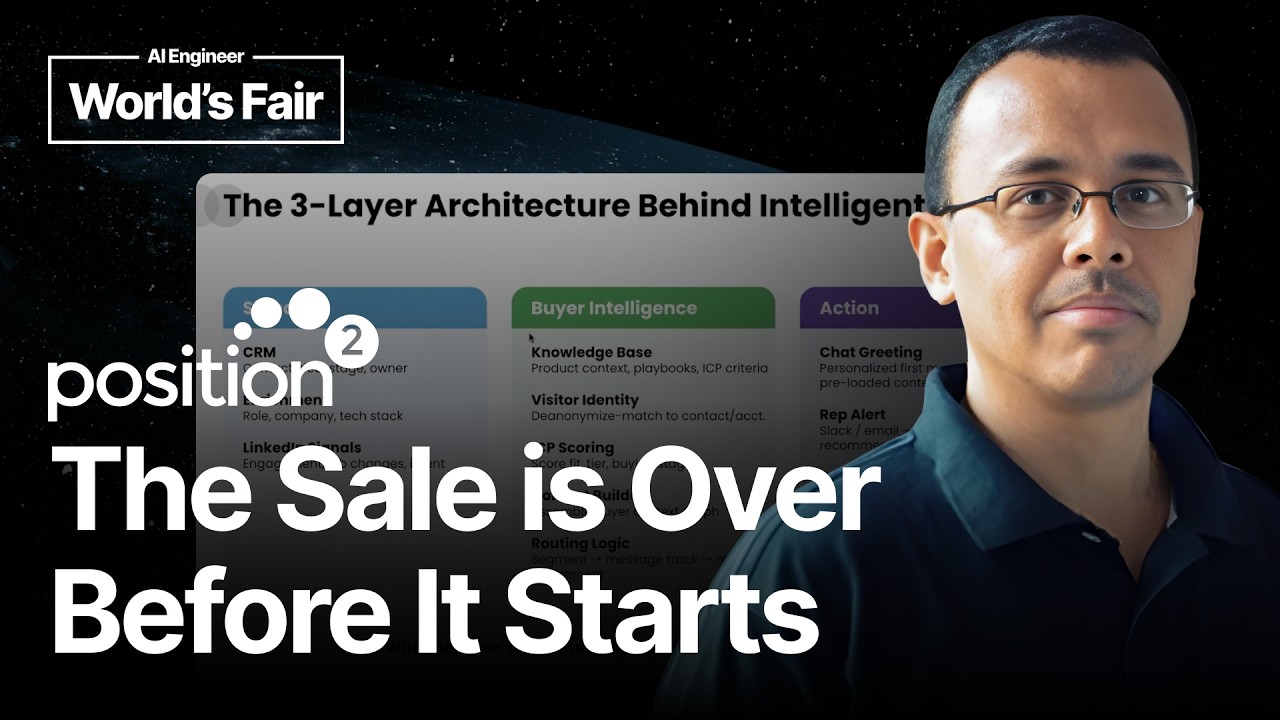
Build the AI GTM Agent That Knows the Buyer - Dr. Sajjan Kanukolanu, Position2 (Position Squared)
Jul 20, 2026 · 26:27
Position2's Dr. Sajjan Kanukolanu presents an AI GTM architecture that knows buyers before they message, solving three problems—AI, integration, and architecture—rather than bolting AI onto legacy stacks. The system uses three layers: signals (CRM, enrichment, LinkedIn), buyer intelligence (knowledge base, ICP scoring, context graph), and action (personalized chat, rep alerts, CRM updates, sequence triggers). A demo shows anonymous visitors deanonymized into a dashboard tracking 3,000+ visitors from 280 accounts, with LinkedIn intelligence capturing engagement across 8 posts from 100 visitors. Kanukolanu warns of ICP drift (retrain quarterly), alert fatigue (use context graph to cut noise), identity ceiling (~70% company, 15-20% individual accuracy), and human bottleneck (keep email editing under 30 seconds). The four takeaways: start with identity, score fit and intent separately, build an auditable policy engine, and let every send and deal compound into the knowledge base.

Practical GraphRAG: Making LLMs smarter with Knowledge Graphs — Michael, Jesus, and Stephen, Neo4j
Jul 22, 2025 · 19:46
Michael Hunger and Stephen Chin of Neo4j present GraphRAG as a method to enhance LLMs by integrating knowledge graphs, achieving more accurate, contextual, and explainable answers than standard RAG. They highlight limitations of vector search, showing GraphRAG improves relevance and reduces hallucinations. They detail a three-step construction process: lexical graphs, entity extraction, graph enrichment with algorithms. They demonstrate open-source tools like Neo4j Knowledge Graph Builder and GraphRAG Python package, and show an agentic approach using domain-specific retrievals. They cite studies showing three times improvement in accuracy.
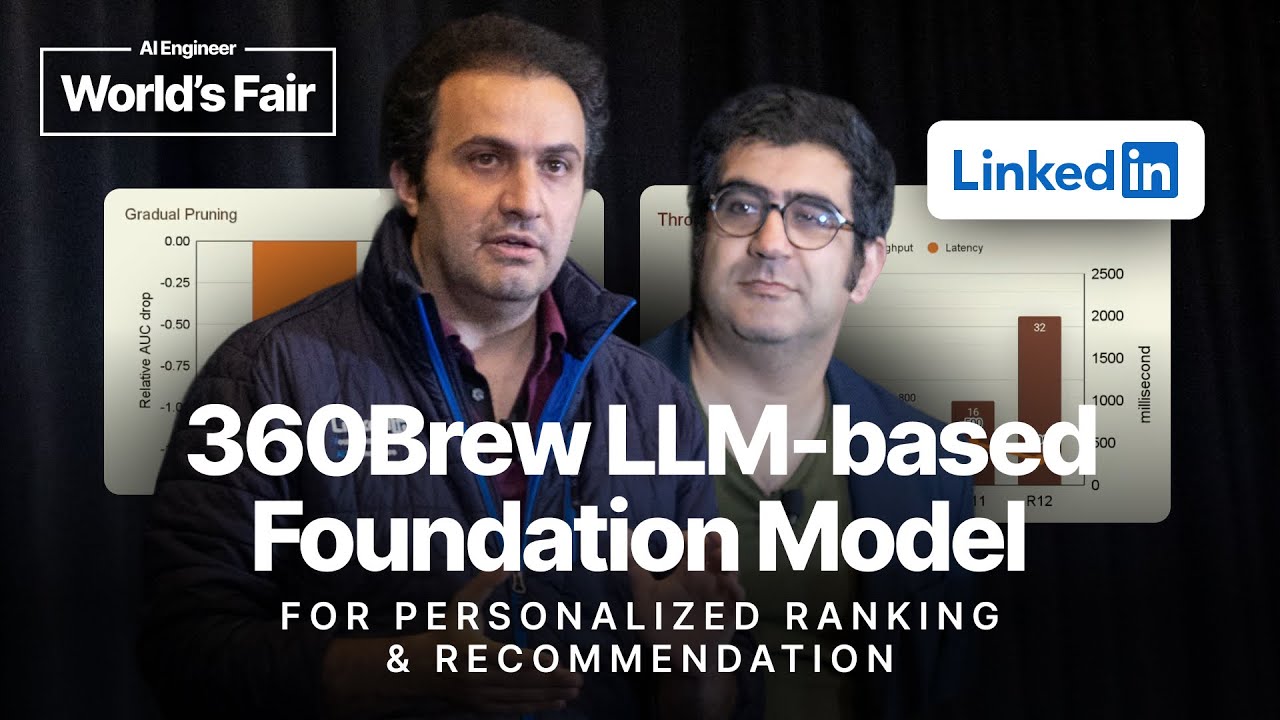
360Brew: LLM-based Personalized Ranking and Recommendation - Hamed and Maziar, LinkedIn AI
Jul 16, 2025 · 22:00
LinkedIn AI's Hamed Firooz and Maziar Sanjabi present BrewXL, a 150-billion-parameter foundation model for ranking and recommendation that personalizes the platform's feeds, jobs, and search. They show that training a large model then distilling to a 3B model outperforms training a small model from scratch. Scaling data, model size (from 7B to 8x22B), and context length all improve performance, though context beyond the trained length degrades accuracy. The model achieves zero-shot generalization on out-of-domain tasks, matching or beating task-specific production models, and significantly reduces the cold-start gap for users with fewer than five interactions. For serving, they combine gradual pruning, mixed-precision quantization (FP8 for most layers, FP32 for the LM head), and 4D attention masks to score up to 500 items without cross-attention, yielding a 7X latency reduction and 30X throughput increase per GPU.

Recsys Keynote: Improving Recommendation Systems & Search in the Age of LLMs - Eugene Yan, Amazon
Jul 16, 2025 · 20:54
Eugene Yan's keynote presents three innovations for recommendation systems: Semantic IDs, LLM-augmented data, and unified models. Kuaishou’s trainable multimodal Semantic IDs increased cold-start coverage by 3.6% and velocity by 3.5% by clustering content embeddings. Indeed used GPT-4 fine-tuning and distillation to filter bad job recommendations, reducing bad recs by 20% while boosting application rate 4% and cutting unsubscribes 5%. Spotify’s LLM-generated exploratory search queries drove a 9% increase in exploratory queries for new categories like podcasts. Netflix’s Unicorn unified ranker matched or exceeded specialized models across search and recommendations, while Etsy’s unified embeddings with a quality vector achieved a 2.6% sitewide conversion lift and 5% more search purchases.
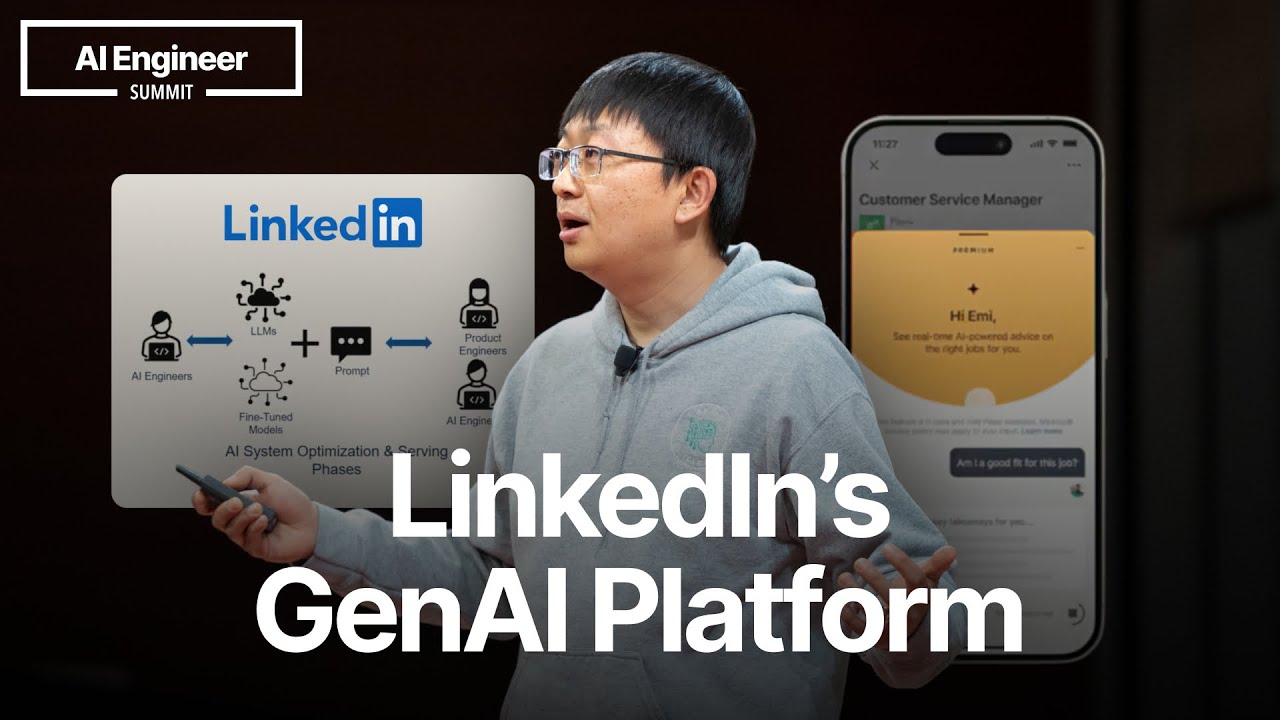
Building LinkedIn's GenAI Platform — Xiaofeng Wang
Apr 16, 2025 · 17:53
Xiaofeng Wang, manager of LinkedIn's GenAI Foundation, explains the evolution of LinkedIn's GenAI platform from simple prompt-in string-out applications to a multi-agent system for LinkedIn Hire Assistant, arguing that a unified platform is critical for bridging the gap between AI and product engineers in the era of compound AI systems. He details the platform's four-layer architecture—orchestration, prompt engineering, tools/skills invocation, and memory management—and key investments like a Python SDK, centralized skill registry, experiential memory across working, long-term, and collective layers, and observability built on OpenTelemetry. Wang discusses hiring philosophy: prioritize strong software engineers over AI expertise, hire for potential, and build diverse teams integrating full-stack engineers, data scientists, and AI engineers. He recommends solving immediate needs first, leveraging existing scalable infrastructure like messaging systems for memory, and focusing on developer experience to drive adoption.

Reverse Conway's law and GenAI: How agents will take over the organisation - Patrick Debois
Feb 22, 2025 · 28:12
Patrick Debois argues that generative AI will reverse Conway's law, reshaping organizations around agents instead of human teams. He traces a progression from AI as a copilot to a team member, then a peer, and eventually a manager, with each stage unbundling human tasks and shrinking team sizes. Debois cites Amazon's AI pricing glitch as a reminder that humans remain needed for failure cleanup, and notes that LLMs mimic human collaboration behaviors, as shown in a multi-agent simulation. He warns of agent toxic behavior and the need for guardrails akin to human codes of conduct, while speculating that companies may replace SaaS with internally built AI services, making performance reviews and ROI calculations for agents inevitable. Debois advises engineers to focus on building the AI that builds their current work, not the work itself.

GraphRAG: The Marriage of Knowledge Graphs and RAG: Emil Eifrem
Aug 28, 2024 · 19:15
Emil Eifrem, Neo4j co-founder and CEO, argues that GraphRAG—combining knowledge graphs with vector search—significantly improves RAG application accuracy, ease of development, and explainability. Citing studies, he reports accuracy gains of 3x (Data.org), 75-77% (LinkedIn), and Microsoft's finding that GraphRAG enables answering entirely new question types. He demonstrates Neo4j's Knowledge Graph Builder, which auto-generates graphs from PDFs, Wikipedia, and YouTube, making graph creation accessible. Eifrem frames this as the next evolution in search after PageRank and Google's knowledge graph, urging developers to adopt GraphRAG for richer context and better AI outcomes.
Powered by PodHood