
LangChain
CompanyA company discussed on AI Engineer.
4 episodes

Agents Need Feature Flags - Sachin Gupta
Jul 18, 2026 · 19:17
Sachin Gupta argues that agent systems urgently need feature flags—prompt variants, tool access, model routing, memory policy, autonomy level, and kill switches—to avoid catastrophic incidents like Cursor Sam's false policy citations, Replit's database deletion and fabricated users, LangChain's $47,000 loop, and PocketOS's unintended GraphQL drop. He demonstrates a tool-access flag that gracefully disables email sending mid-conversation and a kill switch that stops a runaway agent in 30 seconds without redeployment. Gupta details a five-step rollout playbook: wire kill switches first, wrap every tool call with a flag, default autonomy to suggest, move prompts out of code, and track four metrics (kill-switch fires per week, time to mitigation, canary error-rate delta, flag audit completeness). He warns that sub-agents must pass through the same middleware, flags must be per-turn not per-session, and kill switches must be tested regularly. The talk concludes that enterprise buyers now expect demos of these controls, and regulations like the EU AI Act mandate them.
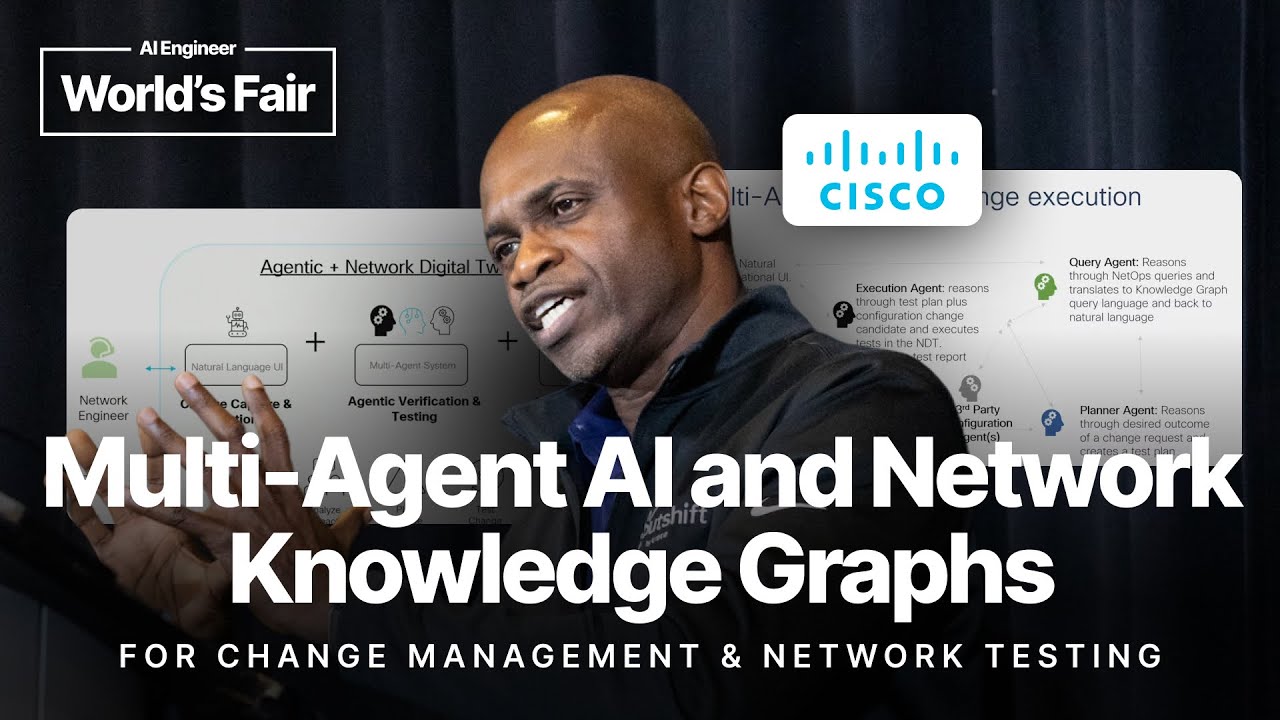
Multi Agent AI and Network Knowledge Graphs for Change — Ola Mabadeje, Cisco
Aug 22, 2025 · 18:49
Ola Mabadeje from Cisco's Outshift presents a multi-agent AI system that combines network knowledge graphs with natural language interfaces to improve change management. The solution ingests data from ITSM tools like ServiceNow, uses five specialized agents built on an open framework (agency.org) to automate impact assessment, test planning, and execution within a digital twin. A fine-tuned query agent reduces token usage and latency when querying the ArangoDB knowledge graph, layered using OpenConfig schema. The demo shows agents collaborating to assess a firewall rule change, generate test cases, and run them on a synthetic network, attaching results back to the ticket. Early evaluations focus on extrinsic metrics tied to customer outcomes, with the knowledge graph and open agent framework as key building blocks for scalable network operations.
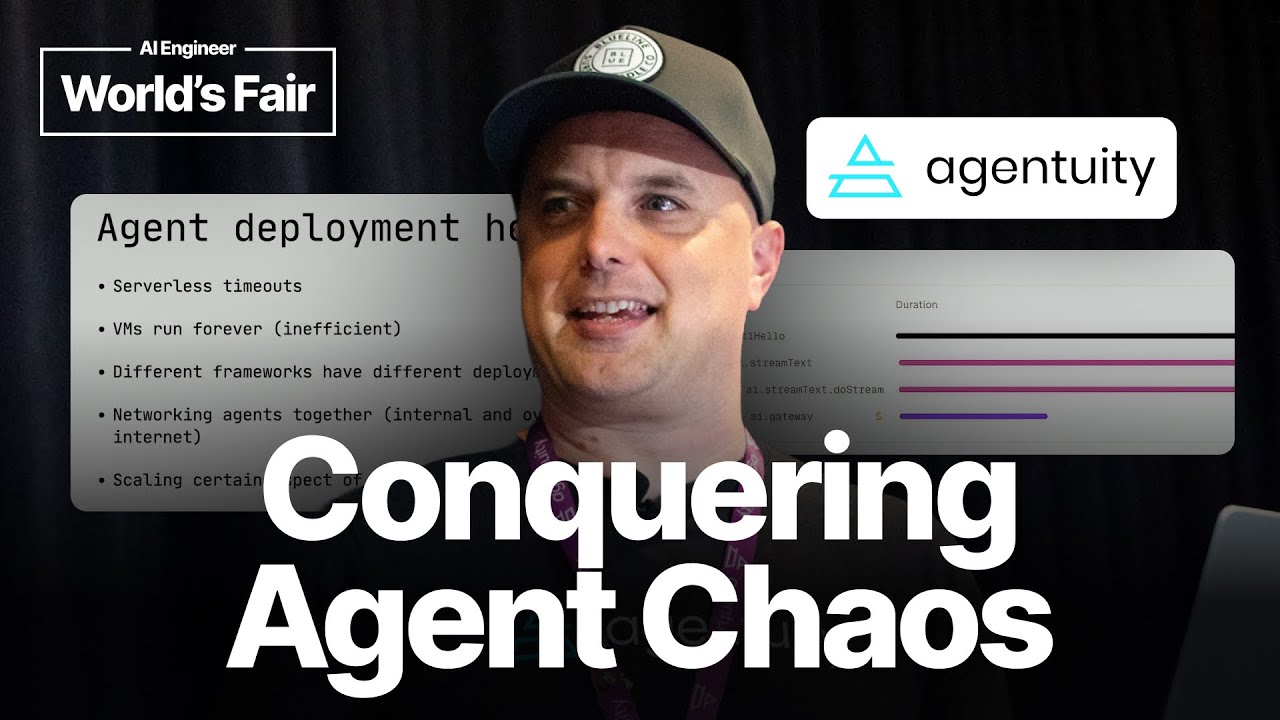
Conquering Agent Chaos — Rick Blalock, Agentuity
Jul 1, 2025 · 14:40
Rick Blalock, founder of Agentuity, argues that deploying AI agents remains the number one headache for developers, citing common issues like serverless timeouts (agents running 15–30 minutes), statelessness, and networking complexities. He demonstrates Agentuity’s platform, which treats agents as first-class infrastructure citizens: users scaffold projects via a CLI (supporting Bun, Python/UV, Node.js), write a simple request handler, and deploy with automatic routing, tunneling, and a built-in AI gateway that tracks costs per run. The platform decouples inputs and outputs—agents can be triggered via email, SMS, webhooks, or cron—and provides human and agent-facing telemetry via OTel tracing. Blalock notes Agentuity already hosts 50–60 internal agents and is building infrastructure agents to replace tools like PagerDuty, with plans to add Slack/Discord integrations and service-level reasoning capabilities.

Architecting and Testing Controllable Agents: Lance Martin
Oct 11, 2024 · 2:21:54
Lance Martin presents LangGraph, a graph-based framework for building controllable agents that trade some open-ended flexibility for significantly higher reliability compared to classic React agents, achieving 100% consistent tool-calling trajectories even with an 8B local model. He demonstrates self-corrective RAG patterns like Corrective RAG, SelfRAG, and Adaptive RAG, where the agent grades retrieved documents, checks for hallucinations, and routes to web search when needed. Martin also covers three testing loops: in-app error handling with LangGraph, pre-production evaluation using LangSmith to compare agent answers and tool trajectories against ground-truth datasets, and production monitoring with online evaluators that flag retrieval quality, answer relevance, and hallucinations without reference answers. He shares results from a five-question evaluation showing LangGraph agents achieve 80% answer accuracy and 100% tool-trajectory correctness with Fire Function V2, while React agents with GPT-4o degrade in tool reliability. The talk addresses practical concerns like handling many tools (suggesting RAG for tool selection), multi-turn conversations, and the importance of…
Powered by PodHood