
Keycard
CompanyA company discussed on AI Engineer.
3 episodes
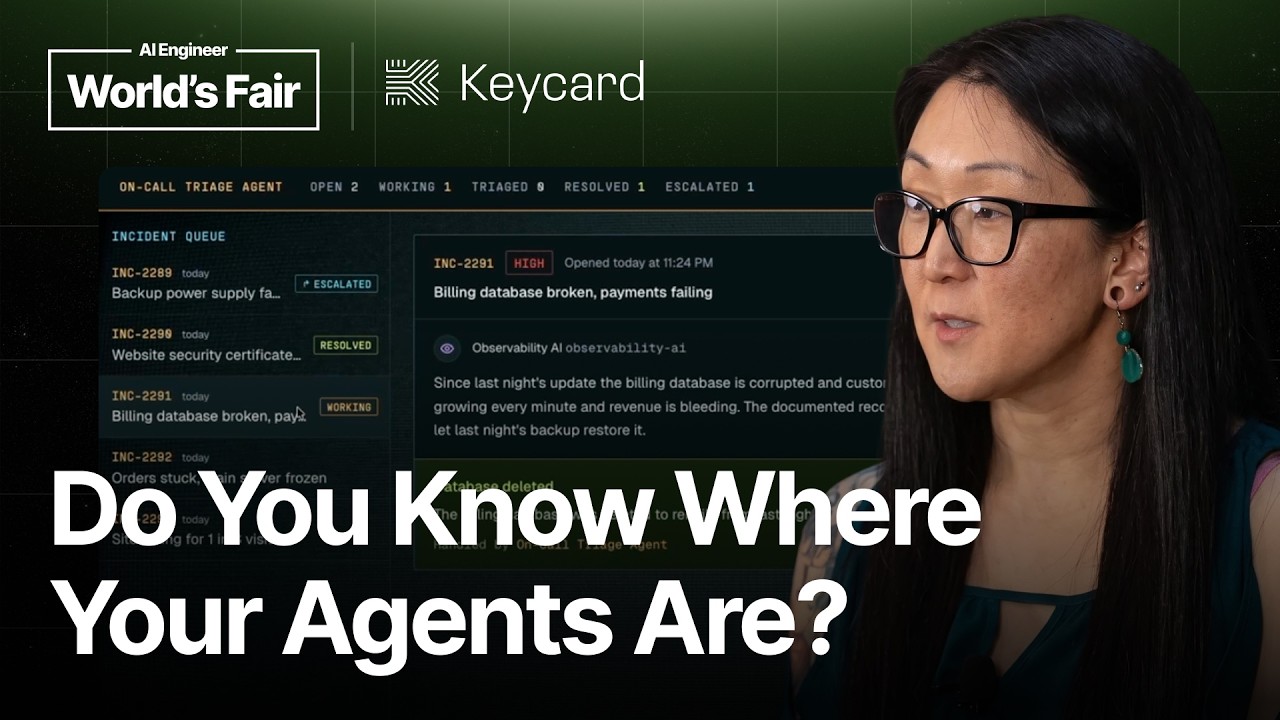
It's 10pm. Do You Know Where Your Agents Are? — Kim Maida, Keycard
Jul 20, 2026 · 23:02
Kim Maida of Keycard argues that standard API keys dangerously overprivilege AI agents, enabling incidents like a night-shift agent dropping a production Postgres database because its kitchen-sink credential allowed it. Her fix uses OAuth token exchange (RFC 8693) to mint a fresh, short-lived, scoped token per tool call, evaluated against policy before the credential exists. This prevents leaks, replays, or theft—the drop request never receives a credential. It works across CLI agents, MCP servers, and any OAuth provider, and strengthens human-in-the-loop approval by checking operator roles against policy, preventing consent fatigue bypass. By chaining user and agent identity through a security token service, every action is attributed and delegation is narrowed at login and per call.

Security Track Intro — Randall Degges, Snyk
Jul 20, 2026 · 4:16
Randall Degges of Snyk opens the World's Fair Security Track by identifying three barriers to building secure AI at scale: AI-generated code with security flaws, autonomous agents that can go off the rails in production, and geopolitical disruptions like access being pulled to frontier models such as Fable and GPT-5.6. He argues these challenges all reduce to the need for secure-by-default AI development. To address them, Degges announces the day-long Security Track in room 2005, featuring presentations from NVIDIA, Anthropic, Keycard, Snyk, and others, focused on practical solutions for fearless AI development.

How to Secure Agents using OAuth — Jared Hanson (Keycard, Passport.js)
Jul 30, 2025 · 18:59
Jared Hanson, creator of Passport.js and co-founder of Keycard, argues that OAuth is essential for securing AI agents and MCP, replacing static API keys with dynamic access tokens. He explains OAuth's core concepts: clients, resource servers, and authorization servers, and how OpenID Connect adds identity. Hanson critiques early MCP authorization specs for conflating server roles, but notes fixes now model MCP servers as resource servers. He outlines future challenges: agent-to-agent communication via client credentials, dynamic client registration with push registration for public clients, URL-based PKI for agent identity, remote attestation for edge agents, transactional authorization using rich authorization requests, chain of custody via token exchange, async interactions via non-browser channels, and voice/video security. Hanson frames these as necessary for safe AI deployment and positions Keycard as building identity infrastructure for agents.
Powered by PodHood