
IBM
CompanyA company discussed on AI Engineer.
9 episodes

Structuring the Unstructured - Cedric Clyburn, Red Hat
Jun 28, 2026 · 20:41
Cedric Clyburn (Red Hat) demonstrates how Docling, an open-source tool from the Linux Foundation, converts unstructured documents like PDFs, tables, and images into structured formats (Markdown/JSON) for AI workflows. He shows that naive PDF parsers lose table structure and image content, while proprietary VLMs are expensive and non-deterministic. Docling uses OCR and layout analysis to preserve context, achieving 50x cost savings compared to VLMs on CPU. The demo covers extracting tables and images from an 8-page PDF, using a local Granite vision model for image annotation, and implementing chunkless RAG where an LLM queries a Docling document outline directly. Scaling is addressed via Docling Serve (REST API) and Docling MCP server for agentic document processing with tools like Claude Code.
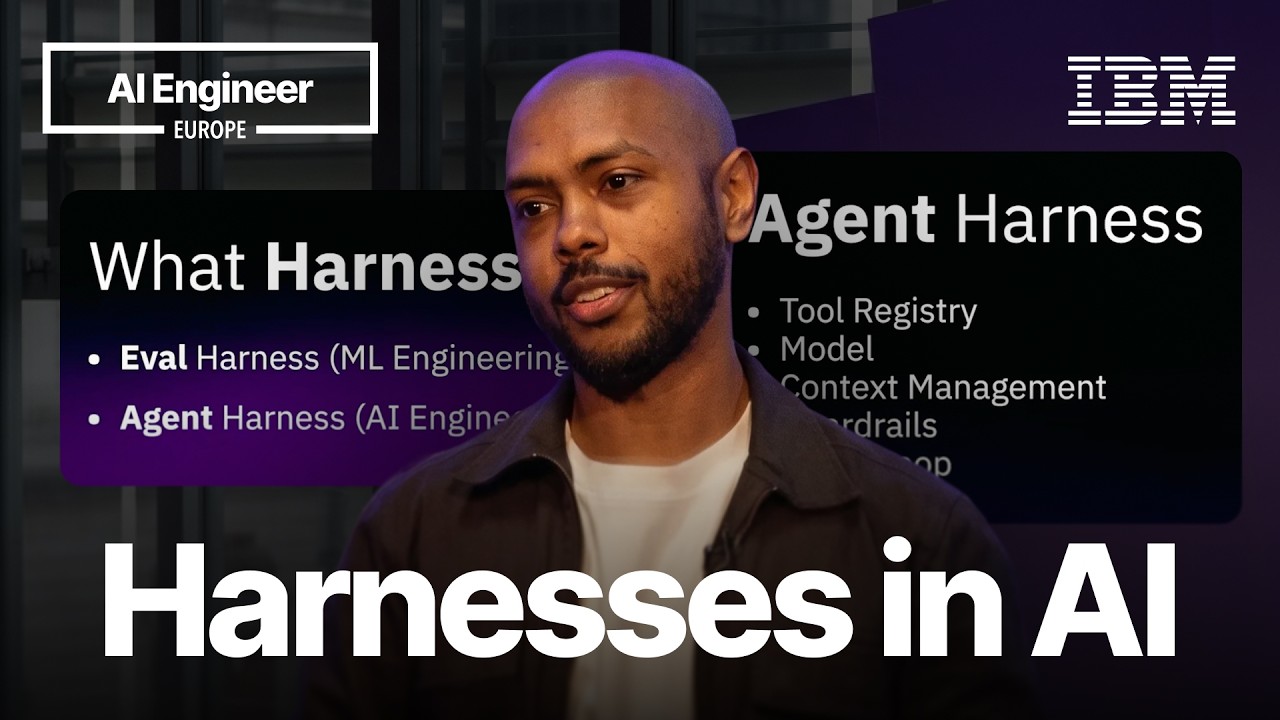
Harnesses in AI: A Deep Dive — Tejas Kumar, IBM
May 17, 2026 · 20:27
Tejas Kumar, AI Developer Advocate at IBM, defines an AI harness as everything around the model that grounds it in reality, contrasting it with an agent loop. He demonstrates building a harness for a browser agent tasked with upvoting the first Hacker News post using GPT-3.5 Turbo, emphasizing that the prompt remains unchanged. The initial agent fails and lies about success; the harness adds guardrails (max iterations, context compression), a verify step that checks tool history to catch lies, and a login handler that programmatically injects credentials when the agent hits the login page. The final agent reliably logs in and upvotes. Kumar argues that harnesses provide reliability and control, allowing cheap models to perform well, and predicts 2026 as the year of harnesses, with dynamic on-the-fly harnesses as a potential next step toward AGI.

Two Roads to Durable Agents: Replay vs. Snapshot — Eric Allam, CEO, Trigger.dev
May 10, 2026 · 16:36
Eric Allam, CEO of Trigger.dev, argues that durable agents require two separate strategies: context durability via an append-only log of LLM interactions, and execution durability via OS-level snapshot and restore. He contrasts this with the replay model, which wraps every step in a journal but becomes unwieldy as agents run for hours. Trigger.dev built snapshot-and-restore on Firecracker microVMs, achieving snapshots as small as 14 MB compressed with sub-second save and hundred-millisecond restore times. The approach preserves files, memory, and subprocesses that a journal cannot capture. Allam notes that IBM mainframes in 1966 pioneered checkpointing, and that Trigger.dev will open-source the tool as FCRun.
How AI is changing Software Engineering: A Conversation with Gergely Orosz, @pragmaticengineer
Apr 21, 2026 · 26:42
Gergely Orosz explains how AI is reshaping software engineering, from token maxing at Meta, Microsoft, and Salesforce—where engineers use AI tools to inflate token counts out of fear of layoffs and performance reviews—to the broader shift in the engineer's role toward orchestrating agents rather than managing people. He notes that big tech companies like Uber, Airbnb, and Shopify are building custom internal AI infra (MCP gateways, coding agents) to stay ahead, even tolerating high churn for a six-month competitive edge. Shopify secured GitHub Copilot a year early by offering feedback from 3,000 engineers. Gergely also shares how The Pragmatic Engineer hit product-market fit: 100 paid subscribers before publishing, reaching 1,000 in six weeks, and becoming the #1 paid tech newsletter by focusing on two deep-dive articles per week for two years.
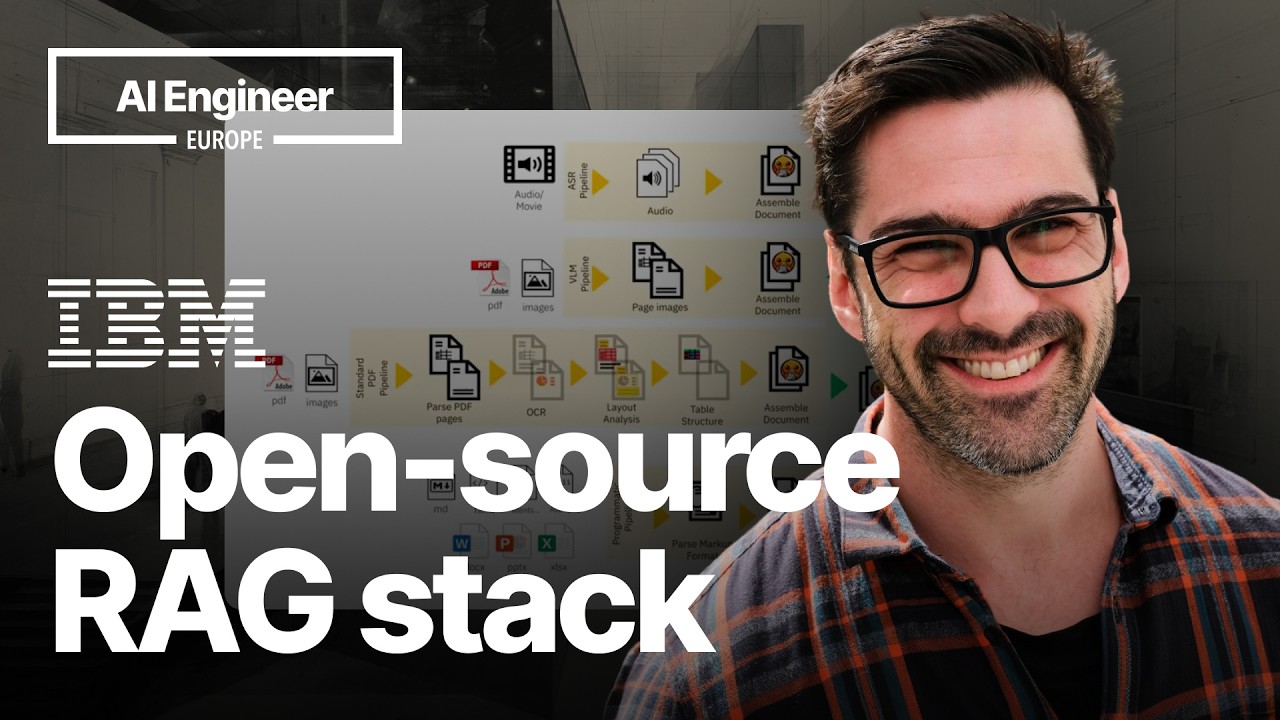
OpenRAG: An open-source stack for RAG — Phil Nash
Apr 8, 2026 · 15:52
Phil Nash introduces OpenRAG, an open-source RAG stack from IBM combining Docling, OpenSearch, and Langflow, arguing that RAG remains hard and custom despite claims it's dead — every business has unique data requiring more than simple vector search. Docling parses PDFs, audio, and more with specialized pipelines, outputting hierarchically chunked text. OpenSearch provides hybrid vector and keyword search using JVector for live indexing and disk-based ANN. Langflow enables visual agentic retrieval where the LLM decides searches with tools like a calculator and MCP servers. The stack supports local models via Ollama, cloud connectors for Google Drive and SharePoint, and an API. Nash demonstrates adding guardrails in Langflow and invites contributions to the open project.

Strategies for LLM Evals (GuideLLM, lm-eval-harness, OpenAI Evals Workshop) — Taylor Jordan Smith
Jul 27, 2025 · 32:28
Taylor Jordan Smith from Red Hat presents a hands-on workshop on evaluating large language models (LLMs) for production, using three open-source tools: GuideLLM for system performance benchmarks (latency, throughput), lm-eval-harness for factual accuracy via MMLU Pro, and promptfoo for safety and bias custom evaluations. He argues that traditional benchmarks are insufficient and advocates for a layered evaluation pyramid—starting with system performance, then factual accuracy, then safety/bias—taking an incremental approach similar to software testing (unit, integration, end-to-end). He demonstrates deploying an IBM Granite 2B model with vLLM on an L4 GPU, showing how to adjust input/output tokens for use cases like chatbots or RAG. The episode emphasizes that evaluations must be tailored to the specific system (RAG, agents, etc.) and continuously integrated into CI/CD pipelines to manage risk, cost, and reliability in production. Attendees gain actionable strategies for custom eval suites and human-in-the-loop feedback.
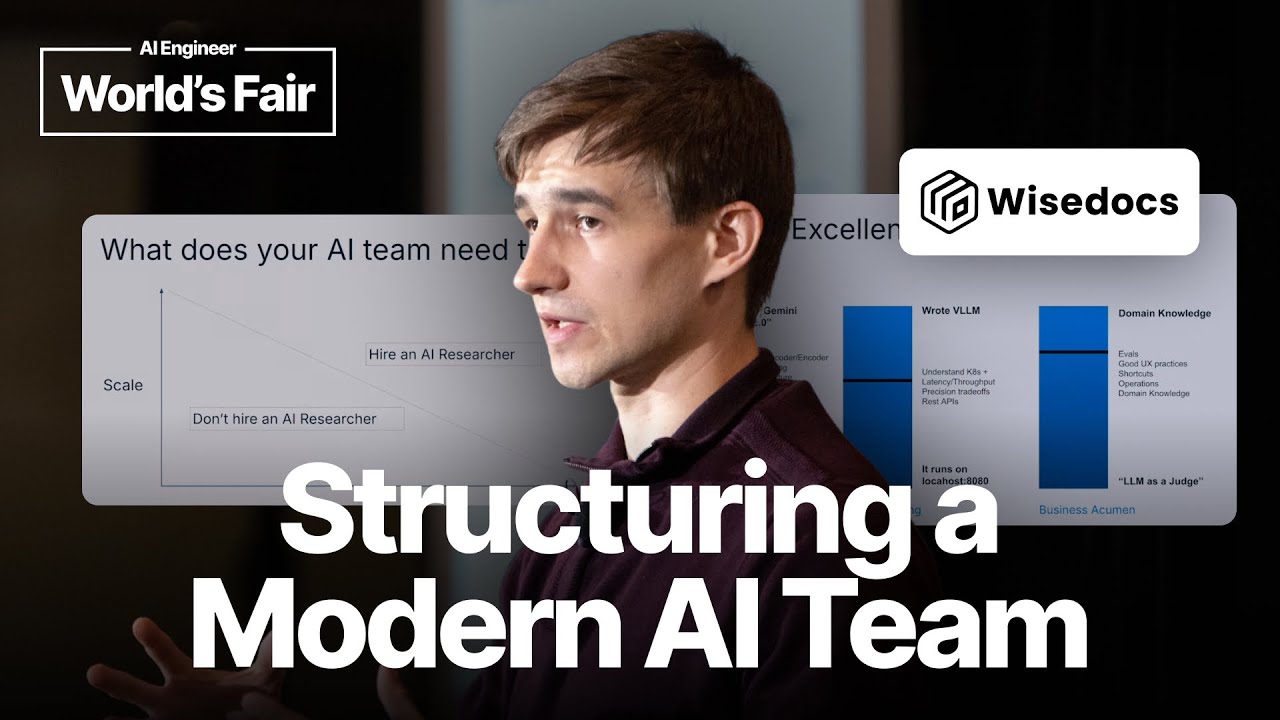
Structuring a modern AI team — Denys Linkov, Wisedocs
Jul 24, 2025 · 17:40
Denys Linkov, who leads ML at Wisedocs, argues that building a modern AI team hinges on identifying your company's bottleneck—shipping features, acquiring users, or scalability—rather than reflexively hiring AI researchers. He introduces Ampere's Wager: trading your entire domain-savvy team for five top-lab researchers is usually a losing bet. For early-stage AI strategy, generalists who blend model training, serving, and business acumen outperform specialists; Linkov lived this in 2021 building a custom MLOps platform for a conversational AI startup and again in 2024 using advanced open-source tools for medical record processing. He stresses reskilling existing teams through weekly learning cadences and moving domain experts from giving feedback to writing evaluations. Hiring should hold context and act on it, verifying trends like 'don't hire juniors' against YC's AI school drawing 2,000 young people.

The Bitter Layout or: How I Learned to Love the Model Picker — Maximillian Piras, Yutori
Jul 21, 2025 · 14:24
In this talk, Maximillian Piras argues that conversational interfaces remain dominant in AI apps not because they are natural, but because they are 'conformable' — able to absorb the next model's capabilities without redesign. He calls this pattern 'The Bitter Layout': an input field, turn-by-turn flow, and a model picker, which prioritizes flexibility over usability. Applying Clayton Christensen's theory of commoditization, Piras claims that as long as scaling laws keep models from commoditizing, the interface itself is the commodity, and designers must conform to the next model. He traces the debate over chat UX from Linus Lee (2022) to Julian Lear (2024), and criticizes the model picker as a 'mode selector' that creates usability issues. Looking ahead, Piras suggests designers shift from procedural thinking to setting goals and constraints, and speculates that future AI UX will be 'grown' like a garden rather than built.

Tool Calling Is Not Just Plumbing for AI Agents — Roy Derks
Feb 22, 2025 · 25:18
Roy Derks argues that tool calling is the most critical yet overlooked component of AI agents, far more than mere 'plumbing.' He contrasts traditional tool calling—where developers manually manage callbacks, retries, and errors within the agent loop—with embedded tool calling, a black-box approach used by frameworks like LangChain’s createReactAgent. Derks advocates for separation of concerns via the Model Context Protocol (MCP) from Anthropic, which splits tool logic into MCP servers communicating with clients, and via standalone tool platforms such as IBM’s wxflows, Composio, and Toolhouse that let teams build tools once and reuse them across LangChain, CrewAI, or AutoGen. He also introduces dynamic tools, where an agent generates queries on the fly—e.g., using GraphQL or SQL schemas—instead of defining hundreds of static tools, noting that LLMs like Claude handle GraphQL well but may hallucinate on deeply nested schemas. The episode emphasizes that 'an agent is only as good as its tools' and provides practical guidance on designing tool descriptions (which act like system prompts) and output schemas to enable type-safe, chainable tool calls.
Powered by PodHood