
Grok
CompanyA company discussed on AI Engineer.
3 episodes
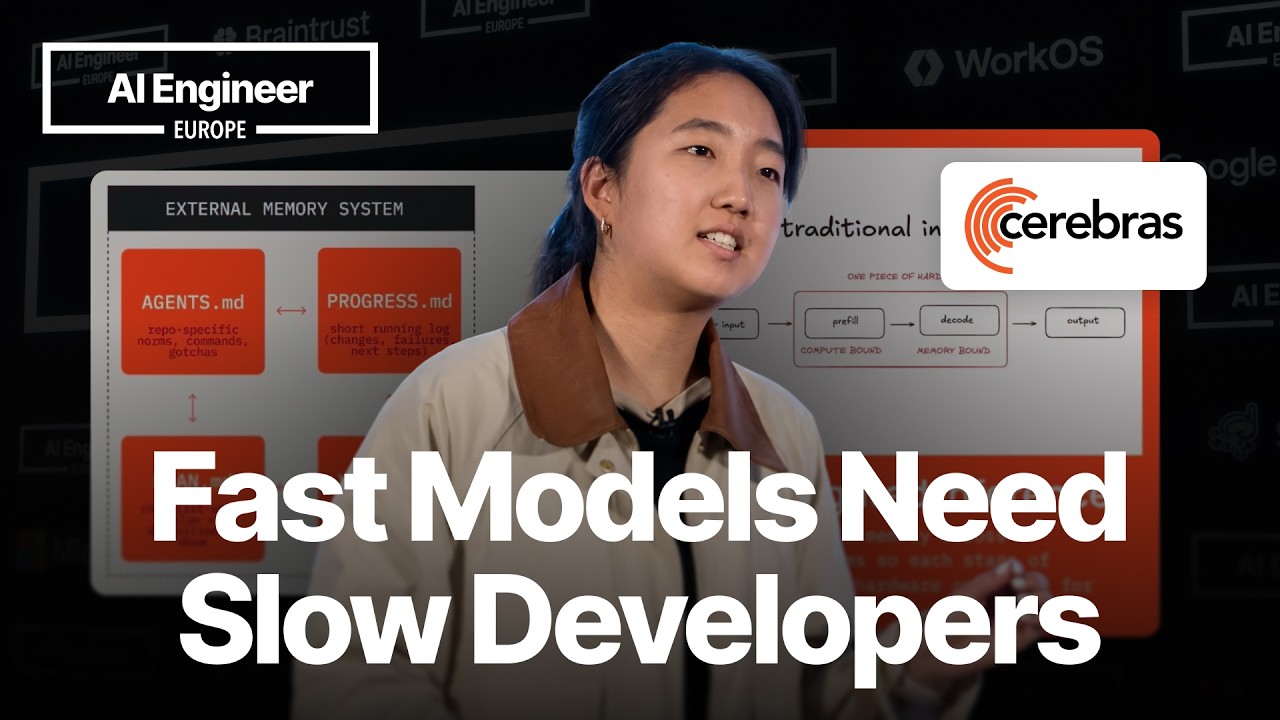
Fast Models Need Slow Developers — Sarah Chieng, Cerebras
May 22, 2026 · 18:02
Sarah Chieng from Cerebras argues that the 20x speed increase of models like Codex Spark (1,200 tokens/sec vs. 40-60 for Sonnet/Opus) forces developers to rethink workflows, or risk generating technical debt at unprecedented scale. She presents a practical playbook: validation and linting become free at every step, so must run continuously; developers can generate 75 component variations across five sub-agents and cherry-pick the best; and with context filling in 30 seconds instead of ten minutes, a four-file external memory system (agents, plan, progress, verify) maintains continuity between sessions. Chieng emphasizes real-time collaboration with the model rather than spawning agents and walking away, and advocates using a slower planner model with a fast executor to orchestrate agents effectively.

Dream Machine: Scaling to 1m users in 4 days — Keegan McCallum, Luma AI
Jul 19, 2025 · 19:03
Keegan McCallum, Head of ML Infrastructure at Luma AI, details how the company's Dream Machine model scaled from 500 to 9,000 H100 GPUs within hours to handle 1 million users in four days, outpacing ChatGPT's initial growth. He explains that their initial Triton inference server setup was brittle and ill-suited for multi-GPU, multi-node video models, prompting a re-architecture to a custom serving stack on vanilla PyTorch. To solve work starvation across user tiers, they implemented an SLO-based aging system that ranks jobs by the percentage of their worst-case wait time elapsed. For managing dozens of model versions, they store immutable full Python environments and checkpoints in object storage, with a YAML file controlling active deployments and enabling zero-downtime rollouts across thousands of GPUs. McCallum also discusses partnerships with Nvidia, AMD, and Grok, and how Luma's broader mission is to build general multimodal intelligence that generates, understands, and operates in the physical world.
Lessons from building GenAI based applications — Juan Peredo
Feb 22, 2025 · 33:13
Juan Peredo details the hidden complexities of building GenAI applications, from model hosting and cost control to output validation and observability. He compares local (Ollama) vs cloud hosting (Modal, SkyPilot) and warns that an agent processing 3,000 calls/day with OpenAI O1 costs nearly $300,000/month, while LLaMA 3.3 70B drops that to $50,000/month. He explains techniques to mitigate hallucinations—prompt engineering, guardrails, RAG, and fine-tuning—each with trade-offs like added latency or cost. Peredo advocates externalizing prompts via LangChain Hub for easy iteration and future-proofing, and illustrates agent design with parallel calls to reduce latency. Finally, he stresses observability using tools like LangSmith to debug probabilistic failures, such as an LLM failing on case sensitivity.
Powered by PodHood