
Gartner
CompanyA company discussed on AI Engineer.
4 episodes
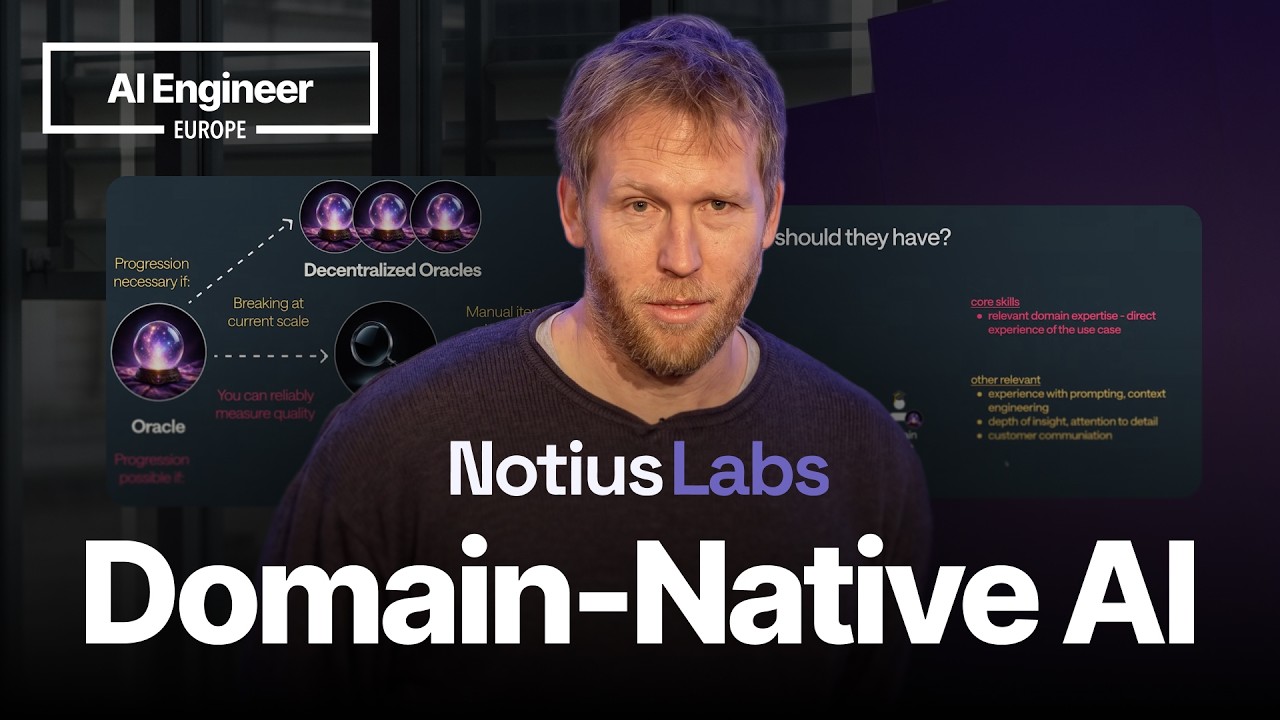
How to Leverage Domain Expertise — Chris Lovejoy, Notius Labs
May 16, 2026 · 24:45
Chris Lovejoy argues that winning in vertical AI is an organizational problem solved by domain experts acting as Oracle (directly improving AI), Evaluator (defining metrics for engineers), or Architect (building self-improving systems). Granola's first employee, a writer, reviews meeting notes and tweaks prompts as an Oracle because there is no objectively perfect note. Tandem used decentralized Oracles—doctors per specialty and country—to handle variation in medical scribe outputs. Anteria progressed from Oracle to Evaluator to Architect as prior authorization required measurable correctness and automated learning from usage variation. Lovejoy advises hiring a principal domain expert early, giving them ownership, and hiring for breadth (domain expertise plus adjacent skills like data science or engineering) to avoid slow progress and turnover.

Connecting the Dots with Context Graphs — Stephen Chin, Neo4j
May 16, 2026 · 17:39
Stephen Chin of Neo4j argues that retrieval alone is insufficient for AI systems, because context graphs—which store relationships, reasoning traces, and decision provenance—enable grounded, auditable answers. He demonstrates with a healthcare example where a generic RAG system returns generic advice while a graph-grounded system knows the patient smokes and has had surgery, tailoring recommendations. The episode walks through Lenny’s Podcast memory demo and a financial services loan-decision app that surfaces prior rejections, margin trades, and fraud risk patterns, making the graph traversal visible. Chin notes Gartner has placed context graphs on the AI hype cycle and Foundation Capital called them a $3 trillion startup opportunity. Neo4j’s open-source agent memory package (short‑term, long‑term, reasoning memory) powers these context graphs, aiming to help engineers escape fragmented enterprise data and build explainable, policy‑aware AI.

Practical GraphRAG: Making LLMs smarter with Knowledge Graphs — Michael, Jesus, and Stephen, Neo4j
Jul 22, 2025 · 19:46
Michael Hunger and Stephen Chin of Neo4j present GraphRAG as a method to enhance LLMs by integrating knowledge graphs, achieving more accurate, contextual, and explainable answers than standard RAG. They highlight limitations of vector search, showing GraphRAG improves relevance and reduces hallucinations. They detail a three-step construction process: lexical graphs, entity extraction, graph enrichment with algorithms. They demonstrate open-source tools like Neo4j Knowledge Graph Builder and GraphRAG Python package, and show an agentic approach using domain-specific retrievals. They cite studies showing three times improvement in accuracy.

Anchoring Enterprise GenAI with Knowledge Graphs: Jonathan Lowe (Pfizer), Stephen Chin (Neo4j)
Apr 7, 2025 · 20:59
Stephen Chin (Neo4j) and Jonathan Lowe (Pfizer) explain how Pfizer uses knowledge graphs with GraphRAG to accelerate drug manufacturing technology transfer, cutting time from years to weeks. They argue graph databases provide superior accuracy and explainability over vector-only RAG, crucial for life-saving drugs. Jonathan details navigating organizational silos in a 100,000-person company, from C-suite taglines to client partners demanding cost savings. Gartner's prediction of 30% GenAI project failure is addressed with a concrete business case: manufacturing worker tenure plunged from 20 to 3 years, making AI essential to capture lost expertise. The architecture combines vector and graph retrieval to deliver contextually relevant, auditable answers, reducing data consolidation from three months to three weeks.
Powered by PodHood