
DeepMind
CompanyA company discussed on AI Engineer.
20 episodes
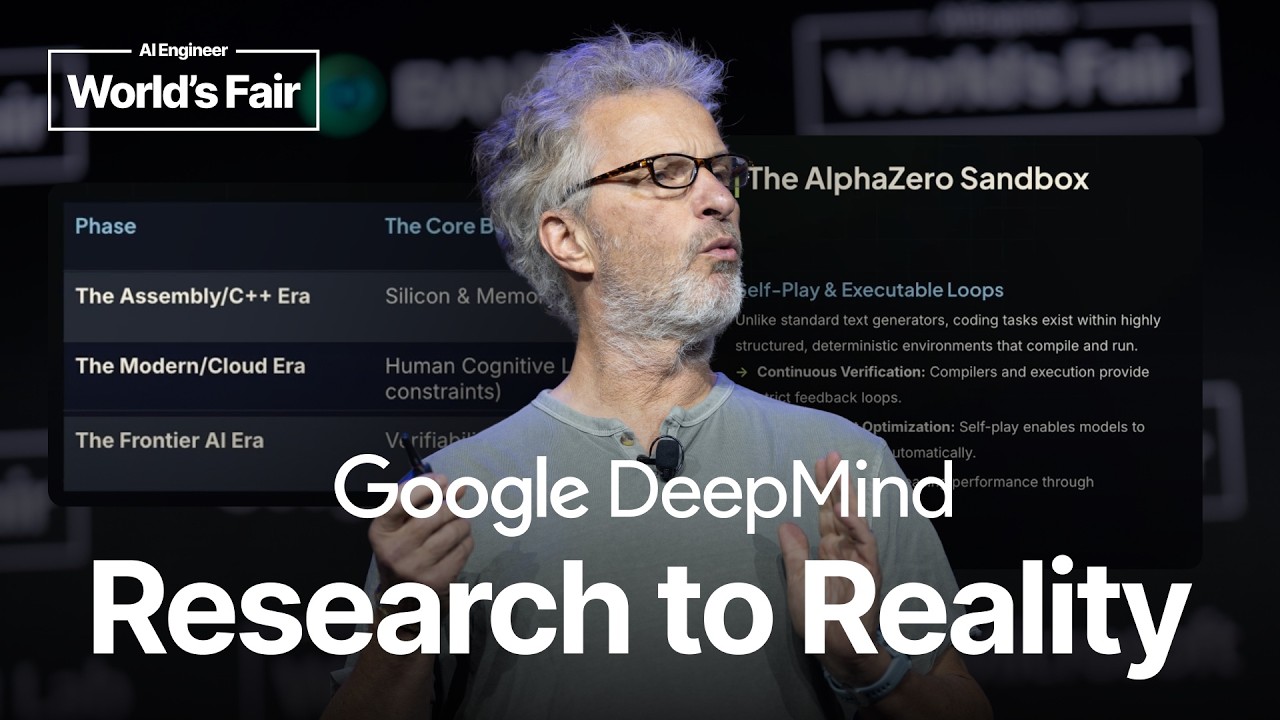
"Software engineering is not about writing code" — Benoit Schillings, Google DeepMind VP of Research
Jul 17, 2026 · 20:26
Benoit Schillings, VP of Technology at Google DeepMind, argues that the era of syntax generation is over, with AI now capable of superhuman code writing, shifting the bottleneck to architecture and validation. He explains that 80% of new code on GitHub is machine-generated, leading to a saturation of human training data and the need for self-play techniques inspired by AlphaZero. Schillings highlights DeepMind's use of self-play to generate and verify coding challenges, enabling models to reach superhuman performance. He emphasizes the shift to inductive architecture, where models must plan, decompose complex problems, and transfer knowledge across domains. Additionally, he calls for new programming languages designed for models rather than humans, and explores how AI's rapid experimentation will transform fields like chemistry and biology by uncovering patterns invisible to humans.
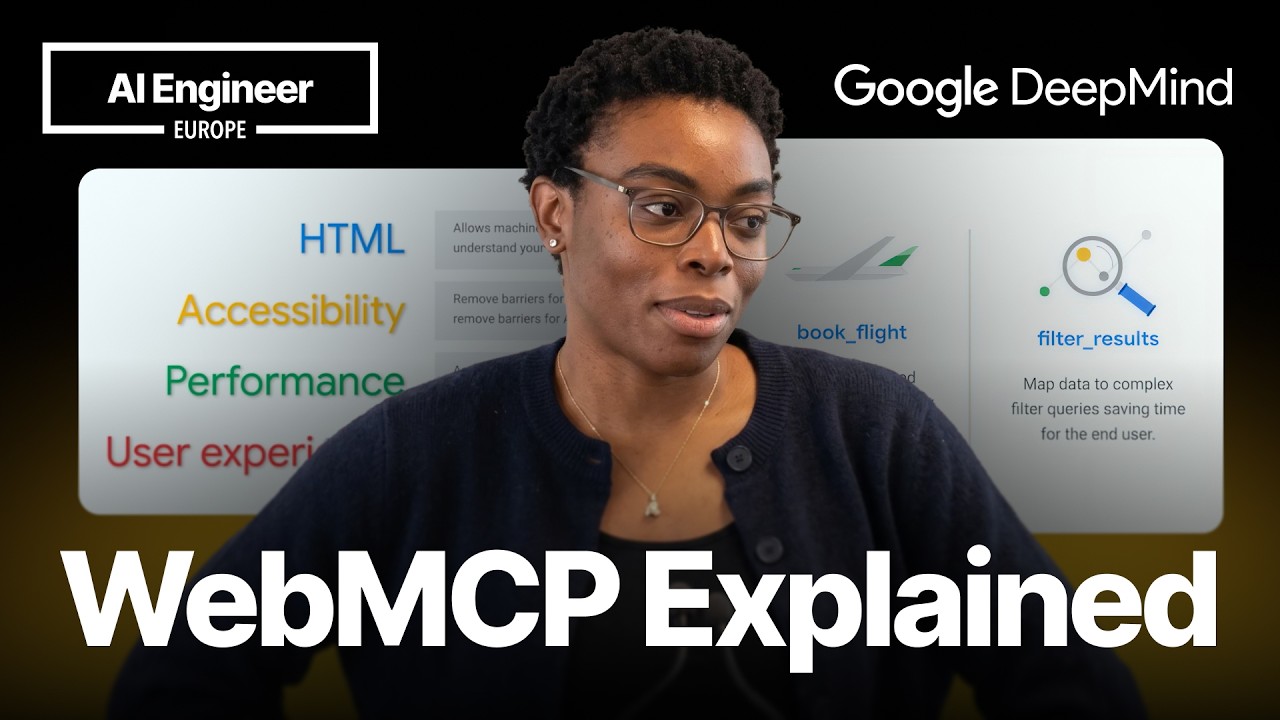
The agent-ready web: Simplify user actions with WebMCP — Tara Agyemang, Google
Jun 11, 2026 · 21:34
Tara Agyemang from the Google Chrome team introduces WebMCP, a proposed web standard that replaces brittle DOM scraping with structured tools for AI agents. She explains two implementation paths: the declarative API (adding HTML attributes to forms) and the imperative API (registering custom JavaScript tools). A live demo shows a concert ticket purchase completed in three tool calls: search, open page, purchase. WebMCP is in early preview on Chrome 146, with an eval CLI and inspector extension available for testing.

Text Diffusion — Brendan O’Donoghue, Google DeepMind
Jun 4, 2026 · 28:03
Brendan O'Donoghue, a research scientist at Google DeepMind, explains that text diffusion models generate tokens 10x faster than autoregressive models by performing 24 denoising steps to produce 256 tokens, dramatically reducing memory transfers. Unlike GPT-4o and Gemini 2.5 Flash, which incorrectly answered 40 and 42 on a math problem, Gemini Diffusion used bidirectional attention to self-correct from 60 to 49 to 39. The model adaptively allocates compute: 4 steps for memorized digits of π, 31 for quantum mechanics, and automatically stops when satisfied. Text diffusion also enables in-place editing, demonstrated by fixing code bugs or adding paragraphs. However, lower throughput on large batches makes it expensive to serve at scale today. O'Donoghue showcases low-latency applications: a fully generated Wikipedia, a Reddit clone with AI text and images, an on-the-fly operating system, and a to-do app built in 15 seconds by voice.
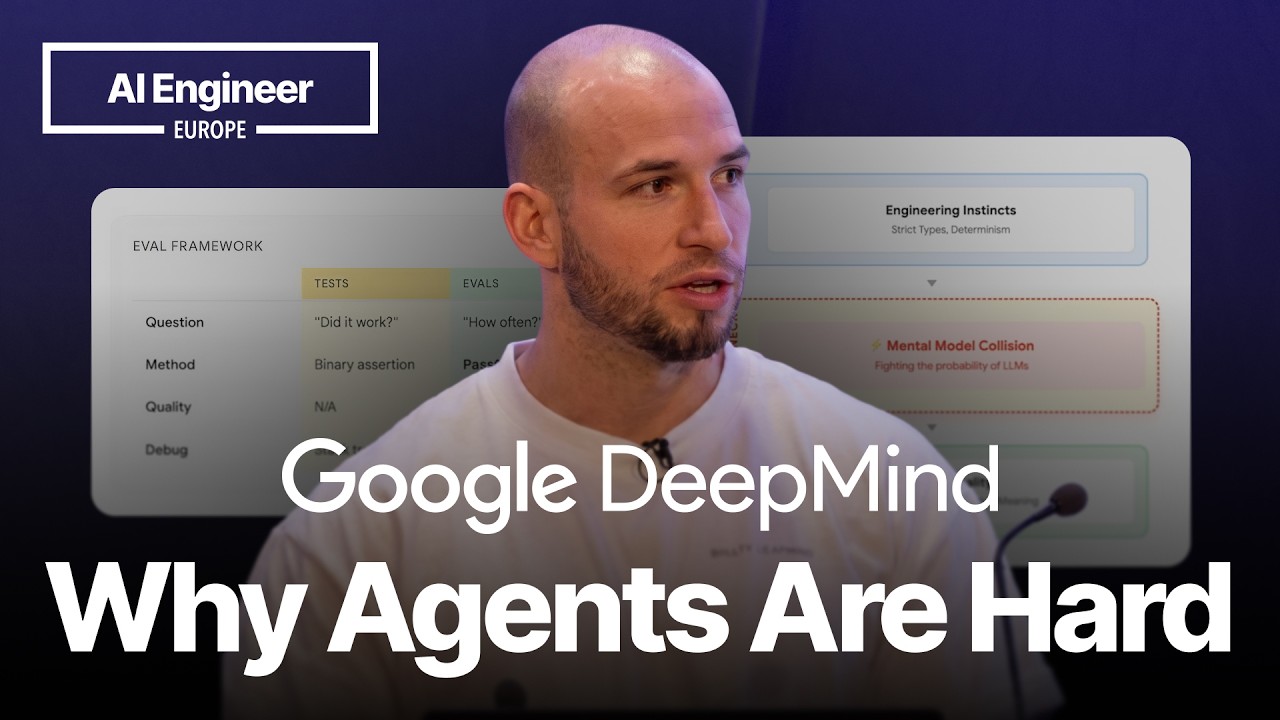
Why (Senior) Engineers Struggle to Build AI Agents — Philipp Schmid, Google DeepMind
May 30, 2026 · 10:40
Philipp Schmid from Google DeepMind argues that senior engineers struggle to build AI agents because they carry years of implicit context that agents don't, designing tools that assume it. He highlights five key shifts: text replaces structured state, so agents can handle semantic meaning like approving a research plan with additional input; errors are inputs, not restart triggers, since long-running agents (5-15 minutes) can't afford to start over; evals replace unit tests because agents are non-deterministic and success is measured by how often it works, not fixed outputs; and agents evolve while APIs don't, so tools like a `deleteItem` endpoint need agent-friendly docstrings because the agent only sees the schema. He advises to hand over control to the LLM, design for recovery, and build to delete since models improve rapidly.

From 46% to 90%: Fine-Tuning Tiny LLMs for On-Device Agents — Cormac Brick, Google
May 20, 2026 · 21:01
Google's Cormac Brick explains how developers can build on-device AI agents using either system-level Gemini Nano via AI Core or app-level custom models via LiteRT-LM. He demonstrates a skill harness built on Gemma 4 that enables agentic tasks like restaurant roulette, running fully on-device with JavaScript UI. For fine-tuned tiny models, Function Gemma at 270M parameters improved from 46% to over 90% accuracy on eight of ten app-intent functions after synthetic data fine-tuning. The talk also covers the Eloquent transcription app, which chains two Gemma 3-based models (ASR and text polishing) under a few hundred million parameters for offline use. Key trade-offs are latency, privacy, and customization versus system integration effort.
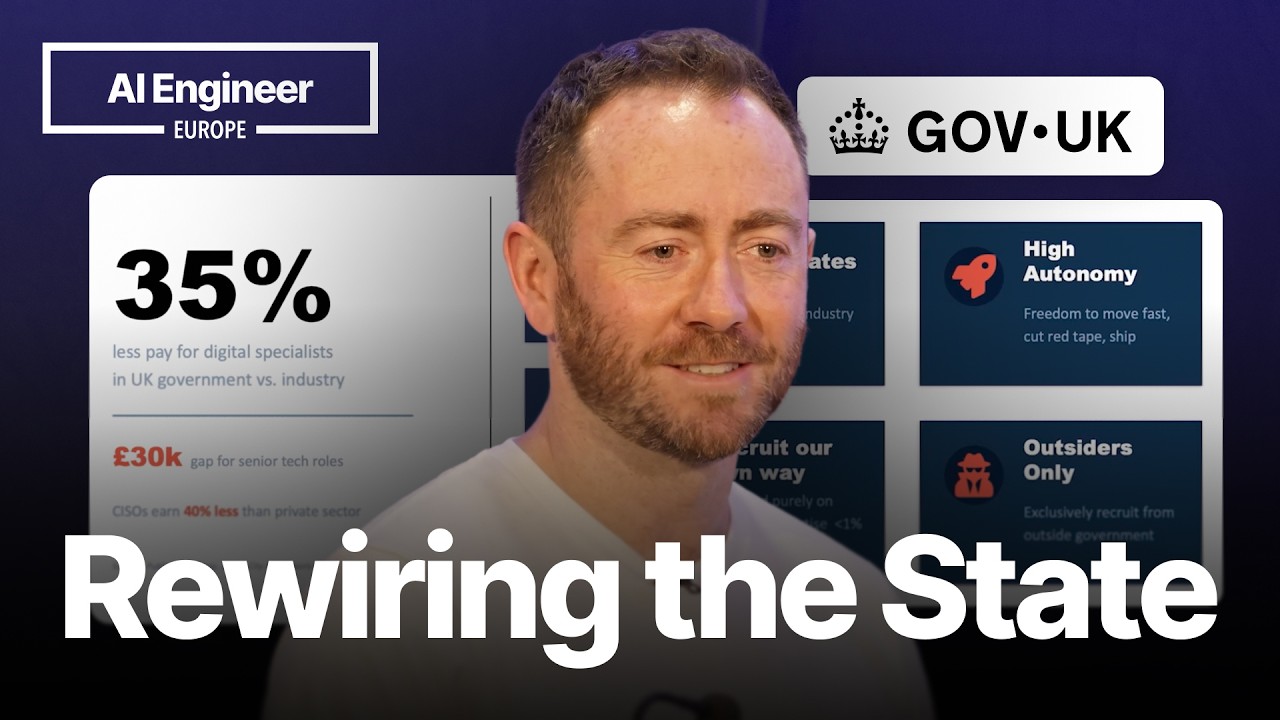
Rewiring the State — Eoin Mulgrew, No. 10 (Downing Street)
May 18, 2026 · 28:18
Eoin Mulgrew, from the Number 10 Data Science team, details how a small insurgent unit at the center of UK government bypasses bureaucracy to rapidly deploy AI. The team recruits exclusively outsiders (0.7% acceptance rate), pays market rates, and ships tools in weeks. Examples include an engineer who saved £1.5M by building a statute-book analysis tool in two weeks, a policy simulation platform for Universal Credit, a delivery red-teaming PMO, and a public service that went from idea to live in two months. The team also placed fellows in the AI Safety Institute, the Incubator for AI (co-creating Xtract with DeepMind to digitize planning applications), and Justice AI, which embeds engineers in prisons. Mulgrew closes with Will, a Y Combinator founder and Harvard dropout, standing outside HMP Wormwood Scrubs with the keys two weeks into the job, urging talented technologists to 'join us, and we'll give you the keys to the state.'

Building a Chess Coach — Anant Dole and Asbjorn Steinskog, Take Take Take
May 13, 2026 · 18:22
Anant Dole and Asbjørn Steinskog of Take Take Take, Magnus Carlsen's chess app, built an AI chess coach that keeps LLMs as translators rather than reasoners. Stockfish evaluates positions, tactical and positional detectors extract forks, pins, and structural weaknesses, and the LLM only converts those structured signals into English—preventing hallucination. They target sub-3-second latency using Gemini Flash. When a user flags bad commentary, it posts to Slack and injects into a running Claude Code channel via MCP. Claude investigates, modifies prompts or detectors, regenerates commentary, and asks clarifying questions. They run automated evals across 16 scenarios: Gemini Flash at 75%, Claude thinking below 60%, GPT-5 Mini lower. Their key insight: separate data pipeline from language generation, and close the loop with autonomous agents.

TLMs: Tiny LLMs and Agents on Edge Devices with LiteRT-LM — Cormac Brick, Google
May 3, 2026 · 1:20:58
Cormac Brick from Google AI Edge explains how Tiny LLMs (sub-1B parameters) and on-device agent skills are making edge AI practical. He details LiteRT-LM, an open-source runtime that runs Gemma models on Android, iOS, and embedded systems, achieving over 1,000 tokens/s on high-end phones. Agent skills use progressive disclosure—loading skill details on demand—enabling reliable tool calling on 2B-4B models. For app deployment, fine-tuning boosts tiny model reliability by 20-40 points (e.g., Function Gemma 270M hit 86% accuracy on 10 functions). Synthetic data workflows and modular design (ASR + text polishing) power real apps like AI Edge Eloquent, which runs entirely offline. Safety is managed through system-level checkers and narrow functional scope for tiny models.

How Google DeepMind is researching the next Frontier of AI for Gemini — Raia Hadsell, VP of Research
Apr 18, 2026 · 20:37
Google DeepMind VP of Research Raia Hadsell presents three non-language-model frontiers of AI: Gemini Embeddings 2, an omnimodal embedding model that unifies text, video, audio, and PDFs into a single semantic vector for fast retrieval; weather forecasting models including GraphCast (spherical GNN for 15-day forecasts), GenCast (probabilistic model 97% more accurate than benchmarks), and FGN (directly predicts cyclones, used by the US National Hurricane Center); and Genie world models that create interactive, memory-rich 3D environments from prompts, enabling real-time dynamic changes for gaming and education.
Welcome to AIE CODE - Jed Borovik, Google DeepMind
Jan 5, 2026 · 4:10
Jed Borovik, Google DeepMind's Gemini assistant and lead of the Jewels coding agent product engineering team, opens the 2025 AI Engineering Code Summit in New York by declaring that the most important problem in applied AI is code. He frames the event as a single-track summit designed to push the entire AI coding industry forward, not any single company. Borovik highlights the previous leadership track, which covered how AI transforms software organizations, and sets the day's focus on patterns, systems, and products enabling that transformation. He thanks DeepMind as presenting sponsor, noting the timely release of Gemini 3 and Nano Banana Pro, along with Anthropic as platinum sponsor and other gold and silver sponsors. Borovik encourages attendees to visit sponsor booths in the expo area and expresses excitement for the keynotes to come.

Building in the Gemini Era – Kat Kampf & Ammaar Reshi, Google DeepMind
Dec 15, 2025 · 17:57
Kat Kampf and Ammaar Reshi from Google DeepMind present Gemini 3 and Nano Banana Pro, arguing that these models enable anyone to build complex, aesthetic applications through natural language alone. Gemini 3 achieves state-of-the-art results in one-shot UI design and agentic tool calling, with SweBench outperformance. Nano Banana Pro integrates Google Search for world knowledge and renders text accurately, handling up to 14 consistent people per image. They demonstrate vibe coding in AI Studio, building a personalized comic book with precise text, laptop stickers grounded in search, and a 3D racing game that scaled to 23 players live. Upcoming full-stack runtime adds backend support and automatic database integration, further democratizing software creation.

Defying Gravity - Kevin Hou, Google DeepMind
Dec 2, 2025 · 25:10
Kevin Hou from Google DeepMind introduces Antigravity, a new agent-first IDE that combines three surfaces: an AI editor, an agent-controlled Chrome browser, and an Agent Manager. The central claim is that agents should live outside the IDE, enabling longer-running tasks and multimodal interactions. Key features include Artifacts—dynamic representations like plans, screen recordings, and diagrams—that replace raw chain-of-thought with visual summaries. The browser enables context retrieval and verification via screen recordings, while image generation allows iterative design through comments. Hou explains the research-product flywheel: DeepMind researchers use Antigravity internally to identify model gaps, improving capabilities like computer use and instruction following, which then ship in the product. He also details four categories of model improvements: intelligence, tools, long-running tasks, and multimodal, all powered by Gemini 3 Pro and related models.

The Next Unicorns: 7 Top AI startups from the HF0 Residency
Aug 21, 2025 · 22:16
Diego Rodriguez (Krea) presents an AI creative suite that generated 1M images/day for a Fox ad, while OpenHome debuts the first AI smart speaker with 10K developers and 500 free dev kits. Josh’s Coframe made $20M for a travel firm by making websites adaptive, and Eugene’s Featherless AI built QWERTY 72B without transformer attention, claiming scale is dead in favor of reliability. Jonas Bauer’s Upside uses LLMs to structure enterprise data, Lengyue’s OpenAudio introduces S1, the first instructable voice model beating ElevenLabs, and Alex Atallah’s OpenRouter provides a single API for all LLMs, growing 10–100% monthly.

Real-time Experiments with an AI Co-Scientist - Stefania Druga, fmr. Google Deepmind
Jul 28, 2025 · 18:42
Stefania Druga, formerly at Google DeepMind, demonstrates a real-time AI co-scientist system built with under $300 in open-source hardware and two weeks of effort, capable of live scientific experimentation. Using a micro:bit with Jack DAC temperature sensor, ReCamera for object tracking, and a microscope, the system streams sensor data, images, and voice to Gemini via a React app that dynamically assembles multimodal context. Druga presents two home experiments: crystal growth, where she discovered that formation occurs in bursts once critical saturation is reached, and fermentation, monitoring CO2 and temperature to optimize dough rise. She references DeepMind's AI co-scientist paper, which replicated a 12-year gene transfer discovery in two days and identified novel drug targets for liver fibrosis that proved effective in wet labs. Her vision moves from async data analysis to real-time empirical hypothesis generation, and she highlights open-source platforms like Jubilee and open bioreactors for automating lab equipment, with future plans to use real-time data to inform realistic simulations.

Google Photos Magic Editor: GenAI Under the Hood of a Billion-User App - Kelvin Ma, Google Photos
Jul 19, 2025 · 20:28
Kelvin Ma, an engineer on Google Photos' editing team, explains how the billion-user app built the Magic Editor by integrating generative AI with on-device computational photography. He traces the evolution from earlier ML features like post-capture segmentation (UNet model, 10 MB) and Magic Eraser (a system of models) to the new server-side generative AI experience, which handles tasks like relocating objects and reimagining backgrounds. Key challenges include managing model size (now hundreds of MB), client-server latency, ambiguous problem scoping (e.g., moving from 5% to 80% reliability), and trust and safety. Ma advocates using evals, reducing ambiguity through product-research collaboration, and iterating from large general models to smaller, faster ones for production. He also highlights that Google Photos serves 1.5 billion monthly active users and processes hundreds of millions of edits per month, and the editor is being rebuilt as AI-first.

Thinking Deeper in Gemini — Jack Rae, Google DeepMind
Jul 10, 2025 · 18:13
Jack Rae, lead of Gemini Thinking at Google DeepMind, presents thinking as a solution to the fixed test-time compute bottleneck in large language models. He explains that Gemini inserts a thinking stage where the model iterates via reinforcement learning, learning to self-correct and explore multiple strategies. This enables a continuous cost-performance tradeoff via thinking budgets, improving reasoning on math and code. Future work includes Deep Think, which raises USA Math Olympiad performance from the 50th to the 65th percentile by scaling inference compute further. Rae envisions models that, like mathematician Ramanujan, achieve deep, data-efficient reasoning from limited knowledge.

A year of Gemini progress + what comes next — Logan Kilpatrick, Google DeepMind
Jul 10, 2025 · 11:58
Logan Kilpatrick, head of product for Google AI Studio at DeepMind, announces the final update to Gemini 2.5 Pro, which achieves state-of-the-art results on Aider and HLE benchmarks. He details Google's 50x increase in AI inference over the past year, driven by merging research and product teams into DeepMind. The episode outlines Gemini's evolution toward a universal assistant that unifies Google products, with upcoming features including proactivity, native audio and video capabilities (Veo), and smaller models. Kilpatrick also previews developer-focused updates: a SOTA embeddings model, a deep research API, and Veo 3 and Imagine 4 in the API, alongside repositioning AI Studio as a dedicated developer platform.
Milliseconds to Magic: Real‑Time Workflows using the Gemini Live API and Pipecat
Jun 27, 2025 · 21:43
Kwindla Kramer (Daily, Pipecat) and Shrestha Basu Mallick (Google DeepMind, Gemini API) argue that voice is the most natural interface and that the Gemini Live API combined with the Pipecat framework enables developers to build real-time multimodal voice agents covering the full stack from models to application code. They demo a voice-driven task management app that handles grocery, reading, and work lists, showing impressive context-aware tool use (e.g., consolidating lists, web searching for 'Dream Count' author) but also jagged edge limitations like turn detection errors and persistent misspelling of 'Kwin.' They discuss how capabilities like turn detection migrate down the stack over time. The episode also covers proactivity, multilinguality, telephony integration, and experimental native audio models for emotive, steerable dialogue.

Insights on Building AI Teams — Heath Black, SignalFire
Apr 15, 2025 · 20:30
Heath Black, Managing Director of Product at SignalFire, uses Beacon platform data to guide AI team building, arguing that credentialism is declining—only 7% of AI engineers had PhDs in 2023 versus 16% in 2015—and that work experience now outweighs education. He shows AI talent concentrates in San Francisco (35% of AI engineers), Seattle (22%), and New York (10%), and that tracking retention rates (e.g., Anthropic at 66% four-year retention vs. Perplexity at 43%) helps time outreach. Black advises hiring based on a candidate's body of work, removing academic requirements from postings, and understanding generational job-hopping (27% of Gen Z left jobs in 2023). He warns against relying solely on salary and equity, as AI engineers command 5% salary and 10–20% equity premiums, and recommends narratives centered on mission, speed, and collaborative teams. The talk emphasizes using data to filter, locate, time, and close hires effectively.
Low Level Technicals of LLMs: Daniel Han
Jul 31, 2024 · 2:52:26
Daniel Han of Unsloth explains how to find and fix bugs in open-source LLMs like Gemma, Phi-3, and Llama, covering tokenizer issues, architecture pitfalls, and finetuning optimizations. He details the eight Gemma bugs Unsloth fixed, including a critical RoPE downcasting error that broke positional encoding, and a 2048 sliding window bug in Phi-3. Han walks through transformer internals: attention masking, layer norms, RoPE embeddings, and SwiGLU activation, showing how to derive gradients for custom kernels. He demonstrates Unsloth's 2x faster finetuning with 70% less memory via Triton kernels, and introduces new features: automatic Ollama model file creation, CSV fine-tuning with merged columns, and chunked cross-entropy for large vocabularies. The session includes live Q&A on learning rate schedules, precision trade-offs, and mechanistic interpretability.
Powered by PodHood