
Deepgram
CompanyA company discussed on AI Engineer.
7 episodes

Voice Agents That Handle Interrupts - Chintan Agrawal and Daniel Wirjo, AWS
Jul 20, 2026 · 32:57
AWS Solutions Architects Chintan Agrawal and Daniel Wirjo argue that the hardest problem in production voice agents is audio engineering—not AI—specifically turn-taking, the decision of when an agent should stop speaking or start responding. They present three levels of turn detection: Level 1 uses Silero VAD with a silence timeout (e.g., 300ms default), Level 2 delegates to STT providers like Cartesia or Deepgram for built-in endpointing (p50 ~250-300ms), and Level 3 combines Silero VAD with SmartTurn, an open-source 8MB model achieving 58.9% recall and 68.4% precision while falling back to VAD on low confidence. They show how interruption handling (barge-in) flushes TTS/LLM in ~15ms and distinguish real interruptions from backchannel acknowledgments. Latency budgets are tight: 40ms mic encoding, 52ms network/jitter, 300ms STT+endpointing, 500-650ms LLM time-to-first-byte (dominant bottleneck), and 120-190ms TTS playback, totaling 800-1300ms in standard cloud setups. Co-locating models in one GPU cluster can achieve ~500ms voice-to-voice. For LLMs, Nemotron 3 Ultra and GPT-4.1 achieve ~530ms p50 but GPT-4.1 spikes to 1.7s p95, and multi-turn drift (>15 turns) can break prompt…
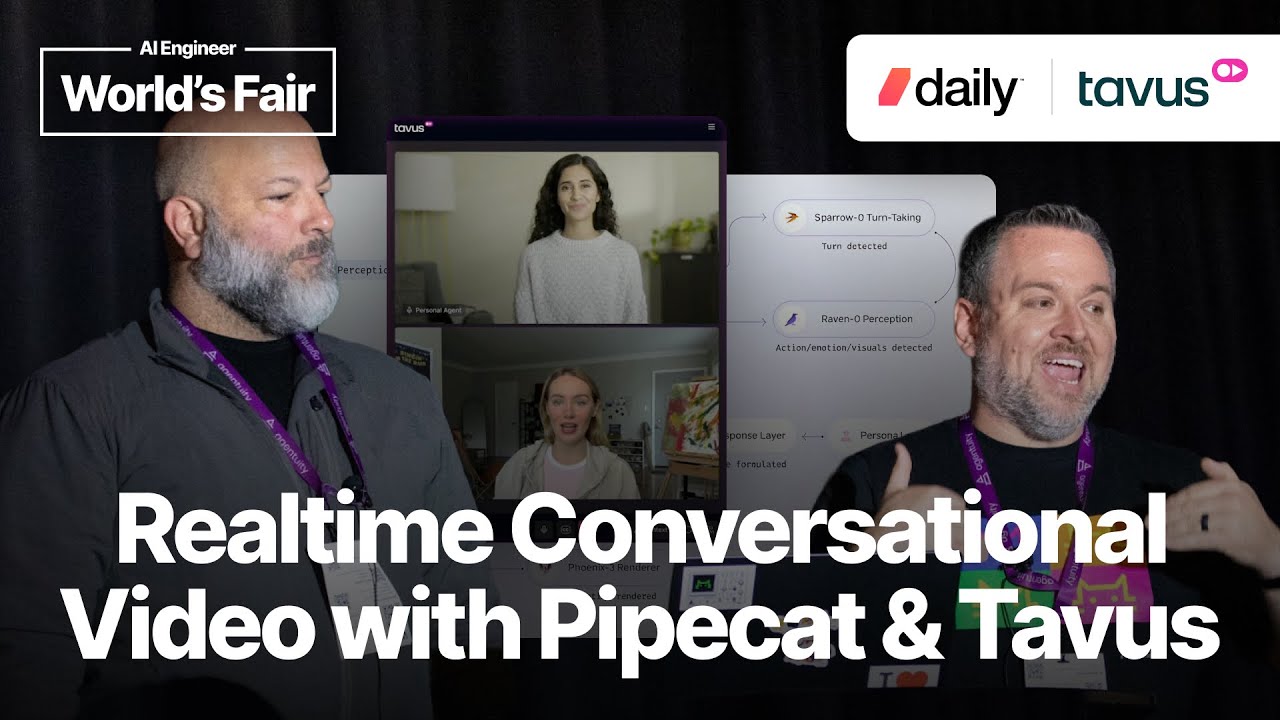
Realtime Conversational Video with Pipecat and Tavus — Chad Bailey and Brian Johnson, Daily & Tavus
Jun 27, 2025 · 18:46
Chad Bailey of Daily and Brian Johnson of Tavus explain how to build real-time conversational video bots using the Pipecat open-source framework and Tavus's avatar platform. They argue that beyond models, an orchestration layer is essential for handling input, processing, and output with low latency. Bailey details Pipecat's pipeline of frames, processors, and pipelines that manage audio/video frames, speech-to-text, LLM inference, and text-to-speech in a modular way. Johnson describes Tavus's 600-millisecond response time and proprietary models—Sparrow Zero, Raven Zero—plus future turn detection, response timing, and multimodal perception models being integrated into Pipecat. They emphasize that Pipecat solves real-world production challenges like observability, barge-in handling, and parallel pipelines for tasks like voicemail detection. Johnson admits Tavus initially built its own orchestration but now plans to adopt Pipecat internally, as its customers are already using it.

Voice Agent Engineering — Nik Caryotakis, SuperDial
Apr 18, 2025 · 19:07
Nik Caryotakis from SuperDial argues that in 2025, the key to production Voice AI is reliability over realism, especially for sensitive healthcare calls. SuperDial automates back-office phone calls, saving over 100,000 hours of human calling with a lean team of four engineers. He advocates for the 'say the right thing at the right time' approach, using open-source tools like PipeCat for orchestration, TensorZero for LLM routing, and self-hosted LangFuse for HIPAA-compliant observability. Caryotakis warns that new voice-to-voice models often produce nonsensical audio, favoring a sequenced STT/LLM/TTS pipeline for control. He shares specific last-mile challenges: pronunciation of names like 'Caryotaikis', avoiding confusing bot names like 'Billy', and the need for fallbacks when OpenAI goes down. The talk emphasizes that the unique value of a voice agent lies in conversational design and vertical integrations, not realistic voices.

The Agent Development Life Cycle — Zack Reneau-Wedeen, Sierra
Apr 11, 2025 · 18:40
Zack Reneau-Wedeen from Sierra explains the company's Agent Development Lifecycle for building reliable, testable AI agents at scale for brands like Chubbys and SiriusXM. He contrasts LLMs' nondeterministic, slow nature with traditional software, calling them a 'foundation of Jello.' Sierra treats every agent as a product, using an experience manager to review conversations, file issues, create tests, and release improvements—growing from hundreds of thousands of requests for Chubbys to tens of millions for larger customers. The lifecycle spans quality assurance, testing, and deployment, with reasoning models acting as a force multiplier. Voice agents launched generally in October 2024, handling calls with the same underlying platform, enabling responsive design across channels.

Giving a Voice to AI Agents: Scott Stephenson, CEO, Deepgram
Feb 10, 2025 · 13:08
Scott Stephenson, CEO of Deepgram, outlines the evolution of voice AI from slow, domain-specific systems to fast, open-ended conversational agents powered by LLMs, arguing that speed and accuracy are now solved and the key differentiator is contextual understanding. He explains that state-of-the-art speech-to-text and text-to-speech can achieve round-trip latencies under 500 milliseconds—matching human turn-taking—but notes that current systems fail to pass context between components, causing 10-20% of interactions to feel unnatural. Stephenson introduces Deepgram's 'contextual AI' vision, where models are prompted with the full conversation history, including tone, pace, and background audio, enabling the LLM to generate responses and instruct the TTS on delivery. He cautions against monolithic speech-to-speech models for enterprise use due to controllability and cost concerns, advocating for a modular stack that lets businesses optimize each component (e.g., small LLMs for simple tasks like password resets). Deepgram’s upcoming voice AI agent API integrates all components for low latency and offers $250 in free credits for experimentation.
How to build the world's fastest voice bot: Kwindla Hultman Kramer
Feb 10, 2025 · 20:38
Kwindla Hultman Kramer, CEO of Daily, argues that colocating speech-to-text, LLM inference, and text-to-speech in a single compute container is the most effective way to achieve sub-500 millisecond voice-to-voice latency for conversational AI. He details how architectural flexibility and low-latency media transport are critical, citing measured bottlenecks like 30–40ms from macOS mic processing and typical voice-to-voice latencies of 600–700ms. To hit faster response times, his team uses Deepgram’s on-premises STT and TTS models via Docker and Llama 3 8B for LLM inference, achieving 500–700ms in an open-source demo. The talk introduces PipeCat, a vendor-neutral open-source framework for real-time multimodal AI that orchestrates components like transcription, endpointing, interruption handling, and text-to-speech. Kramer emphasizes that while frontier multimodal models are coming, orchestration layers remain essential for building production-grade voice bots, and shares that a recent latency demo gained over 175,000 views on Twitter.

Building and Scaling an AI Agent Swarm of low latency real time voice bots: Damien Murphy
Oct 8, 2024 · 1:07:23
Damien Murphy, Senior Applied Engineer at Deepgram, demonstrates building and scaling low-latency real-time voice bots using Deepgram's new voice agent API, which wraps speech-to-text, LLM, and text-to-speech into a single streaming endpoint. He shows a drive-thru ordering demo with function calling (add/remove items) using GPT-4o, achieving sub-second latency by co-locating components. Murphy explains scaling to millions of concurrent calls through regional Kubernetes clusters and multi-agent swarms (routing, booking, support agents) to reduce complexity and cost. He addresses endpointing challenges, VAD-based barge-in, and cost/quality trade-offs with hosted vs. self-hosted models, noting Deepgram offers 20x cheaper TTS than ElevenLabs and 50ms STT latency self-hosted. The talk emphasizes keeping agents simple, using smallest capable LLMs, and composability for reuse.
Powered by PodHood