
Cohere
CompanyA company discussed on AI Engineer.
18 episodes
Building the platform for agent coordination — Tom Moor, Linear
Jul 28, 2025 · 19:43
Tom Moor, Head of Engineering at Linear, explains how the company is evolving from an issue tracker into an operating system for engineering teams that treats AI agents as first-class teammates. He details Linear's pragmatic AI journey: starting with embeddings and PG vector, then moving to a hybrid search index using TurboPuffer and Cohere embeddings, leading to features like Product Intelligence (query rewriting, reranking, deterministic rules for suggestions), natural language filters, Slack-to-issue creation, and daily audio pulses. The core of the talk is Linear's agent platform, launched two weeks ago, where coding agents like CodeGen, Bucket, and Charlie integrate via OAuth, GraphQL, and new webhooks, allowing users to assign, mention, and interact with agents just like human teammates. Moor emphasizes best practices for builders: respond fast, inhabit the platform's language, move issues to 'in progress,' and clarify plans before acting, all while keeping interactions concise and value-adding. The episode argues that with this platform, engineering teams can build more, faster, and with higher quality by offloading grunt work to infinitely scalable cloud-based teammates.
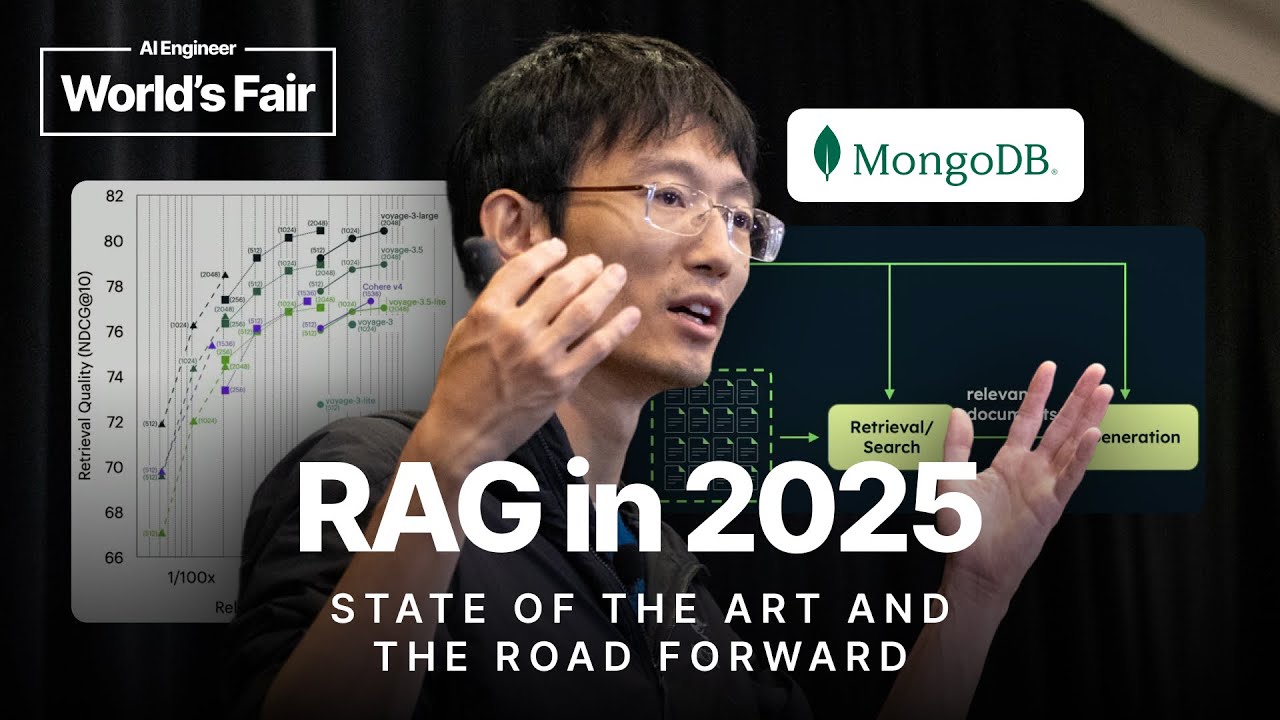
RAG in 2025: State of the Art and the Road Forward — Tengyu Ma, MongoDB (acq. Voyage AI)
Jun 27, 2025 · 18:48
Tengyu Ma, Chief AI Scientist at MongoDB (acquired Voyage AI), argues that retrieval-augmented generation (RAG) will outlast fine-tuning and long-context models for enterprise AI because it mirrors how humans use libraries—retrieving only relevant information rather than memorizing or reprocessing entire corpora. He reports that Voyage's embedding models now achieve ~80% average accuracy across 100 datasets, with half exceeding 90%, and that 100x storage compression via matryoshka learning and quantization loses only 5–10% accuracy. Ma advocates hybrid search with rerankers and domain-specific embeddings (e.g., for code) to further improve retrieval. He predicts the model layer will absorb current 'tricks' like query decomposition and contextual chunking, simplifying RAG pipelines. New products like multimodal embeddings (accepting screenshots of PDFs, tables, videos) and auto-chunking embeddings that incorporate cross-chunk metadata are designed to shift complexity from users to model providers.
Building Agentic Applications w/ Heroku Managed Inference and Agents — Julián Duque & Anush Dsouza
Jun 27, 2025 · 52:35
In this workshop, Heroku Principal Developer Advocate Julián Duque and Product Manager Anush Dsouza introduce Heroku Managed Inference and Agents, a platform designed to make every software engineer an AI engineer by simplifying the attachment of agents and AI to applications. They demonstrate an opinionated, curated set of models (e.g., Claude 4) and an agentic control loop running on Heroku's trusted compute (Dynos) that provides first-party tools like code execution (Python, Node, Go, Ruby), Postgres schema inspection and querying, and document conversion, all streaming responses in real time. The workshop walks through provisioning inference via a single CLI command or add-on, using a Jupyter notebook to chain multiple tools (e.g., HTML-to-markdown then Python execution), and attaching custom MCP servers (like Brave Search) that spin up one-off Dynos and scale to zero. They also show how to expose MCPs remotely via a server-sent events endpoint for use with Cursor or other clients, emphasizing security (read-only database followers, bearer tokens) and future OAuth support. The episode concludes with a call to try the platform via a free trial team valid through the weekend.

The RAG Stack We Landed On After 37 Fails - Jonathan Fernandes
Jun 3, 2025 · 18:52
Jonathan Fernandes, independent AI engineer, details the RAG stack his team settled on after 37 failed attempts, covering orchestration (LlamaIndex), embeddings (BAAI BGE small), vector database (Qdrant), LLMs (GPT-4, Qwen, Llama), reranking (Cohere), monitoring (Arize Phoenix), and evaluation (RAGAS). He demonstrates a live prototype in Google Colab using a London railway knowledge base, showing how a naive RAG returns irrelevant results (e.g., suggesting black cabs for "where can I get help at the station"). By swapping components—replacing in-memory storage with Qdrant, using an open-source embedding model, upgrading to GPT-4, and adding Cohere reranking—the answer improves to "go to booth number five next to the Eurostar ticket gates." For production, he deploys via Docker Compose with NVIDIA embedding/reranking models and Ollama for serving. The episode also stresses the importance of tracing latency per component and using RAGAS for systematic evaluation across many queries.

Insights on Building AI Teams — Heath Black, SignalFire
Apr 15, 2025 · 20:30
Heath Black, Managing Director of Product at SignalFire, uses Beacon platform data to guide AI team building, arguing that credentialism is declining—only 7% of AI engineers had PhDs in 2023 versus 16% in 2015—and that work experience now outweighs education. He shows AI talent concentrates in San Francisco (35% of AI engineers), Seattle (22%), and New York (10%), and that tracking retention rates (e.g., Anthropic at 66% four-year retention vs. Perplexity at 43%) helps time outreach. Black advises hiring based on a candidate's body of work, removing academic requirements from postings, and understanding generational job-hopping (27% of Gen Z left jobs in 2023). He warns against relying solely on salary and equity, as AI engineers command 5% salary and 10–20% equity premiums, and recommends narratives centered on mission, speed, and collaborative teams. The talk emphasizes using data to filter, locate, time, and close hires effectively.

OpenLLMetry is all you need
Feb 22, 2025 · 9:12
Nir, CEO of Trace Loop, introduces OpenLLMetry, an open-source project extending OpenTelemetry for tracing and monitoring GenAI applications. OpenTelemetry, maintained by CNCF, standardizes logging, metrics, and traces across cloud environments, supported by platforms like Datadog, New Relic, and Grafana. OpenLLMetry provides over 40 automatic instrumentations for foundation models (OpenAI, Anthropic, Cohere), vector databases (Pinecone, Chroma), and frameworks (LangChain, LlamaIndex, CrewAI). These instrumentations emit logs, metrics, and traces in OpenTelemetry format, allowing users to send data to any supported observability backend with a configuration change, avoiding vendor lock-in.

Cohere: Building enterprise LLM agents that work (Shaan Desai)
Feb 22, 2025 · 18:29
Shaan Desai, a machine learning engineer at Cohere, presents key strategies for building enterprise LLM agents that are scalable, safe, and seamless. He recommends using native or LangGraph frameworks for high observability in large-scale agents, while CrewAI or AutoGen suit quick proofs of concept. Core insights include starting with a single LLM and a handful of tools, simplifying tool specifications with clear descriptions and sharp examples, and caching chat history to prevent hallucinations beyond 20 turns. For multi-agent setups, the router needs clear routing instructions for edge cases, and sub-agents should be constrained to independent tasks. Safety is paramount, with human-in-the-loop triggered before or after tool calls based on codified rules. Evaluation uses a golden set of ground truth queries, expected tool calls, and outputs. Failure mitigation ranges from prompt engineering for low-severity issues to targeted annotation datasets for 10–20% failure rates and synthetic data fine-tuning for high failure rates. Cohere packages these learnings into NORTH, a single container deployment with RAG, vector DBs, and connectivity to Gmail, Outlook, Drive, and Slack,…

Claude plays Minecraft!
Feb 15, 2025 · 18:16
Derek from AWS demonstrates building Rocky, an autonomous Minecraft agent using Amazon Bedrock, Claude 3 Haiku, and serverless AWS services, proving agentic workflows enable AI to reason and act beyond chatbots. He explains the architecture: Minecraft server on ECS with Mineflare bot framework, agents for Bedrock with return of control, and prompt engineering for tasks like digging and building. In a live demo, Rocky jumps, finds players, digs a hole, and builds a double-decker couch from a chat command, inferring parameters from natural language. The code is open-source and built with CDK/CloudFormation, emphasizing that agentic AI can operate in complex 3D environments through tool orchestration and managed prompt design.
RAG at scale: production ready GenAI apps with Azure AI Search
Feb 13, 2025 · 21:53
Pablo, a Distinguished Engineer at Microsoft, explains how Azure AI Search enables production-grade RAG applications at scale by addressing key scaling challenges: data volume, query load, workflow complexity, and diverse data types. He demonstrates the platform's hybrid retrieval combining vector search (HNSW, exhaustive), keyword search (BM25), and filters, with a two-stage system using cross-encoder re-ranking for improved quality, achieving 100ms re-ranking latency. Azure AI Search supports multi-billion vector indexes through 10–12x storage limit increases and quantization (int8, single-bit) preserving 90–95% precision, with oversampling for full-precision re-ranking. Integrated vectorization automates ingestion from Azure sources (blob, Cosmos DB, OneLake) with change tracking and format handling (PDFs, Office documents, images). OpenAI uses Azure AI Search to back ChatGPT file uploads and the Assistants API, scaling user limits 500x after Microsoft's infrastructure upgrades.

Cohere for VPs of AI: Vivek Muppalla
Feb 5, 2025 · 16:11
Vivek Muppalla, Director of Engineering at Cohere, details the company's enterprise AI strategy centered on security, customization, and deployment flexibility. He presents Cohere's product line: Command R and R+ for generation, plus advanced retrieval models like embeddings and the ReRanker, which reduces RAG costs by narrowing context. Key claims include a focus on enterprise-specific eval suites (health, HR, finance), out-of-the-box citations, and multilingual performance. Partnerships with Accenture and McKinsey bridge the last-mile gap, while wins often stem from private cloud deployment and data control. In Q&A, he recommends purpose-built classifiers for high-throughput production and notes current 128k context windows.
Navigating RAG Optimization with an Evaluation Driven Compass: Atita Arora and Deanna Emery
Nov 12, 2024 · 18:14
Atita Arora (Qdrant) and Deanna Emery (Quotient AI) demonstrate how evaluation-driven optimization improves Retrieval Augmented Generation (RAG) systems, using Qdrant's vector database and Quotient's evaluation platform. They detail a 10-experiment pipeline on Qdrant documentation, starting with naive RAG and incrementally testing chunk sizes, embedding models, LLMs (Mistral, GPT-3.5), re-rankers (MixedBread, Cohere, ColBERT), and hybrid search. Key metrics—faithfulness (hallucination reduction), context relevance, and chunk relevance—guide decisions: increasing chunk size hurt faithfulness (0.76 to 0.72), while smaller chunks with larger retrieval windows improved it. Switching to GPT-3.5 lifted all metrics, but poor context relevance revealed retrieval issues. Adding Cohere re-ranking boosted faithfulness to 0.82, and hybrid search with re-ranking achieved 0.85, proving domain-specific terminology demands tailored search strategies. The episode stresses avoiding over-engineering without metrics, keeping evaluation datasets current, and using domain understanding for systematic RAG improvement.

No more bad outputs with structured generation: Remi Louf
Oct 14, 2024 · 15:32
Rémi Louf, CEO of .txt and co-maintainer of Outlines, argues that structured generation—guiding LLMs to produce valid regex, JSON, or context-free grammar outputs—eliminates parsing errors and hallucinations while adding negligible overhead. Outlines masks tokens that violate the target structure, enabling Mistral 7B to achieve 99.9% valid JSON (vs. 17% without). It also accelerates inference: a chatty 50-token ChatGPT answer shrinks to 8 tokens, and structured generation boosts open models beyond GPT-4—Phi-3 Medium hits 96.5% on Berkeley function calling (GPT-4 gets 93.5%). With one shot matching eight shots in accuracy, Louf contends that most text is structured and that structured generation should be the default for non-chatbot workflows.

Pydantic is STILL all you need: Jason Liu
Sep 6, 2024 · 15:21
Jason Liu returns to the AI Engineer World's Fair to argue that Pydantic (and his library Instructor) is still all you need for structured output with LLMs. He shows that the core API—response_model, streaming with iterables, and partials for real-time validation—remains unchanged, now supporting Ollama, LlamaCPP, Anthropic, Gemini, and more. Liu demonstrates validators that enforce rules like uppercasing names or verifying receipt totals, reducing errors with automatic retries. He applies structured output to RAG: using a Search model with optional date ranges and source selection, and a Response model with follow-up questions and validated URLs. For extraction, he creates classifiers using Literal types, meeting summaries with action items, and even tables as Pandas DataFrames via custom type hints. Liu’s key takeaway is that one retry often suffices, and as models get faster and smarter, structured output makes LLMs compatible with classical programming—turning generative AI into generating data structures defined by the developer.

Building State of the Art Open Weights Tool Use: The Command R Family: Sandra Kublik
Aug 26, 2024 · 15:03
Sandra Kublik of Cohere presents the Command R family of open-weight models optimized for retrieval-augmented generation and tool use. Released in March 2024, Command R and Command R+ achieved 150,000 Hugging Face downloads within two weeks and now serve nearly 500,000 developers. The models overcome RAG challenges such as prompt sensitivity and citation accuracy through post-training, delivering fine-grained citations and low hallucination. Cohere open-sourced a toolkit UI with plug-and-play components for RAG and tool use, supporting cloud, local, and Hugging Face access. The new Multi-Step API enables sequential reasoning with automatic retry and reflection. Command R+ matches GPT-4 Turbo and Claude Opus on complex reasoning while being three to five times cheaper, positioning it as a scalable enterprise solution.

From Software Developer to AI Engineer: Antje Barth
Jul 24, 2024 · 19:48
Antje Barth, a Principal Developer Advocate for generative AI at AWS, outlines five practical steps from software developer to AI engineer: understanding foundation models, getting hands-on with AI developer tools like Amazon Q Developer, prototyping with models via Amazon Bedrock, integrating agents, and staying up to date with community events. She demonstrates Amazon Q Developer's ability to generate, explain, and transform code, reducing unvaluable tasks from 70% to focus on creative work. Barth introduces Amazon Bedrock's unified Converse API for standardized model invocation across providers like Anthropic's Claude 3.5 Sonnet, and shows how agents can be built to control a Minecraft bot through reasoning and tool use. The episode concludes with the announcement of the AI Engineering Hub at the AWS loft in San Francisco for community workshops and events.

Open Challenges for AI Engineering: Simon Willison
Jul 17, 2024 · 18:49
Simon Willison argues the GPT-4 barrier has been broken as GPT-4o, Claude 3.5 Sonnet, Gemini 1.5 Pro, and open models like LLaMA 3 70B now compete, making GPT-4-class models a commodity. He highlights the AI trust crisis with examples of Dropbox and Slack being falsely accused of training on user data, and notes Anthropic trained Claude 3.5 Sonnet without customer data. Willison warns about prompt injection vulnerabilities, citing the Markdown image exfiltration bug affecting six major chatbots, and defines slop as unreviewed AI-generated content, calling for accountability and responsible use patterns.
How to Become an AI Engineer from a Fullstack Background - Reid Mayo
Feb 2, 2024 · 10:19
Reid Mayo presents a step-by-step syllabus to transition from fullstack engineer to AI engineer, covering generative AI foundations, prompt engineering, LangChain, fine-tuning, and cost-effective open-source model deployment. The syllabus starts with Cohere's LLM overview, then dives into prompt engineering via Elvis Seravia's guide and Learn Prompting org docs. It emphasizes LangChain as the glue layer for modular AI systems, with tutorials from Mayo Ocean. Evals are treated as software tests using OpenAI's cookbook. Fine-tuning is taught via OpenAI's cookbook and then open-source LLaMA 2, with a specific case study showing a $19 fine-tuned LLaMA 2 matching OpenAI's $24,000 model on a target task. The boot camp ends with advanced deep learning courses from FastAI and Hugging Face for further mastery.

Pragmatic AI with TypeChat: Daniel Rosenwasser
Nov 14, 2023 · 18:34
Daniel Rosenwasser, TypeScript program manager, introduces TypeChat, an experimental library that uses TypeScript type definitions to guide and validate unstructured LLM output into structured JSON for traditional apps. He demonstrates a coffee shop ordering system where types define the schema, showing how the library can handle ambiguous inputs like 'a purple gorilla' by including unknown text for recovery. TypeChat also generates programs as JSON using a fake language to safely script multi-step operations, avoiding sandboxing issues from real code. A Python prototype extends the same approach, with examples like CSV data manipulation via a class-based API. The library aims to make AI tools accessible to all engineers by leveraging types they already use.
Powered by PodHood