
AI21 Labs
CompanyA company discussed on AI Engineer.
3 episodes
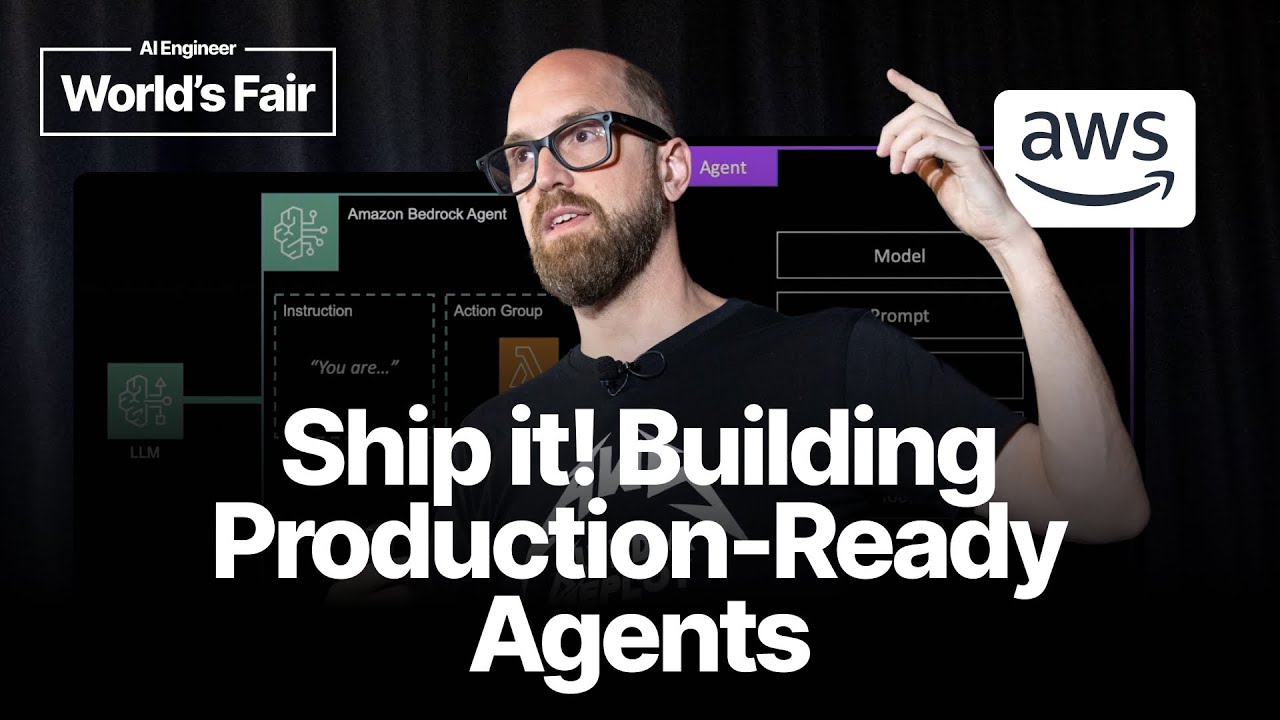
Ship it! Building Production Ready Agents — Mike Chambers, AWS
Jun 27, 2025 · 19:37
Mike Chambers, a developer advocate at AWS, demonstrates how to take a simple local agent—built with a Llama 3.1 8B model and a dice-rolling tool—and ship it to production at cloud scale using Amazon Bedrock Agents. He breaks down the essential components of an agent: model, prompt, loop, history, and tools. Then he live-deploys the agent with Bedrock Agents, configuring instructions and an action group wired to an AWS Lambda function that handles the dice roll. The fully managed service automates scaling, infrastructure, and the agentic loop. Chambers also highlights free courses on DeepLearning.AI and invites attendees to discuss MCP servers and the new open-source SDK for model-first agents.

RAG Evaluation Is Broken! Here's Why (And How to Fix It) - Yuval Belfer and Niv Granot
Jun 3, 2025 · 10:58
Yuval Belfer and Niv Granot of AI21 Labs argue that current RAG evaluation is broken because benchmarks rely on local questions with answers contained in single chunks, failing to reflect real-world messy data. They demonstrate that standard RAG pipelines—like those from LangChain and LlamaIndex—achieve only 5-11% accuracy on aggregative questions about 22 FIFA World Cup documents, such as 'Which team has won the most times?' Their proposed fix converts unstructured corpuses into structured SQL databases by clustering documents, inferring schemas (e.g., year, winner, top scorer), and using text-to-SQL at inference. This structured RAG approach handles counting and max/min queries that standard chunking cannot, though it requires homogeneous data and careful normalization to avoid ambiguity (e.g., West Germany vs. Germany). They caution that RAG is not one-size-fits-all and that existing benchmarks miss these critical use cases.

Real AI Agents Need Planning, Not Just Prompting - Yuval Belfer
Jun 3, 2025 · 7:58
Yuval Belfer of AI21 Labs argues that LLMs alone still fail at instruction following, as shown by GPT-4.1's struggles in 2025, and that true AI agents require dynamic planning, not just prompting. He critiques ReAct for lacking look-ahead, contrasting it with AI21 Maestro's planner and smart execution engine, which uses best-of-n sampling, candidate pruning, and replanning. On AIfeval, Maestro pushes GPT-4.0, Claude Sonnet 3.5, and R3 Mini to near-perfect scores; on internal requirement satisfaction benchmarks, it improves over single LLM calls despite higher runtime and cost. Belfer advises starting simple (SLMs, ReAct) and escalating to planning only for complex tasks, inviting listeners to join the Maestro waitlist.
Powered by PodHood